


Cast Iron Cannon
These cast iron cannon models and signal pieces bring tactile naval history directly to a desk, garden or mantelpiece.
Cast Iron Cannon
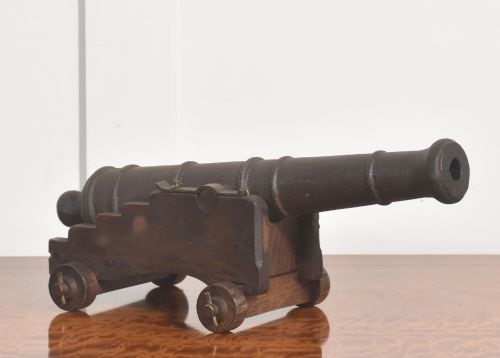
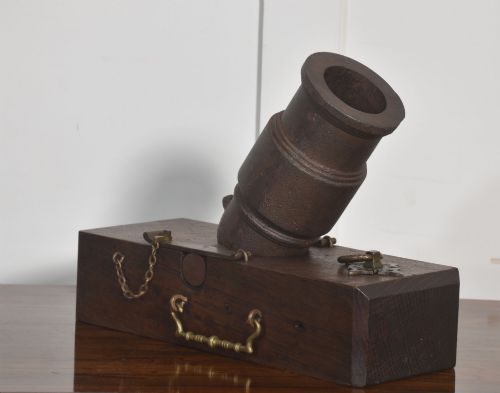
When you search for a cast iron cannon, you are looking at heavy metal ordnance scaled down for signals, desk display or garden ornament. The pieces listed across this page range from nineteenth century maritime signal pieces to early twentieth century garden ornaments.
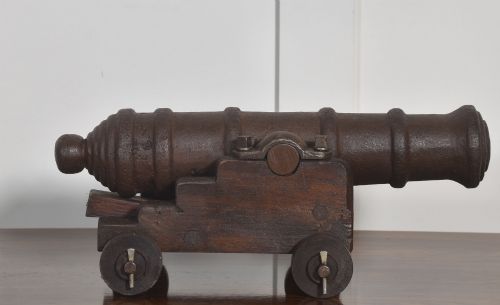
The version you are most likely to meet here is the nineteenth century signal cannon mounted upon an oak carriage. These objects served functional roles on ships or estates before transitioning into decorative and collectible militaria.
Our archive shows a recurring presence of brass and iron combinations, alongside standalone garden cannons and French military models. Buyers choose these objects for their robust material presence and their connection to nineteenth century maritime and military history.
Materials and construction
The primary material is cast iron, chosen for its weight and industrial texture, frequently paired with bronze or brass barrels and fittings. Carriages are predominantly constructed from solid oak or alternative seasoned woods to support the heavy metal barrels.
Foundry work involved pouring molten iron into sand moulds to achieve the rigid barrel forms and reinforcing rings. Wood components on carriages were joined using traditional carpentry techniques, often incorporating metal pins or brackets to withstand the recoil of a signal charge.
One tiny cast iron toy gun carries a 1907 patent date, proving playtime ordnance took precision seriously.
Quality and execution
Quality in these pieces depends upon the crispness of the iron casting and the fidelity of the scale model. Finer examples display sharp detailing around the reinforce and muzzle, whereas lesser items suffer from pitted surfaces and crude assembly.
The relationship between the metal barrel and its wooden carriage dictates the overall integrity of the piece. Superior examples feature well-seasoned oak with tight joinery, while simpler models rely on basic fixings that lack historical accuracy.
The Cast Iron Cannon Glossary
- Signal cannon
- A small piece used to fire blank charges for starting races, marking time or signaling across estates. These barrels are typically shorter and thicker than ordnance intended for shot.
- Oak carriage
- The wooden mount supporting the cannon barrel. In nineteenth century examples, these are built from sturdy timbers with stepped bracket cheeks.
- Militaria
- Collectible items connected with military forces, history or warfare. This category includes scale models, decorative pieces and field gun reproductions.
- Gribeauval system
- A standardised artillery design introduced in France during the eighteenth century. Models replicating this system feature distinctive barrel proportions and carriage construction.
Cast Iron Cannon: Frequently Asked Questions
Were these cannons actually fired?
Many signal and ceremonial cannons were designed to fire blank charges using gunpowder.
They served practical functions on ships and coastal stations to communicate across distances or mark occasions.
How do I identify a signal cannon?
Signal cannons usually feature shorter, thicker barrels without a functional bore for solid shot.
They often appear mounted on wooden carriages suited for stationary deck or garden use rather than field mobility.
What woods are used for carriages?
Oak is the predominant timber found on nineteenth century carriages due to its strength and durability.
Other dense woods occasionally appear on smaller desk models and early twentieth century decorative pieces.
Are brass and iron combined historically?
Yes, many nineteenth century pieces pair a cast iron carriage with a brass barrel.
This combination provided a striking visual contrast while utilising the most practical metal for each component.