


Brass Model Cannon
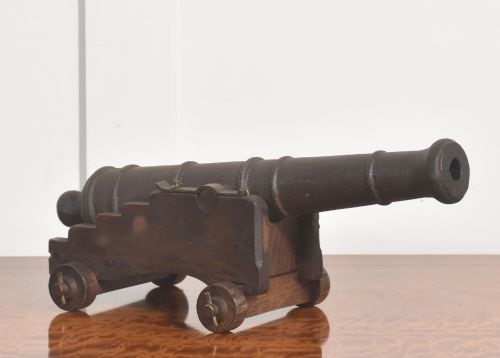
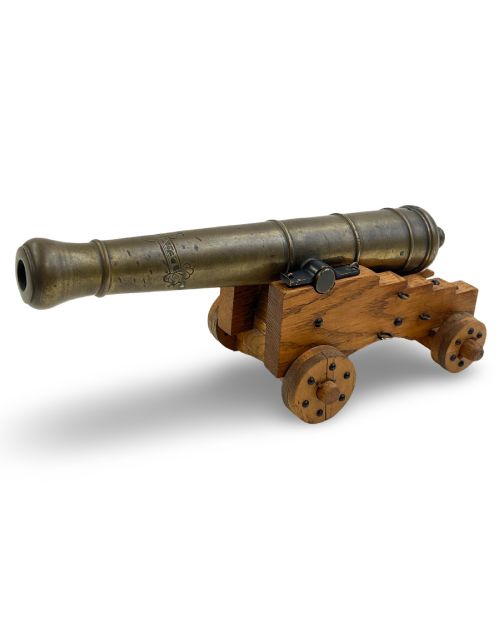
These brass model cannon items are desktop ornaments and signal pieces built to replicate historical ordnance in brass, bronze, and iron.
Brass Model Cannon
A brass model cannon is a decorative object or signal piece designed to replicate historical artillery for display on a desk or mantelpiece. Buyers searching for a brass model cannon look for tangible pieces of maritime and military history that demonstrate the scale and mechanics of past ordnance.
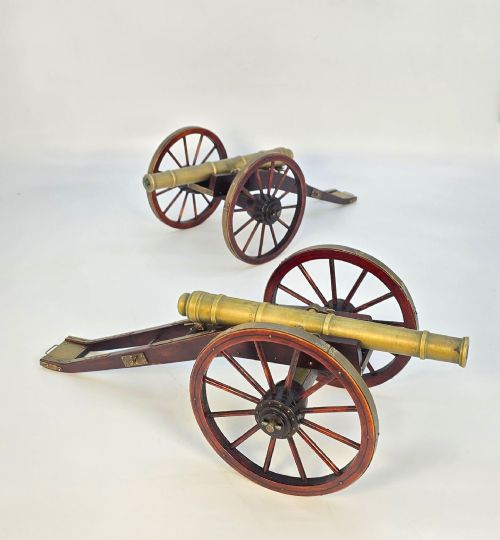
The pieces appearing on this page span the eighteenth, nineteenth, and early twentieth centuries, including Victorian and Edwardian examples. You will find items ranging from small French bronze signal cannons to heavy field guns mounted on oak or mahogany carriages.
Most entries function either as purely decorative scale models or as operational signal cannons designed to fire a blank charge. They appear in diverse regional styles, including French maritime designs and English Victorian pieces.
What varies in quality
Quality rests in the crispness of the metal casting and the fidelity of the scale proportions relative to historical artillery. Superior examples display clean barrel inscriptions, well-defined touch holes, and securely turned trunnions.
The construction of the carriage dictates much of the overall standard, distinguishing simple turned blocks from joined wooden carriages with metal straps and operational wheels. Materials also separate standard desk ornaments from heavier signal pieces designed for functional use.
Some models arrived bearing the proud name Le Tonnant, ready to thunder across the mahogany desk at a moment's notice.
The Brass Model Cannon Glossary
- Signal cannon
- A small piece designed to fire blank charges for starting races or sounding alarms. These items typically feature heavier metal walls to withstand the pressure of a small powder charge.
- Trunnion
- The cylindrical projections on either side of a cannon barrel that attach it to the carriage and allow elevation. Their precise placement ensures the barrel balances correctly.
- Gribeauval
- A standardised system of artillery developed in France during the eighteenth century. Models replicating this style feature specific geometric proportions and characteristic carriage designs.
- Undercarriage
- The wooden or metal base that supports the cannon barrel and wheels. In desk models, this element provides stability for display.
- Colubrina
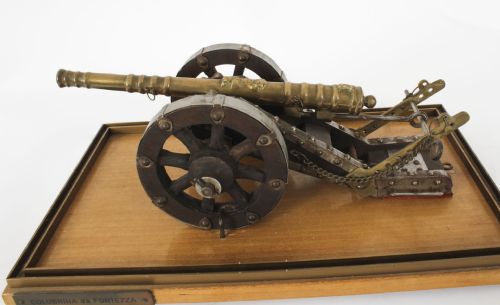
- An early type of long-range cannon design replicated in nineteenth-century decorative models. The term derives from historical serpent-inspired naming conventions for ordnance.
Brass Model Cannon: Frequently Asked Questions
Can these model cannons actually fire?
Signal cannons are built with thick metal barrels and touch holes intended for firing blank powder charges. Purely decorative scale models lack the construction required for discharge.
Buyers should examine the bore and touch hole to determine if a piece was made as an operational signal gun or strictly for display.
What woods were used for the carriages?
Carriages commonly employ dense timbers such as oak, mahogany, and assorted hardwoods to support the weight of metal barrels. These woods provide the necessary durability and stability for desktop display.
Many nineteenth-century examples feature stepped wooden beds fitted with small metal wheels.
How do I tell an 18th-century piece from a 19th-century one?
Dating relies on stylistic markers, inscriptions, and metallurgical characteristics recorded across the periods. Eighteenth-century models often reflect French military designs or specific campaign ordnance.
Nineteenth-century examples frequently incorporate Victorian maritime motifs and standardised cast iron carriages.
Where were these displayed originally?
Owners placed these models on desks, mantelpieces, and officers' mess tables as decorative conversation pieces. Signal variants also served functional roles on maritime vessels and estates.
Their compact size made them popular desk ornaments throughout the Victorian and Edwardian eras.