


Cast Brass Cannon
These cast brass cannon pieces are solid desk ornaments and model armaments built to display historical military form, prized for their heavy weight and polished metal finish.
Cast Brass Cannon
When you search for cast brass cannon, you are looking at decorative models, signal cannons, and heavy desk ornaments designed in miniature to echo full-sized military artillery. These pieces appear most frequently from the 18th century, 19th century, Victorian, and Edwardian eras, reflecting maritime and military traditions of those periods.
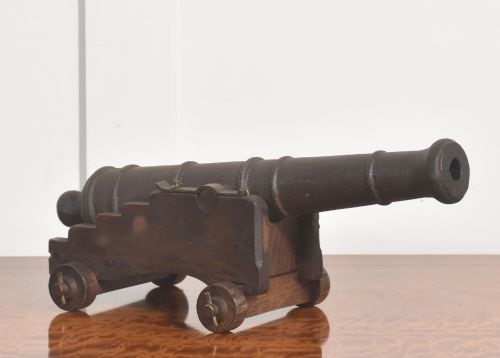
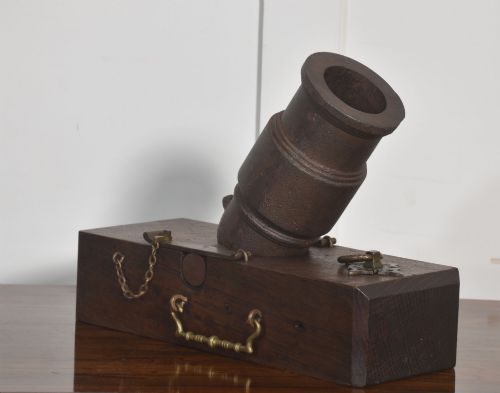
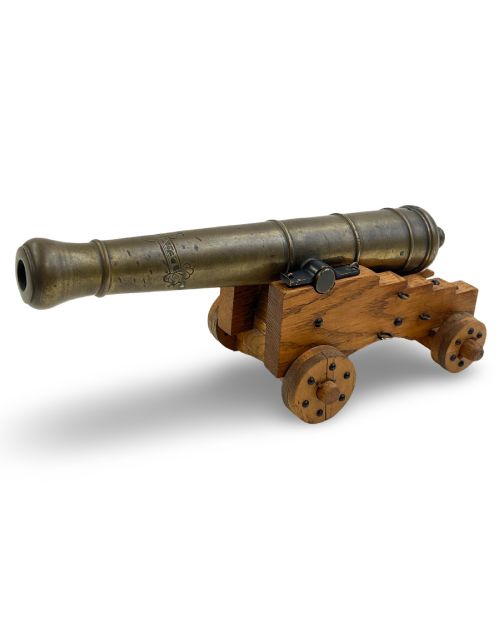
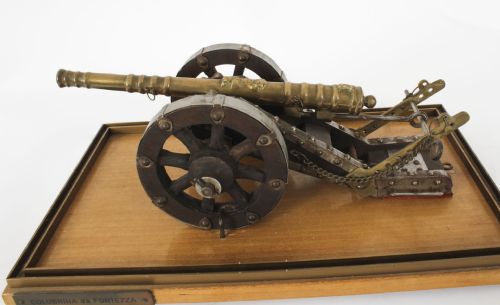
The objects take several distinct forms, ranging from small signal cannons intended to produce a loud report on celebratory occasions to scale models of field guns and fort artillery. Many examples combine cast brass or bronze barrels with carriages made from cast iron, oak, or mahogany.
Most items on this page function as decorative objects or desk ornaments rather than functional weaponry, though some historic signal cannons retain their touch-holes. Origin styles span English and French maritime aesthetics, along with specific military commemorations such as the Crimean War.
How they were made
The primary metal components of these pieces are formed through casting, utilising copper alloy mixtures like brass and bronze, alongside cast iron and polished steel. Metal barrels are cast in moulds to achieve the cylindrical form and stepped reinforcement rings characteristic of historic artillery.
Carriages and undercarriages are constructed from dense hardwoods such as oak and mahogany, or fabricated from heavy cast iron to support the weight of the metal barrel. Individual components are fastened together with small metal pins, bolts, or screws, creating stable platforms for display.
Several models commemorate historic conflicts with miniature brass barrels stout enough to make an Admiral double-take from across the room.
What varies in quality
Quality in these pieces depends heavily on the precision of the casting and the crispness of the barrel details, such as turned mouldings and inscribed lettering. Smoother metal surfaces and carefully finished bronze or brass elements distinguish finer ornamental models from simpler production items.
The choice and execution of the carriage materials also determine the grade of a piece. Well-grained mahogany or oak undercarriages, fitted with matching metal wheels and robust joinery, separate high-end desk ornaments from standard decorative models.
The Cast Brass Cannon Glossary
- Signal cannon
- A small piece designed specifically to make a loud noise for maritime signaling, yacht races, or public celebrations rather than for combat. These often feature reinforced barrels to handle small powder charges.
- Carriage
- The mounting structure, made of wood or iron, that holds the cannon barrel. In smaller models, these are scaled down to sit flat on a desk or shelf.
- Colubrina
- An early type of long-range cannon design reproduced in model form during the nineteenth century. The term refers to a slender serpent-like ordnance shape.
- Gribeauval system
- A standardised artillery design introduced in France during the eighteenth century that reorganized gun sizes and carriage construction. Models reproducing this system reflect specific military historical forms.
Cast Brass Cannon: Frequently Asked Questions
What is a signal cannon?
A signal cannon is a small-scale ordnance piece designed primarily to produce a loud report rather than fire a projectile. People used them historically for yacht starting signals, maritime alerts, and estate celebrations.
Today, these pieces survive largely as decorative desk objects and mantle ornaments. Their heavy metal construction and traditional wooden carriages give them a distinct presence in a study or library.
How do I display a desk cannon?
Desk cannons fit well on heavy timber surfaces, bookshelves, or side tables where their substantial weight provides stability. They require minimal space compared to larger antiques and pair naturally with other nautical or military items.
Keep the metal polished with a soft cloth to maintain the finish of the brass or bronze. Avoid abrasive cleaners that can remove historical patina from older pieces.
Are these cannons functional?
Most of the pieces found in this category serve strictly as decorative models, desk ornaments, or scale replicas. While some historic signal cannons include a touch-hole, many modern owners display them uncharged.
Attempting to fire antique or vintage models carries significant risk due to material degradation over time. It is safest to treat them purely as sculptural objects.
How do I tell the period?
Dating these pieces relies on examining the style of the carriage, the method of metal casting, and any inscribed dates or makers' marks. Victorian and Edwardian examples often feature standardised cast iron carriages paired with polished brass barrels.
Earlier eighteenth-century models tend to display hand-finished bronze barrels with distinct patination and solid oak or mahogany undercarriages. Comparing the form to known military artillery timelines helps narrow down the decade.