




Vintage Privacy Screen
A vintage privacy screen offers a practical way to divide interiors, combining period craftsmanship with movable room architecture.
Vintage Privacy Screen
A vintage privacy screen stands as a movable partition designed to divide interior spaces, create secluded dressing areas, or conceal parts of a room. These pieces take the form of multi-fold room dividers constructed across periods from the nineteenth century to the mid-twentieth century.
Buyers encountering this selection will frequently meet French walnut, mahogany, and painted wooden frames, alongside examples featuring Chinese lacquer, Japanese decoration, and Burmese carving. Styles range from Edwardian and Victorian iterations to French Rococo Revival, Arts and Crafts, and Chinoiserie.
The format relies on hinged panels that fold flat for storage or extend to form a solid barrier. Common configurations span three-fold and four-fold designs, as well as larger six-panel room dividers.
What varies in quality
Construction sturdiness distinguishes the build quality across different pieces, specifically the weight of the timber frame and the durability of the connecting hinges. Heavier hardwoods provide greater stability when extended, preventing the panels from tipping under pressure.
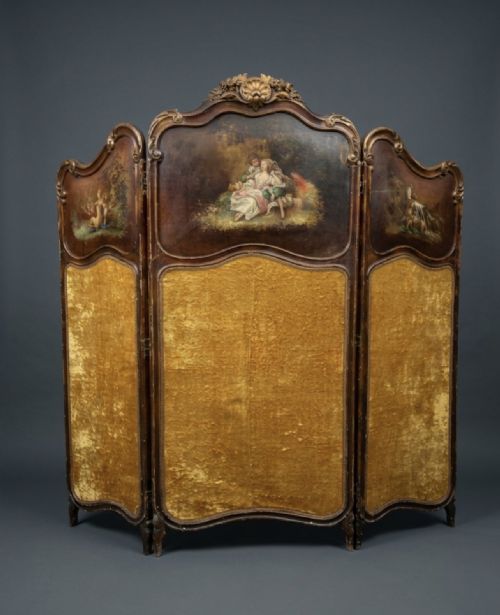
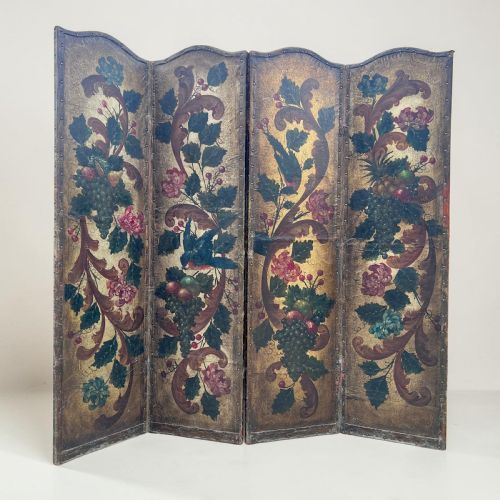
Artistic execution dictates the visual standard, seen in the precision of hand-painted pastoral scenes, carved dragon details, or inlaid woodwork. The integration of specialised materials such as hardstone mounts, quality leather, or patterned textile panels elevates the finish of the room divider.
Screen configurations vary from three-fold domestic dressing dividers to large six-panel room partitions incorporating glass, fabric, and painted panels.
The Vintage Privacy Screen Glossary
- Chinoiserie
- European decorative style reflecting Chinese artistic traditions. This aesthetic appears on lacquered screens featuring figures, landscapes, and gold motifs.
- Folding screen
- A piece of furniture consisting of two or more panels connected by hinges. It stands independently to divide a room or block line of sight.
- Needlepoint
- Embroidery stitched onto a canvas mesh ground. Examples on these screens form decorative pictorial panels within the wooden frame.
- Fretwork
- Ornamental design created by cutting patterns through thin wood. This technique provides openwork detail in the upper or lower sections of panels.
- Hardstone
- Semi-precious stones carved and applied to decorative surfaces. They provide relief and colour contrast on lacquered panels.
Vintage Privacy Screen: Frequently Asked Questions
How do I use a privacy screen?
Position the hinged panels at angles to create a stable zigzag shape that stands unsupported on the floor. Use them to section off corners, create private dressing spaces, or hide storage areas within a larger room.
Fold the panels flat against one another when you need to store the divider behind furniture or inside a closet. Ensure the floor surface remains even so the hinges do not strain under uneven weight distribution.
How are panels connected?
Metal hinges join the vertical wooden frames together, allowing the panels to swing in both directions for flexible folding. These metal joints range from simple hinges to more decorative brass fittings depending on the period and style.
Check that the hinges operate smoothly without binding or sagging the wooden frame. Proper alignment ensures the screen maintains its freestanding shape when positioned in a room.
What materials are used?
Frames consist primarily of solid timbers such as mahogany, walnut, oak, and ebonised hardwood. Infill panels incorporate painted leather, needlepoint fabric, decorated lacquer, glass, and woven cane.
Asian pieces often feature carved wood or lacquered surfaces with applied hardstone details, while European examples favour painted linen, silk, or pastoral canvas scenes. Each material combination reflects the regional preferences of its manufacturing period.
How do I date a screen?
Examine the timber species, joinery methods, and hardware style to establish a baseline period. Victorian and Edwardian examples often feature specific decorative motifs like needlepoint, painted leather, or Arts and Crafts fabric insertions.
Compare the surface ornamentation, such as Chinoiserie lacquer work or painted pastoral scenes, against known design movements of the nineteenth and twentieth centuries. Look for construction marks or labels if the wooden frame provides visible joinery details.