



Edwardian Room Divider
An edwardian room divider partitions space with folding leaves of timber, fabric or lacquer, offering flexible privacy and period character.

Edwardian Room Divider
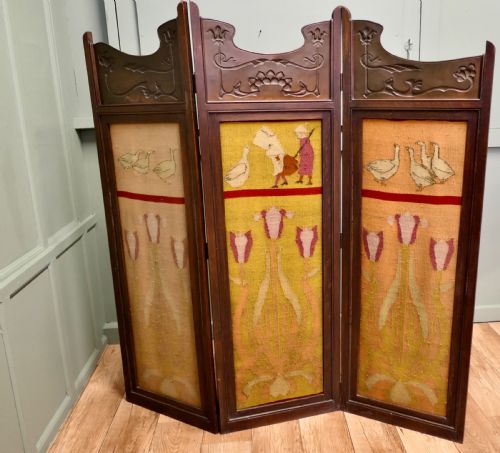
An edwardian room divider takes the form of a folding screen with three or four leaves, designed to partition interior spaces or create private corners in a parlour. These pieces emerge predominantly from the Edwardian period, though related examples span from late Victorian decades into the nineteen-twenties.
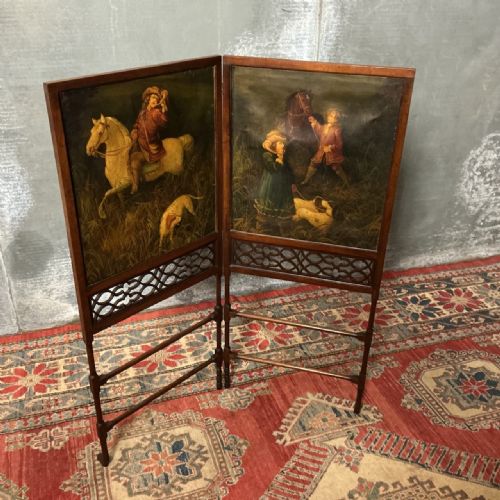
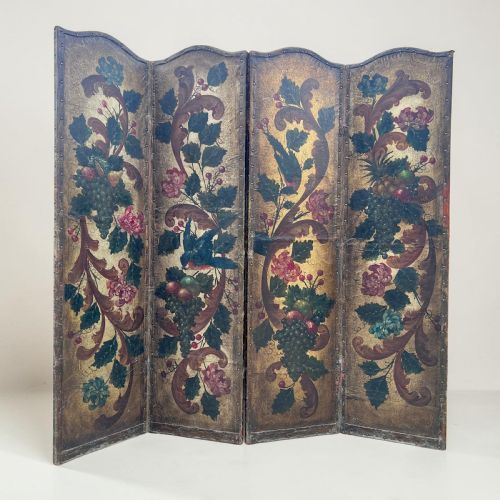
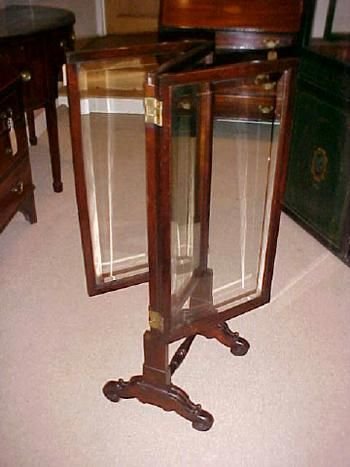
The construction relies on hinged wooden frames enclosing panels of mahogany, walnut or oak, frequently incorporating decorative inserts of fabric, glass or painted leather. Surviving examples range from plain timber frames to elaborate multi-fold partitions featuring hand-painted scenes or inlaid woodwork.
Buyers encounter folding screens configured for specific domestic duties, including dressing room vanity dividers, boudoir screens and fire screens. The core function remains the division of living space through portable, hinged panels.
How they were made
Makers constructed the structural frames using solid hardwoods like mahogany, walnut, oak and ebonised timber, joined with hinges to permit multi-directional folding. Panels were inset directly into the timber framework.
Surface decoration involved diverse techniques, including oil paintings on canvas or panel, hand-painted leather, lacquer work with hardstone mounts, and stretched textiles such as velvet, jaquard and naive wool work.
Listings feature folding screens spanning the Victorian era through the nineteen-thirties, constructed in mahogany, oak, brass and black lacquer.
What varies in quality
Quality reveals itself in the weight and stability of the timber frame, the smoothness of the metal hinges across multiple folds, and the integration of the panels within the structure. Heavier hardwoods and fully reversible joints indicate superior construction.
The artistic execution of the infill panels separates standard pieces from exceptional ones, particularly in hand-painted oil scenes, intricate fretwork, or applied lacquer and hardstone details.
The Edwardian Room Divider Glossary
- Folding screen
- A piece of furniture consisting of two or more frames joined by hinges. These panels stand upright and angle to partition a room.
- Chinoiserie
- European decorative art imitating Chinese and East Asian artistic styles. These designs frequently appear in lacquer on black backgrounds.
- Bergere
- A closed upholstered armchair or a panel insert of woven cane. In screens, this term describes woven cane panels within a wooden frame.
- Inlay
- A technique where pieces of contrasting timber or shell are inserted into depressions in the base wood. This creates flat decorative patterns on the frame.
- Fretwork
- Ornamental design created by cutting patterns through wood with a scroll saw. This technique adds openwork detail to upper screen panels.
Edwardian Room Divider: Frequently Asked Questions
How do I use a room divider?
These folding screens stand independently on the floor to partition large rooms, shield doorways from draughts, or create private dressing areas within a bedroom.
Position the hinged panels at gentle angles so the screen remains stable under its own weight without needing wall fixings.
How are different periods identified?
Dating relies on timber choices, such as dark mahogany or walnut for Edwardian pieces, alongside decorative motifs like Art Nouveau copper work or Chinoiserie lacquer.
Hardware style and construction methods also indicate the era, shifting from Victorian ebonised oak toward lighter Edwardian satinwood and inlaid frames.
Are these screens fully reversible?
Certain multi-fold screens utilise double-action hinges that allow panels to swing in both directions, making the piece completely reversible.
This flexibility permits the screen to fold flat in either direction for storage or custom room configurations.
How do I clean fabric panels?
Textile inserts like velvet, jaquard or wool require gentle surface dusting with a soft brush to protect the vintage fibres from damage.
Avoid liquid cleaners on antique fabrics and painted panels unless tested on a hidden corner first.