



Vintage Green Glass Stemware
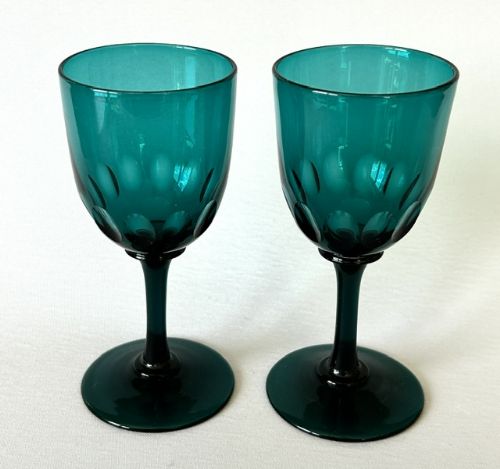
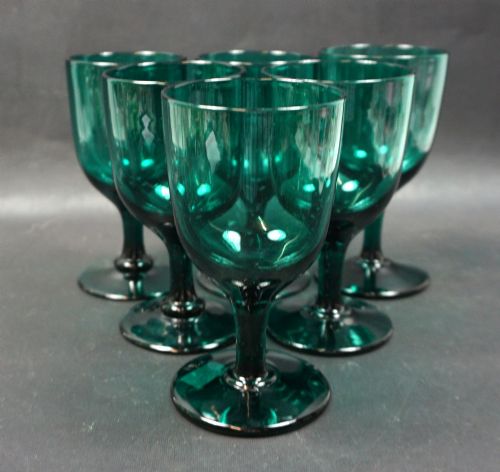
These vintage green glass stemware pieces bring rich colour and historic form to the table, ranging from deep emerald wine glasses to delicate enamelled cordials.
Vintage Green Glass Stemware
Vintage green glass stemware encompasses a broad sweep of drinking vessels, with wine glasses and hock glasses forming the core of what appears in these collections. You will frequently encounter sets of six alongside matched pairs, spanning periods from the Georgian era through to the Art Deco decades of the nineteen-thirties.
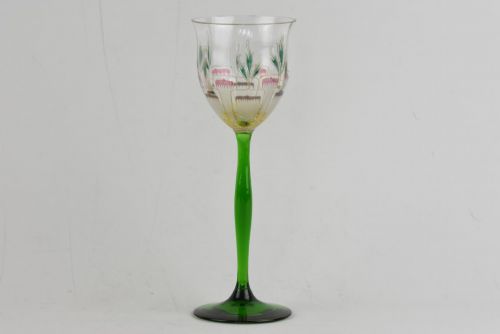
The styles shift noticeably across these eras, moving from simple Bristol green bowls to ornate Victorian vaseline glass, Art Nouveau floral enamelling, and dramatic green over crystal forms. Pieces range from tall turquoise goblets to delicate champagne coupes and cordial glasses.
Origins are correspondingly diverse, taking in English glasshouses, French makers such as Baccarat and St Louis, German workshops like Theresienthal, and Venetian inspired designs. Buyers looking for vintage green glass stemware will find functional vessels that double as striking decorative objects.
Materials and techniques
Production relies heavily on blown glass and lead glass, often manipulated into cased glass formations where a green exterior layer overlies a clear crystal core. Cut crystal techniques allow makers to create faceted stems and bowls that catch the light, revealing the depth of the coloured glass beneath.
Surface ornamentation frequently involves hand applied enamel and delicate traces of gold leaf, particularly on pieces originating from continental workshops. Molten metal manipulation produces distinct hues, from deep emerald and Bristol green to softer aqua and turquoise tones.
Materials represented include lead glass, cased glass, and blown glass decorated with enamel and gold leaf.
Distinctions in quality
Quality reveals itself in the crispness of the glass cutting and the precision of the enamel work, where hand painted floral details show an artist's steady hand rather than a mechanical transfer. The weight and balance of the stem relative to the bowl indicate the maker's skill in handling lead glass and blown forms.
Depth of colour and the clarity of cased glass layers set finer examples apart, particularly when two contrasting tones of glass fuse seamlessly together. Maker attributions, such as documented work from Baccarat or Theresienthal, elevate pieces well beyond standard commercial tableware.
Baccarat·Theresienthal·Harry Powell for James Powell·St Louis Massenet
The Vintage Green Glass Stemware Glossary
- Hock glass
- A tall-stemmed wine glass traditionally used for German white wines, often featuring an elongated coloured bowl and intricate cutting. These pieces dominate many twentieth-century continental collections.
- Vaseline glass
- Uranium glass that exhibits a distinct yellow-green fluorescence under ultraviolet light. Victorian examples are particularly prized by collectors for their luminous quality.
- Cased glass
- A method where a layer of coloured glass is fused over a clear or contrasting coloured body before being cut back. This technique exposes the underlying layer in sharp geometric or floral patterns.
- Champagne coupe
- A shallow, broad-bowled stemmed glass designed for sparkling wine. Vintage iterations often pair this saucer-like form with vibrant green over crystal colourways.
- Enamel
- Opaque glass paste applied to the surface of a vessel and fired to create raised decorative motifs. Theresienthal pieces frequently utilise this technique for floral decoration.
Vintage Green Glass Stemware: Frequently Asked Questions
How do I clean antique green wine glasses?
Wash these vessels by hand in warm soapy water using a soft cloth, avoiding harsh dishwasher cycles that can cloud old glass or damage delicate enamel.
Dry them immediately with a lint-free linen cloth to prevent water spots and preserve the polish of the lead glass.
Are these glasses safe for daily use?
Most vintage drinking vessels function adequately for occasional dining, provided you handle them with the care due to fragile lead glass and hand-enamelled surfaces.
Pieces featuring heavy gold leaf or delicate over-crystal cutting are best reserved for display or light celebratory use.
How can I tell Victorian glass from later pieces?
Victorian examples often display heavier pontil marks on the base and thicker, hand-blown walls compared to the more refined machine-tooled lines of the nineteen-twenties and thirties.
Colouration also provides clues, with nineteenth-century pieces tending towards rich Bristol greens and vaseline tones rather than later pastel shades.
What is the difference between a hock glass and a wine glass?
Hock glasses generally feature much taller stems and more slender, elongated bowls designed to hold aromatic white wines.
Standard wine glasses from these periods tend to have shorter, more rounded bowls suited to heavier dessert wines and clarets.