


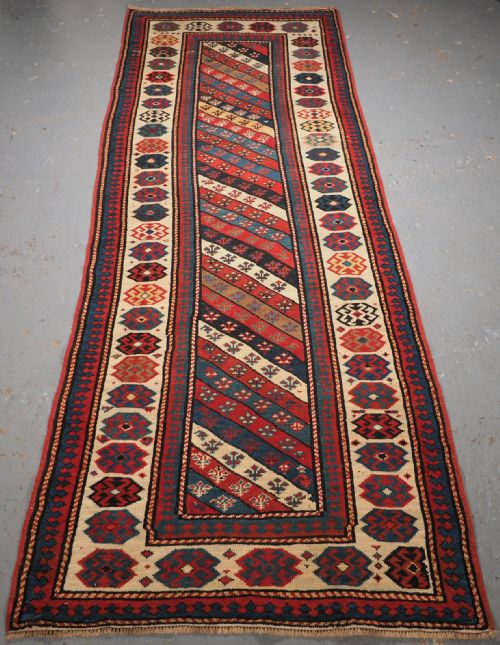
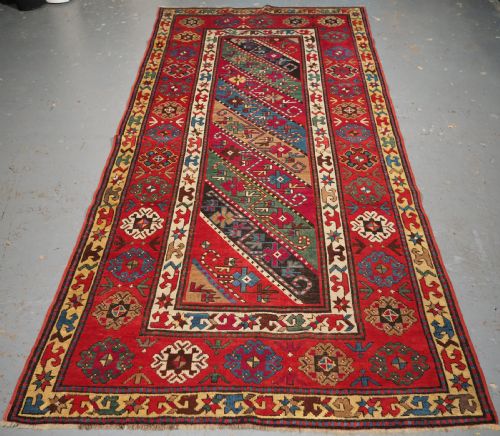

Vintage Gendje Caucasian Rug
These vintage gendje caucasian rug examples are woven tribal textiles from the Caucasus, prized by collectors for their geometric designs and rich natural dyes.
Vintage Gendje Caucasian Rug
You are most likely to meet pieces displaying traditional motifs such as colourful boteh, floral lattices and diagonal stripes. These textiles represent the weaving traditions of Caucasian communities active between 1880 and 1910.
How they were made
These rugs are constructed using wool and hand-spun wool for both the pile and the foundational structure. Weavers tied symmetrical knots by hand on vertical looms to build dense, durable floor coverings.
The materials were dyed using traditional methods to achieve the striking blue grounds and multicoloured patterns recorded across the period.
Diagonal stripes marched across these looms over a century ago, keeping footsteps off cold floors ever since.
What varies in quality
The standard of a woven piece depends on the tightness of the knotting and the crispness of the geometric design. Tightly packed knots create a firmer handle and sharper definition in diagonal stripes and floral lattices.
Colour saturation and the survival of original borders also distinguish finer examples. Pieces with scarce blue grounds or well-preserved hand-spun wool demonstrate superior material selection.
The Vintage Gendje Caucasian Rug Glossary
- Boteh
- A stylised almond or pear-shaped motif of Persian origin. It appears frequently in colourful arrangements across tribal woven textiles.
- Prayer rug
- A small carpet featuring a mihrab or niche design at one end. Historically used for individual prayer, these pieces often display compact dimensions.
- Runner
- A long, narrow carpet format designed for hallways or corridors. These items show repeating diagonal stripes or extended floral lattices.
- Hand-spun wool
- Yarn produced using manual spinning techniques rather than industrial machinery. This material yields subtle variations in texture and dye absorption.
Vintage Gendje Caucasian Rug: Frequently Asked Questions
How old are these rugs?
The pieces available date from the late nineteenth century up to the early twentieth century, specifically spanning the decades between 1880 and 1910.
Each rug reflects the traditional weaving practices of the Caucasus during this era.
Where were they made?
These textiles originate from the Caucasus region, specifically associated with the Gendje region and Eastern Caucasus.
Local tribal weavers produced them on traditional vertical looms using regional materials.
What designs do they have?
Common patterns include diagonal stripes, floral lattices and colourful boteh motifs arranged across the field.
Some examples also incorporate scarce blue grounds and unusual design variations.
How do I care for a runner?
Place the runner in a low-traffic hallway to minimise physical wear on the hand-spun wool pile.
Use a suitable underlay to prevent slipping and protect the structure of the rug.