


Vintage Brass Artillery
Vintage brass artillery pieces are desk ornaments and scale models that bring tangible military history indoors.
Vintage Brass Artillery
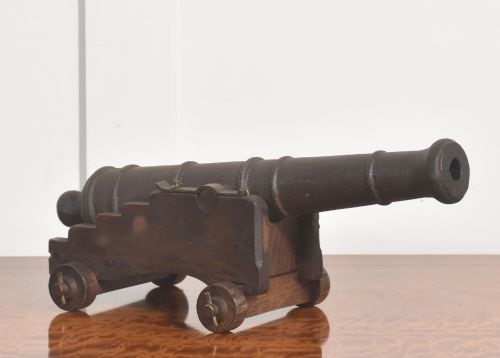
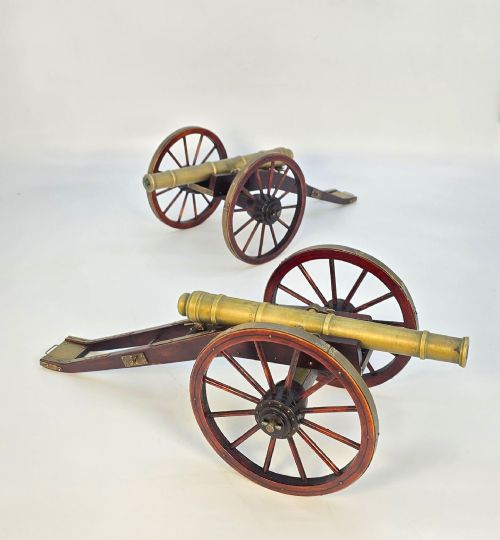
Vintage brass artillery comprises scale models, desk ornaments, and signal cannons fashioned after historical ordnance. These pieces range from Victorian ornamental cannons to trench art shell cases and French field gun models.
A buyer examining this selection will frequently encounter 19th-century examples alongside early 20th-century models from the 1910s, 1920s, and 1930s. Forms vary from simple desk ornaments to intricate models mounted on wooden carriages.
The objects draw on diverse military eras, including styles from the 17th, 18th, and 19th centuries. Many function purely as decorative objects or signal cannons rather than working armaments.
How they were made
Maker construction relies heavily on metal casting, producing barrels in brass, bronze, cast iron, and polished steel. These metal components are often paired with wooden carriages or undercarriages fashioned from oak, mahogany, or general hardwood.
Many items incorporate mixed media, joining bronze barrels with cast iron carriages or steel elements. Hand building and polishing techniques define the finish of these desk cannons and signal models.
Listings feature pieces spanning from the 17th-century military style up to 1930s models, incorporating brass, bronze, cast iron, and oak.
What varies in quality
Quality in vintage artillery models rests on the precision of the casting and the fidelity of the scale reduction. Superior examples display crisp detail in the barrel and ordnance markings, paired with solid timber carriages.
The integrity of the materials also separates standard pieces from finer works, particularly where heavy cast bronze or polished brass meets properly joined hardwood or mahogany undercarriages.
The Vintage Brass Artillery Glossary
- Signal cannon
- A small cannon used for firing blank charges to signal events or start races. These often appear as desk ornaments in brass or iron.
- Trench art
- Decorative items created by soldiers, prisoners, or civilians from military scrap material. Trench art frequently utilises empty brass shell cases from the First World War.
- Gribeauval system
- A standardised system of field artillery developed in France during the 18th century. Models reproducing this design feature distinct military proportions.
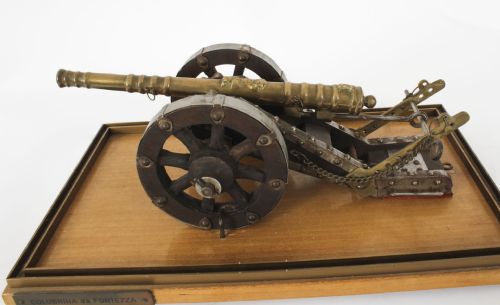
- Colubrina
- An early type of long-range cannon or culverin. Bronze cased models of this ordnance appear in 19th-century decorative pieces.
Vintage Brass Artillery: Frequently Asked Questions
How were these miniature cannons used?
Most surviving pieces serve as decorative desk ornaments, mantle displays, or scale models rather than functional weaponry. Some heavier iron and steel versions functioned as signal cannons.
They reflect historical military design and were collected or displayed as desk ornaments throughout the Victorian era and into the twentieth century.
How do I clean polished brass?
Polished brass and bronze surfaces require gentle dusting with a soft cloth to maintain their finish. Avoid harsh chemical cleaners that strip the metal of its aged character.
Unlacquered brass naturally develops a patina over time, which many collectors prefer to leave undisturbed.
Are these model cannons functional?
While certain robustly built signal cannons were designed to discharge blank loads, the vast majority of these items are strictly decorative models. They are built as static ornaments and scale replicas for display.
Attempting to fire vintage or antique decorative ordnance presents significant safety risks and is generally not recommended.