


Victorian Staffordshire Lions
Victorian staffordshire lions are pottery shelf ornaments capturing domestic power, and you want a pair with clear glazing and crisp moulding.
Victorian Staffordshire Lions
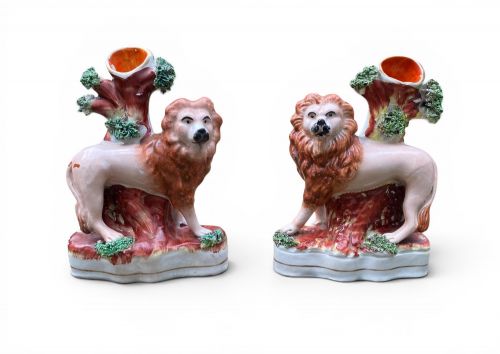
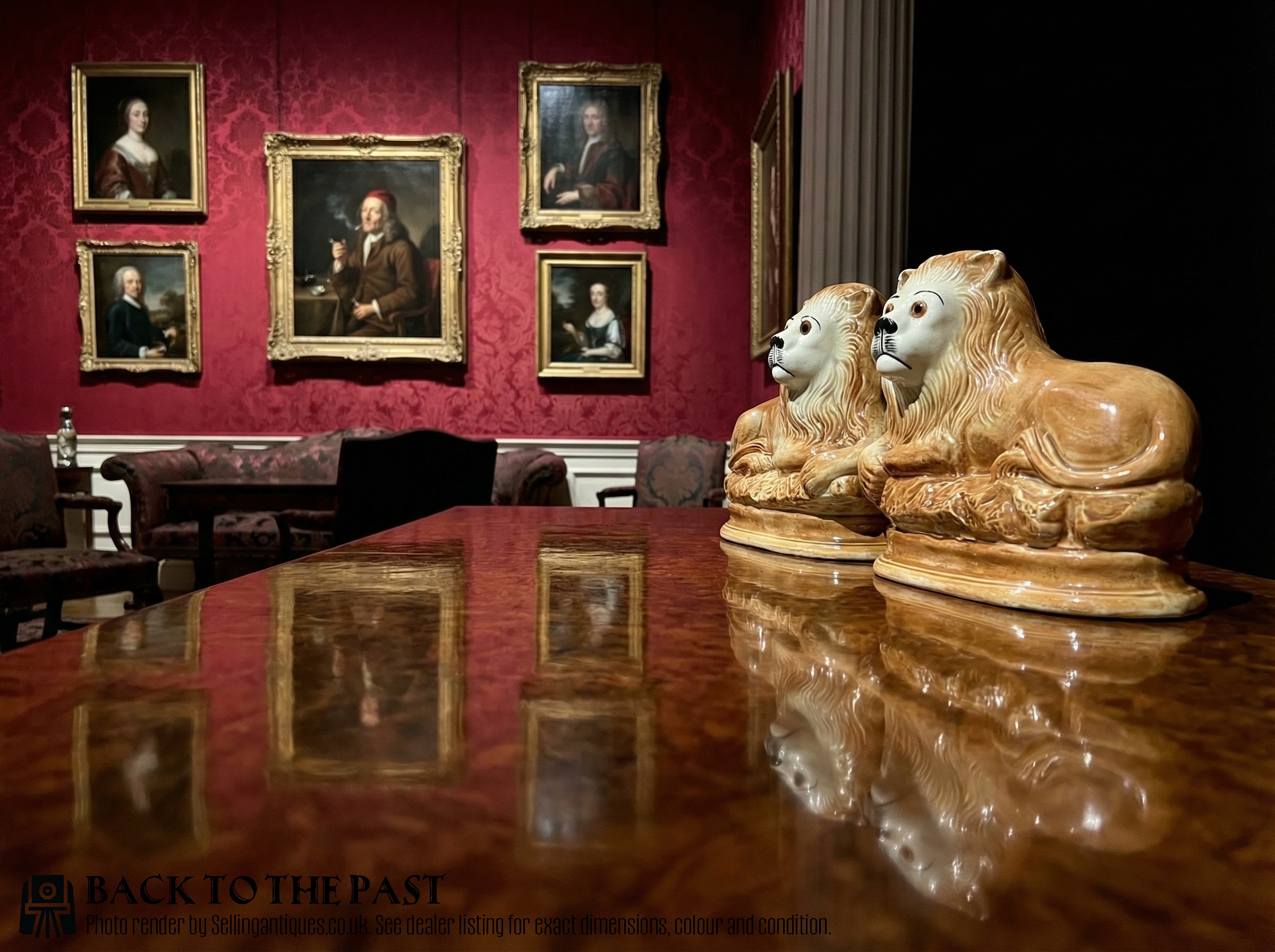
Victorian staffordshire lions encompass earthenware figures, spill vases, and bookends produced in nineteenth-century England. You meet pairs most frequently, often modelled in recumbent poses or standing as Medici lions.
Makers also applied these sculptural forms to functional domestic items, resulting in unusual variants such as jelly moulds, sugar bowls with lion mask handles, and figurative scenes like the death of the lion queen.
Materials and construction
Potters shaped these earthenware and creamware figures in ceramic moulds before applying lead glazes, enamel colours, and occasional gilding. Treacle glaze appears on several examples, producing a rich, dark brown glossy surface.
The listings show earthenware and creamware forms spanning Victorian styles, including spill vases, bookends, jelly moulds, and sugar bowls.
Markers of quality
Quality rests in the crispness of the moulding and the depth of the glaze, which separates finely detailed figures from softer, later recasting. Sharp definition in the mane and facial expression distinguishes superior production.
Scale also dictates distinction, as large pairs demand greater technical skill in firing without distortion compared to smaller standard figures.
Rockingham Pottery·Lancaster and Sons of Hanley
The Victorian Staffordshire Lions Glossary
- Medici lion
- A sculptural representation modelled after the famous marble lions in Florence. Potters frequently adapted this classical stance for pairs of shelf ornaments.
- Spill vase
- A hollow cylindrical holder attached to a figure, designed to hold wooden spills for lighting fires. These combine utility with decorative modelling.
- Treacle glaze
- A thick, dark brown lead glaze applied to earthenware. It creates a lustrous, mirror-like finish common on nineteenth-century animal figures.
- Creamware
- A refined pale earthenware developed in Staffordshire during the eighteenth century and continued into the Victorian era. It provides a smooth ground for glazes.
Victorian Staffordshire Lions: Frequently Asked Questions
How were victorian staffordshire lions displayed?
These figures stood proudly on mantelpieces, often arranged as symmetrical pairs flanking a clock or central ornament.
Their substantial presence suited the formal entertaining spaces of nineteenth-century homes.
What is a spill vase lion?
A spill vase lion incorporates a vertical holder alongside the animal's body for storing wooden fire-lighters.
This practical addition allowed the decorative figure to serve a daily domestic purpose near the hearth.
How do I spot a reproduction?
Original pieces show the weight, crazing, and glaze characteristics typical of nineteenth-century Staffordshire earthenware.
Modern copies lack the subtle hand-painting and soft wear patterns developed over generations.
Why do some lions face left and right?
Makers produced these animals as matched mirror-image pairs designed to look inward toward the centre of a mantelpiece.
Finding a true matching pair that faces both directions remains a primary goal for collectors.