

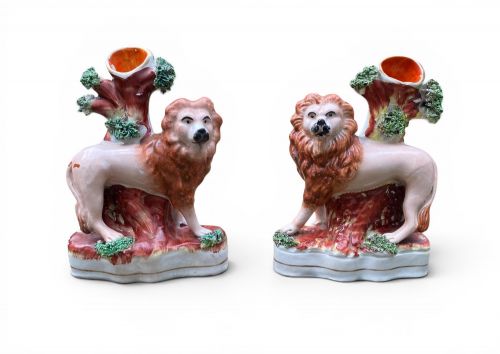


Staffordshire Lion Ornaments
Staffordshire lion ornaments are ceramic figures and spill vases from the nineteenth century that bring traditional mantelpiece character to any room.
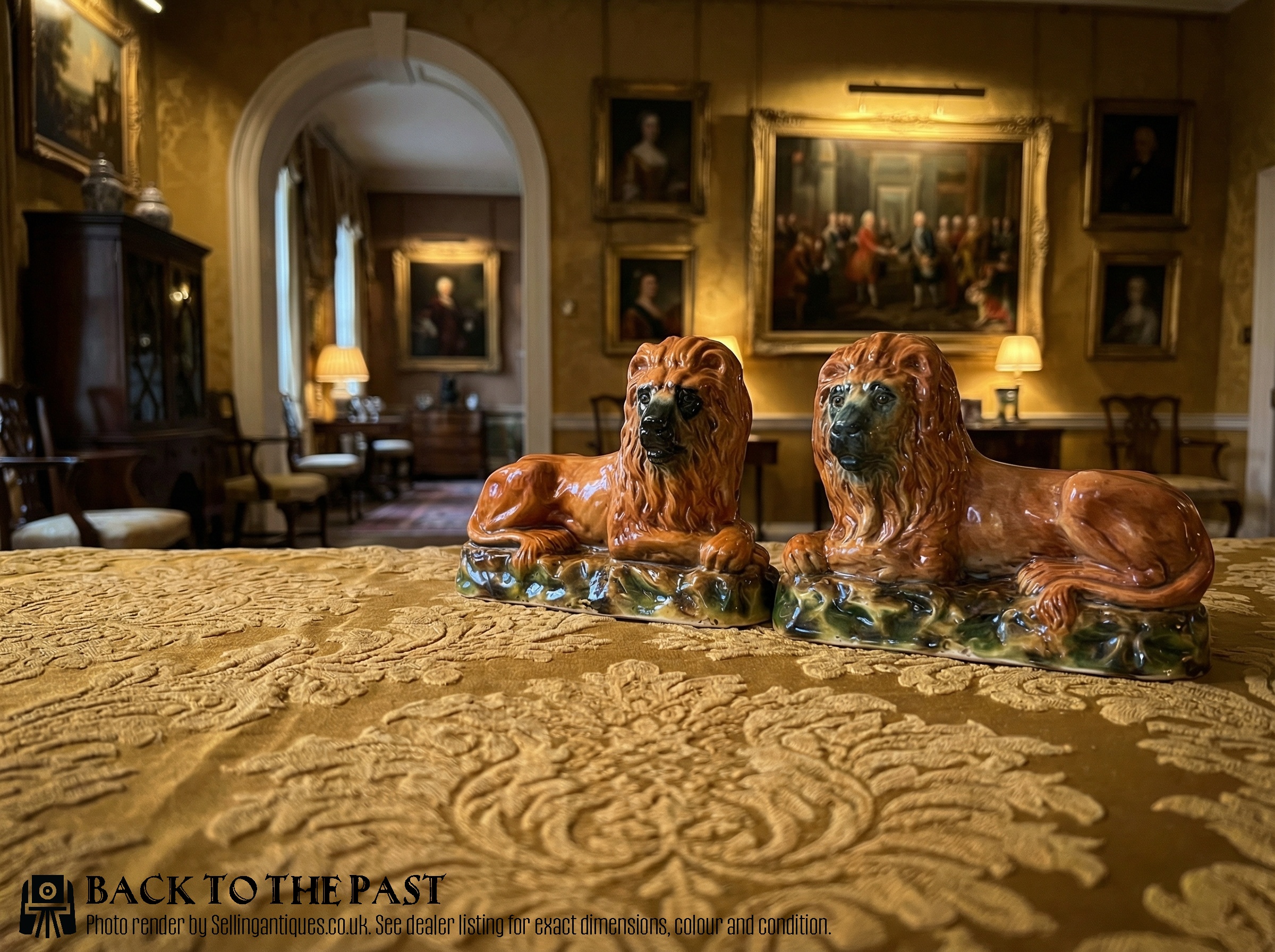
Staffordshire Lion Ornaments
Staffordshire lion ornaments appear in several distinct forms across the nineteenth century, including pairs of recumbent beasts, spill vases, and occasional pairings with unicorns or specific thematic titles like the death of the lion queen. The version most commonly met on this page is the Victorian ceramic pair, often glazed in treacle or finished with enamel details.
Makers and potteries such as Rockingham and Lancaster and Sons of Hanley produced these earthenware figures during the Victorian era and into the early twentieth century. Buyers encounter both single decorative statuettes and matched pairs designed to sit at either end of a shelf or book collection.
How they were made
Moulds captured the musculature and mane of the Medici lion form, allowing workshops to produce consistent shapes before hand-painting individual details. Subsequent low-temperature firings set the glaze and surface decoration.
Listings feature earthenware and pearlware materials shaped into figures, spill vases, and bookends across the Victorian period.
What varies in quality
Completeness of pairs and the survival of original enamel painting or gilding distinguish standard decorative figures from more desirable collector pieces. Stronger modelling in the paws and expression marks the upper tier of nineteenth-century production.
Rockingham Pottery·Lancaster and Sons of Hanley
The Staffordshire Lion Ornaments Glossary
- Medici lion
- A classical sculptural type depicting a majestic lion with one paw resting on a ball, copied from the marble statues in Florence and adapted by Staffordshire potters. This form provides the postural template for many nineteenth-century recumbent figures.
- Treacle glaze
- A dark, translucent brown lead glaze that pools richly in the recesses of earthenware ceramics. It gives these figures a glossy, highly reflective surface reminiscent of dark treacle.
- Spill vase
- A hollow ceramic holder attached to a figure, designed to store wooden matches or tapers for lighting fires and candles. Spill vases combine practical fireside utility with decorative animal modelling.
- Pearlware
- A refined earthenware developed in the late eighteenth century featuring a thin glaze over a whitish body with a faint bluish tint in the pooled areas. It serves as an early ceramic substrate for Staffordshire figures before later earthenware bodies took precedence.
Staffordshire Lion Ornaments: Frequently Asked Questions
What are Staffordshire lion ornaments?
These pieces are ceramic figures and spill vases modelled on lions, produced by regional potteries during the nineteenth century. They include recumbent pairs and themed historical groupings.
Potters used earthenware bodies decorated with lead glazes, treacle surfaces, and enamel colours to create domestic ornaments for mantelpieces and shelves.
How were these lions used?
Victorian households displayed these ceramic lions on mantelpieces, sideboards, and bookcases as decorative ornaments. Some versions incorporated hollow spill vases designed to hold wooden tapers for lighting fires.
Matched pairs functioned symmetrically at either end of a shelf or served as heavy bookends supporting volumes on a study desk.
How do I date a Staffordshire lion?
Dating relies on stylistic clues, ceramic bodies such as pearlware versus later earthenware, and glaze characteristics typical of the nineteenth century. Marked pieces or known maker attributions help narrow the production window.
Victorian examples frequently exhibit characteristic treacle glazes or hand-painted enamel details that align with mid-to-late nineteenth-century manufacturing methods.
What is a Medici lion?
A Medici lion is a classical sculptural representation of a large cat with one paw resting upon a sphere. Staffordshire potters adopted this iconic Florentine marble motif for many of their recumbent animal figures.
This specific posture distinguishes classical revival models from standard seated or standing animal figurines in nineteenth-century ceramic displays.