
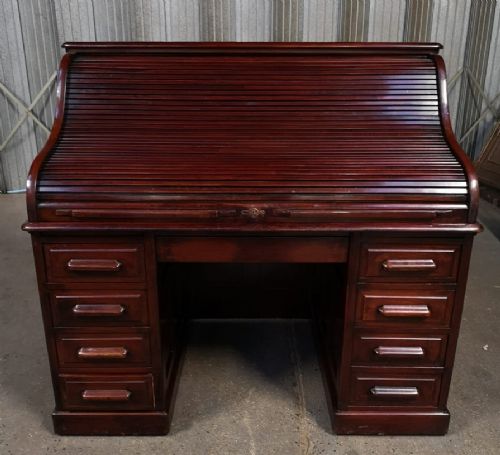
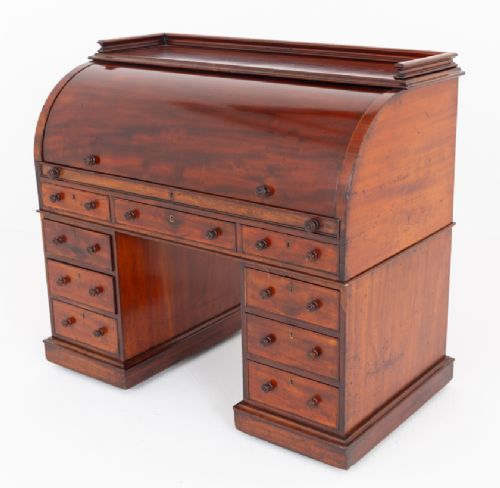
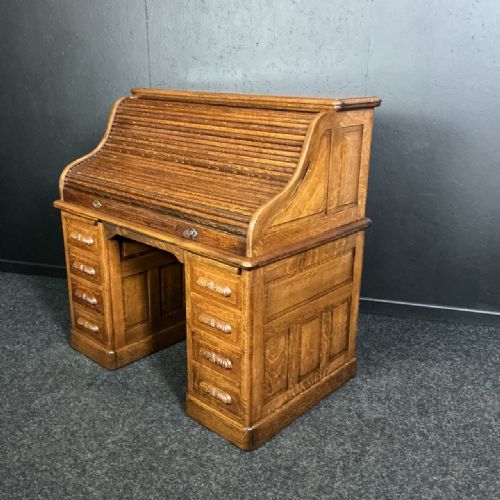

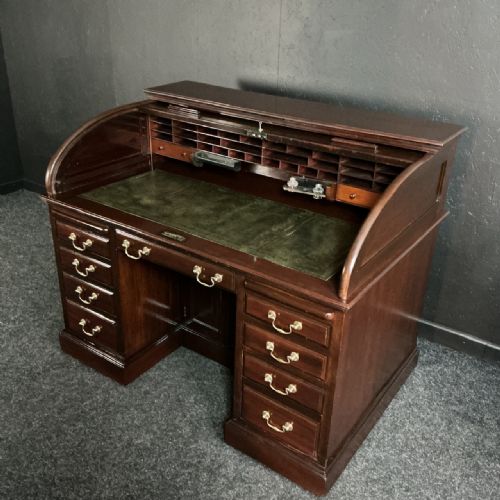


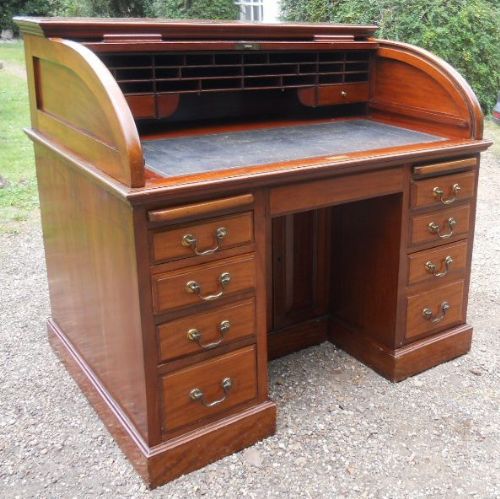
Victorian Rolltop Desk
A victorian rolltop desk is a substantial workspace fitted with a sliding tambour or rigid cylinder to conceal papers, favoured for its practical security.
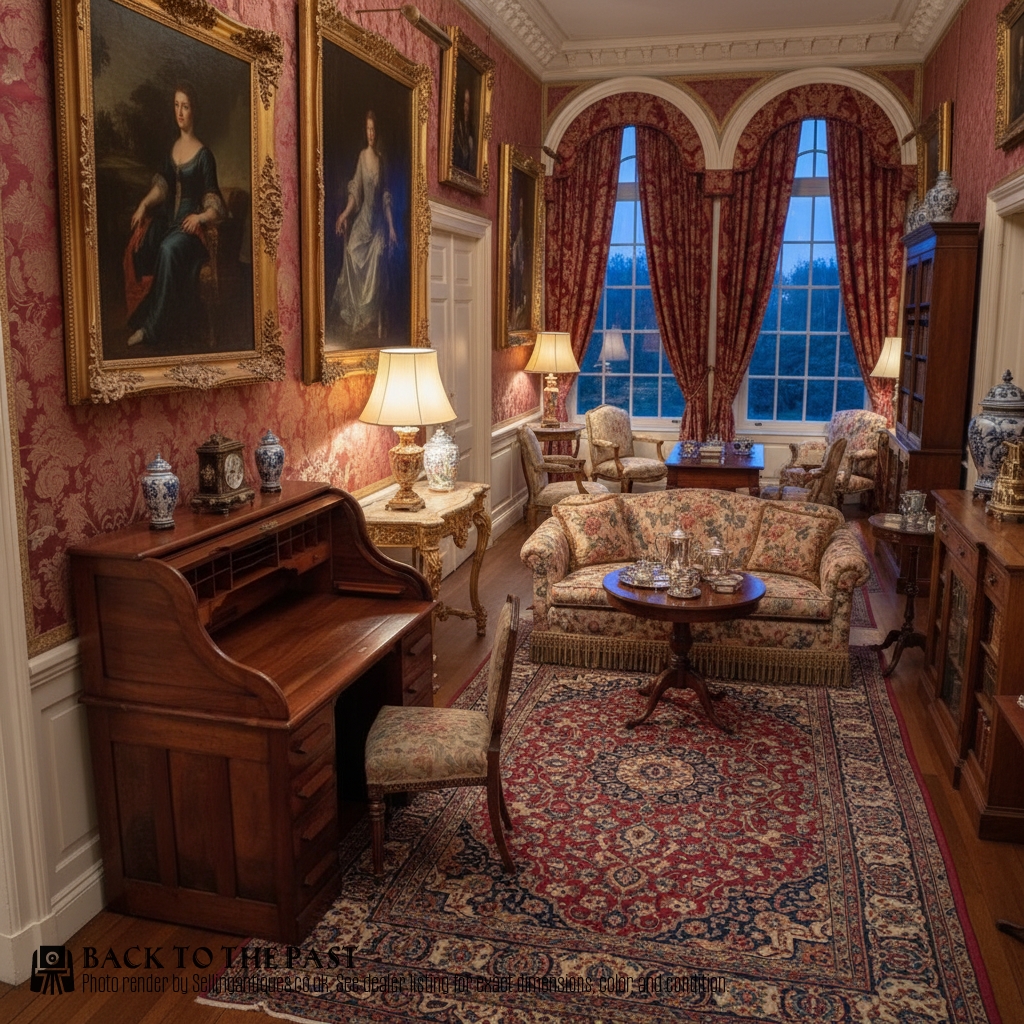
Victorian Rolltop Desk
When you search for a victorian rolltop desk, you encounter large pedestal forms and bureau bookcases designed for private studies and offices. The examples gathered here span the mid nineteenth century through to the Edwardian era, incorporating cylinder desks and tambour variants.
Mahogany and oak dominate the construction, often augmented by walnut or satinwood veneers, alongside utilitarian pieces in maple and camphor wood. These items range from massive kneehole configurations to smaller portable lap writing boxes fitted with brass hardware.
Construction and materials
Cabinetmakers constructed these pieces using dense hardwoods like mahogany and oak as the primary structural frames, frequently applying fine walnut or satinwood veneers to visible exterior surfaces. Tambour shutters utilised narrow slats of wood glued to canvas backings to allow the flexible curtain to slide smoothly around curved tracks.
Internal fittings incorporated pigeonholes, small drawers, and writing surfaces often lined with tooled leather or glass elements. Brass handles, hinges, and locking mechanisms provided both structural reinforcement and operational security for the enclosed compartments.
Some nineteenth-century models include hidden push-spring compartments known as secret drawers, designed to outsmart inquisitive guests and staff alike.
Distinctions in craftsmanship
Superior examples demonstrate meticulous timber selection and seamless movement in the sliding cylinder or tambour mechanism, ensuring the curved wooden tracks operate without binding. The complexity of the internal arrangement, such as secret compartments and finely fitted satinwood interiors, separates standard workshop production from finer cabinet work.
The integrity of the secondary woods, the precision of the dovetail joinery in the drawers, and the preservation of original brass hardware and leather inserts dictate the overall standard of survival and execution.
Boston Chair Company·Wiggers
The Victorian Rolltop Desk Glossary
- Rolltop
- A desk fitted with a flexible slatted wooden shutter that pulls down to conceal the writing surface and pigeonholes. This mechanism travels along recessed tracks cut into the sides of the desk.
- Cylinder desk
- A writing desk featuring a rigid, quarter-circle wooden barrel that rotates backward into the body of the piece to reveal the desk interior. It offers a smoother continuous curve than the slatted tambour version.
- Tambour
- A shutter formed of narrow vertical strips of wood attached to a fabric backing, allowing the assembly to bend around tight curves. It is the defining feature of many traditional rolltop desks.
- Kneehole
- A configuration where a central recessed space for the user's legs is flanked by pedestals containing banks of drawers. This layout provides stability and substantial storage capacity.
- Bureau bookcase
- A combination piece comprising a lower writing desk section and an upper glazed shelving unit enclosed by doors. It integrates workspace and library storage into a single tall cabinet.
Victorian Rolltop Desk: Frequently Asked Questions
How do I care for the leather writing surface?
Clean the leather gently with a dry or barely damp cloth, avoiding harsh chemical cleaners that can strip the natural finish and colour. Apply a neutral leather wax sparingly if the surface shows dryness.
Keep the desk away from direct sunlight and heat sources to prevent the leather and the surrounding wood veneers from cracking or warping over time.
How do tambour tracks work?
Tambour shutters consist of small wooden slats glued side by side onto a flexible canvas or linen backing, allowing the entire panel to curve smoothly. The ends of these slats travel within routed grooves cut into the interior sides of the desk body.
Dirt or accumulated dust in these tracks can cause the shutter to stick, which requires careful cleaning rather than forced movement to restore smooth sliding action.
What is the difference between a cylinder desk and a rolltop?
A cylinder desk uses a solid, rigid piece of curved wood that rotates on a pivot or slides along a fixed circular path to open and close. This design presents a smooth, unbroken wooden surface when shut.
A rolltop desk uses multiple smaller wooden slats joined together flexibly, known as a tambour, which allows the curtain to bend around a tighter radius into the body of the desk.
Where were these desks typically used?
These pieces were primarily designed for private studies, libraries, and administrative offices where correspondence and documents required secure storage at the end of the working day. Large pedestal formats suited professional settings, while smaller variants served domestic household needs.
In modern settings, they function effectively as standalone workstations that conceal computer equipment and paperwork when closed.