


Executive Roll Top Desk
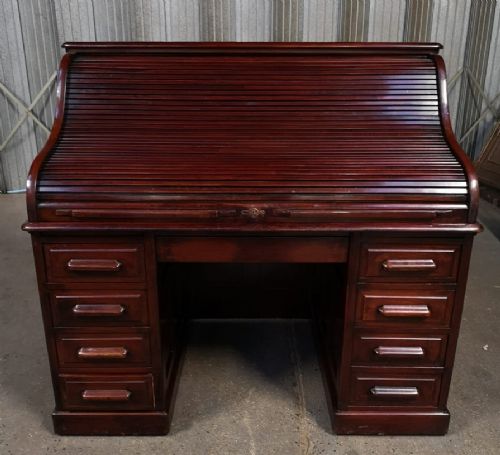
An executive roll top desk is a workspace centrepiece offering concealed storage and security through a slatted tambour.
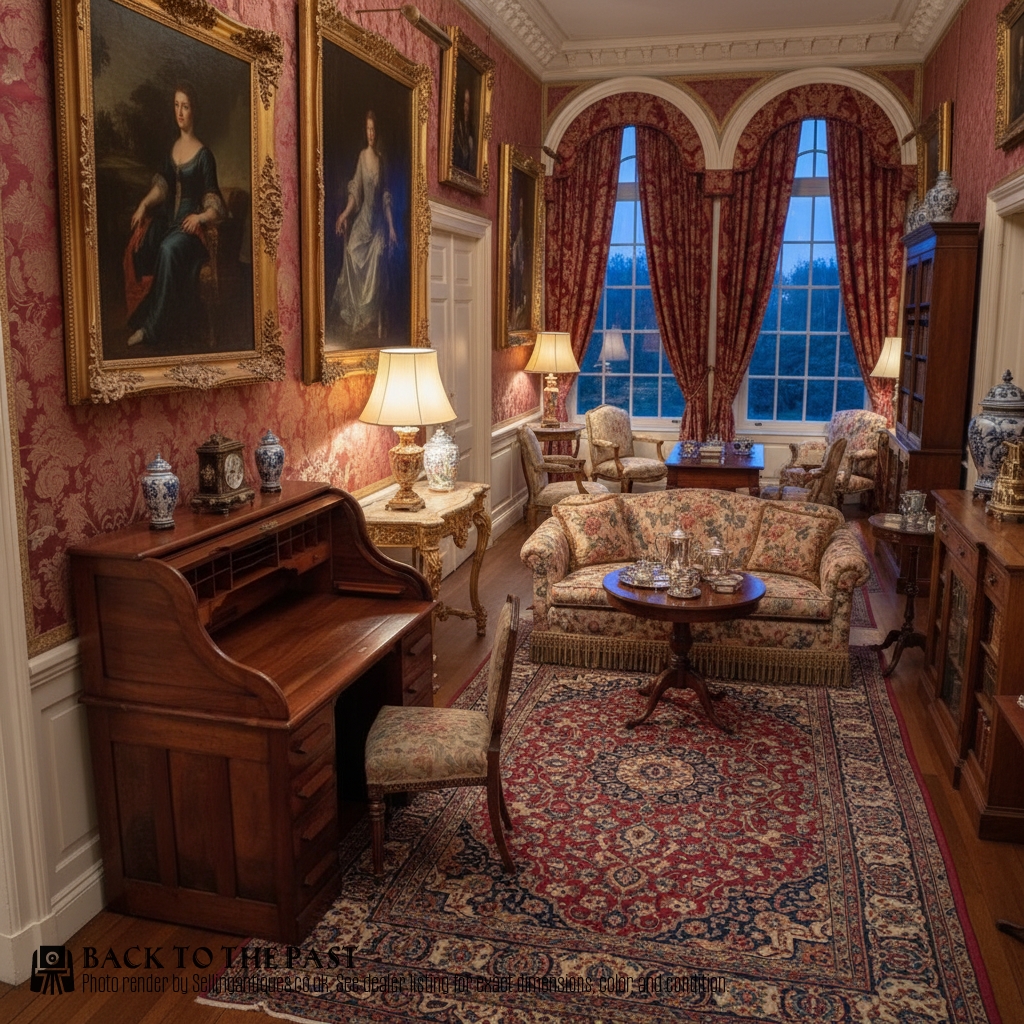
Executive Roll Top Desk
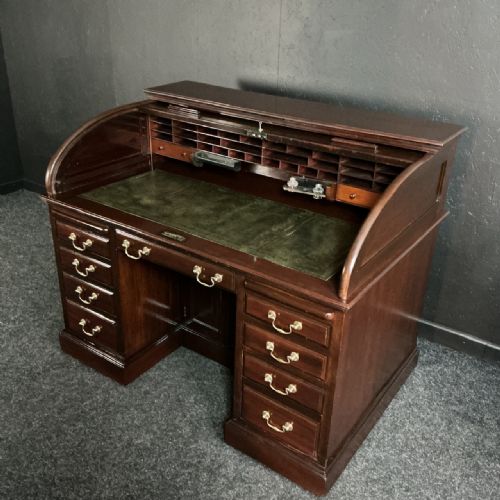
When you search for an executive roll top desk, you encounter substantial writing furniture designed for private administration and paper management. These large pieces provide enclosed compartments, pigeonholes, and drawers that disappear behind a flexible wooden shutter when pulled downward.
The versions you are most likely to meet on this page span the Victorian and Edwardian eras, running from the mid-nineteenth century into the early twentieth century. They originate primarily within British workshops and occasionally from American makers, reflecting the grand office tastes of the period.
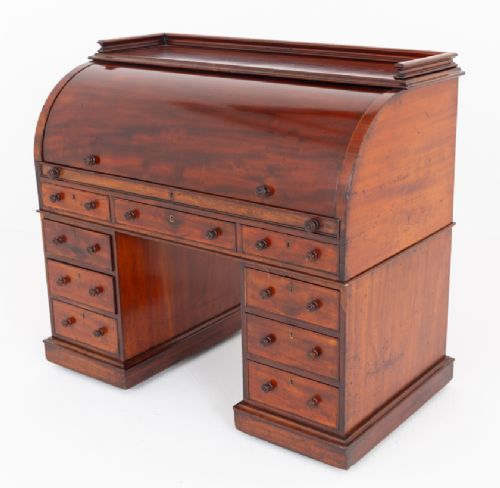
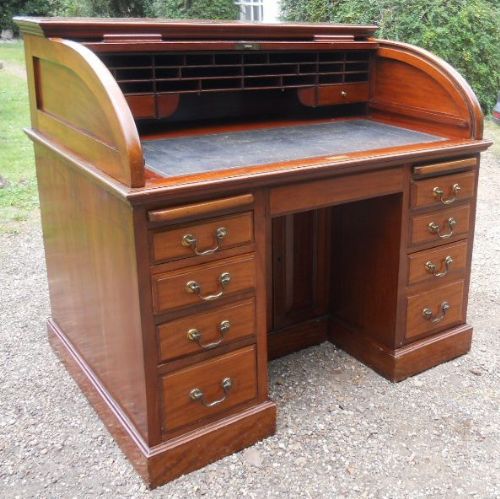
Most examples take the form of kneehole desks or heavy cylinder desks constructed on a grand scale. They serve today as commanding focal points in studies and home offices, combining architectural presence with practical working surfaces.
How they were made
Makers built these desks using solid timbers like mahogany and walnut, frequently applying burr walnut and satinwood veneers to prominent surfaces. Brass hardware appears on drawer pulls and locks, while writing surfaces are traditionally inset with panels of leather.
The defining mechanical feature relies on tambour construction, where narrow strips of wood are glued to a sturdy canvas backing to allow the flexible shutter to glide smoothly along concealed grooves. This intricate joinery required precise hand-fitting to ensure the roll mechanism operated without binding.
Listings feature pieces spanning the Victorian and Edwardian periods, utilising mahogany, walnut, burr walnut, and satinwood.
What varies in quality
Quality in these desks rests upon the selection of timber figures and the structural integrity of the internal pigeonhole arrangement. Finer pieces display carefully matched burr veneers and secondary woods of high grade throughout the drawer linings.
The smoothness of the tambour action and the complexity of the internal locking mechanisms also separate standard production from superior craftsmanship. Desks that incorporate intricate stationery compartments and robust, original brass fittings command greater appreciation.
Boston Chair Company
The Executive Roll Top Desk Glossary
- Tambour
- A flexible shutter made from narrow wooden slats attached to canvas, allowing it to slide around a curved track to cover the desk interior.
- Cylinder desk
- A writing table featuring a quarter-circle solid wooden roll top rather than a slat-based tambour.
- Kneehole desk
- A freestanding desk with a central recess for the sitter's legs, flanked by pedestals of drawers.
- Pigeonhole
- A small compartment within the desk superstructure used for sorting letters and documents.
- Burr walnut
- Wood taken from a tree growth or burl, prized for its swirling, highly figured grain pattern.
Executive Roll Top Desk: Frequently Asked Questions
What is an executive roll top desk?
An executive roll top desk is a large, freestanding piece of antique office furniture featuring a slatted wooden tambour that pulls down to conceal the working surface and internal compartments.
These desks were designed for nineteenth and early twentieth-century professionals who required secure storage for confidential papers and writing materials.
How do cylinder desks differ?
Cylinder desks utilise a solid curved wooden lid that rotates on a track rather than the flexible slatted tambour found on standard roll top desks.
Both forms offer secure enclosed storage, but cylinder desks present a smooth, unbroken curve of polished timber when closed.
What materials were used?
These desks are constructed primarily from dense hardwoods like mahogany and walnut, often enhanced with decorative veneers such as burr walnut and satinwood.
Interior writing surfaces are typically lined with leather, and drawers are finished with brass hardware and working locks.
How should I care for one?
Keep the desk away from direct heat sources and strong sunlight to prevent the timber veneers from drying out and the leather insert from cracking. Regular dusting and occasional application of appropriate furniture wax will preserve the finish of the wood.