
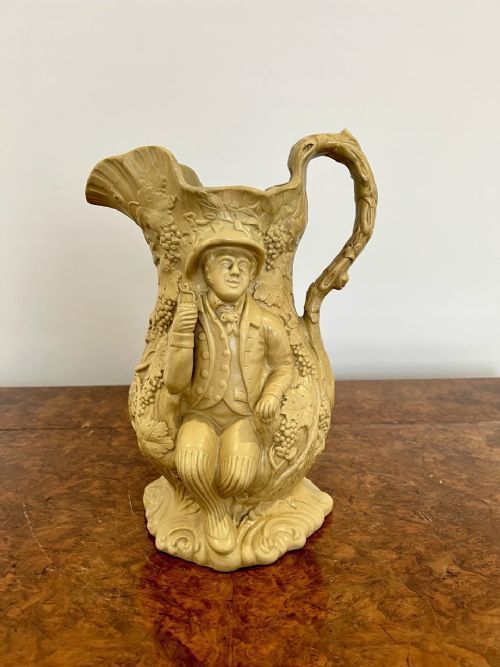


Victorian Relief Moulded Jug
These victorian relief moulded jug examples are pressed or cast ceramic vessels carrying classical, rustic or historic ornament, bought for their bold architectural surface texture.
Victorian Relief Moulded Jug
When you search for a victorian relief moulded jug, you encounter nineteenth century ceramic vessels defined by raised motifs standing proud of the body. The selection on this page centres primarily on Victorian earthenware, stoneware and majolica examples produced across the nineteenth century.
Forms range from milk jugs and pitchers to large exhibition pieces, alongside sets of graduated jugs. The decorative vocabulary draws heavily on classical revival, gothic and naturalistic themes, including dancing figures, bacchanalian scenes and botanical subjects.
Most pieces date from the Victorian era, with specific pieces attributed to decades spanning from eighteen hundred through to the turn of the twentieth century. These vessels served practical pouring roles while functioning as ornamental table or sideboard displays.
Materials and production
Potters utilised earthenware, stoneware and white stoneware, applying glazes, salt glaze or majolica finishes to seal and colour the body. Black basalt pottery and parian body compositions also appear among the listed techniques.
Moulds pressed or cast the elaborate raised ornamentation directly into the wet clay body before firing. Applied sprigged stoneware details and metal pewter lids or mounts complete the construction of specific pitchers.
Victoria and Wellington once shared space on a large gallon jug, immortalising political giants in heavy stoneware.
Judging quality
Quality rests upon the crispness of the moulded relief and the depth of the modelling, where sharp contours reveal superior workshop execution. Finer pieces demonstrate careful control during the pressing process, ensuring motifs remain distinct from the background.
The choice of body and glaze application dictates the visual weight of the vessel, from delicate parian and sage green tones to robust salt glazed stoneware. Scale and ambition also separate standard milk jugs from large exhibition pieces.
Charles Meigh·Ridgway and Sons·Jones and Walley·Minton·George Jones
The Victorian Relief Moulded Jug Glossary
- Relief moulded
- A ceramic production technique where motifs are pressed in sharp three dimensional projection from the vessel wall. This method allowed potteries to achieve intricate architectural and figurative decoration efficiently.
- Stoneware
- A hard, dense, vitrified ceramic fired at high temperatures to achieve impermeability without a full glaze. Salt glaze and white stoneware variants are common in this category.
- Majolica
- A colourful lead-glazed earthenware pioneered by nineteenth-century potteries to produce vibrant botanical and figurative designs. The glaze pools richly over moulded surfaces.
- Parian
- A fine white unglazed biscuit porcelain resembling marble, utilised primarily for ornamental jugs and figures. It takes its name from Greek Paros marble.
- Sprigged
- A decorative method where separately moulded clay reliefs are applied by hand to the surface of an unfired vessel using slip as an adhesive.
Victorian Relief Moulded Jug: Frequently Asked Questions
What were these jugs used for?
These vessels served practical dining table functions, pouring milk, water or larger volumes of liquid during household meals.
Larger exhibition pieces and decorative jugs were equally intended for display on sideboards or mantelpieces to showcase contemporary ceramic design.
How do I date a jug?
Dating relies on stylistic markers such as Victorian classical revival motifs, gothic elements, or registration marks impressed into the base by the pottery.
The choice of material, from early nineteenth-century salt glaze to later majolica finishes, also helps narrow the period of manufacture.
Are these pieces waterproof?
Stoneware and glazed earthenware vessels are generally fully vitrified or sealed, making them suitable for holding liquids in everyday use.
Parian and unglazed bodies are better suited for decorative display rather than holding water.
How do I clean them?
Dust gently with a soft brush and wash by hand in warm water using mild soap when cleaning is necessary.
Avoid harsh scrubbing or soaking to protect the raised relief details and delicate nineteenth-century glazes.