
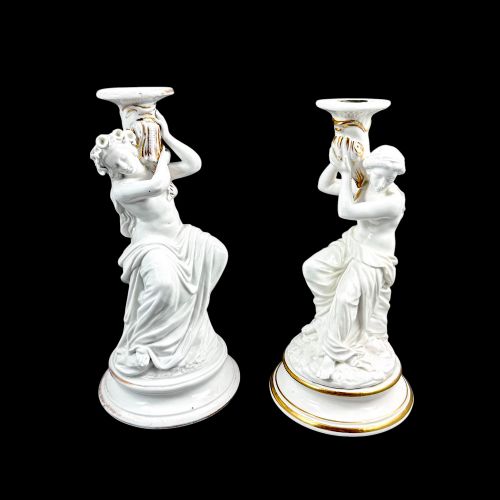


Victorian Porcelain Candleholders
Victorian porcelain candleholders bring tactile elegance to a room, combining painted ceramic bodies with classical forms and gilt detail.
Victorian Porcelain Candleholders
Most examples take the form of figural candlesticks or substantial candelabra employing hard-paste porcelain and enamel decoration. Styles range from spirited Rococo Revival designs to restrained Victorian Neoclassical interpretations.
How they were made
Makers shaped hard-paste porcelain through careful moulding before applying detailed enamels and hand-painted motifs. Many examples integrate gilt bronze or brass fittings to support multiple candle arms.
Gold leaf and hand-applied gilding accent high-relief modelled figures and scrollwork, requiring precise kiln firing to bond the metallic highlights to the porcelain body.
The listings on this page span the nineteenth century, incorporating Victorian, 1880, and 1890 periods alongside materials like gold leaf and hard-paste porcelain.
What varies in quality
The sophistication of the modelling distinguishes standard production from superior artistic output. Figurative pieces with finely rendered facial expressions and intricate drapery demonstrate greater workshop skill.
The crispness of the gilding and the delicacy of the enamel work determine overall visual depth. Complete sets with matching factory marks and integrated metal mounts hold a stronger presence.
Sutherland And Sons·Meissen Porcelain·Sitzendorf Porcelain·Triebner Ens And Eckert·Minton Porcelain·Royal Worcester Hadley
The Victorian Porcelain Candleholders Glossary
- Hard-paste porcelain
- A dense, durable ceramic material fired at high temperatures using kaolin and petuntse. It provides a smooth, impervious surface ideal for detailed enamel painting.
- Candelabra
- A branched candlestick designed to hold multiple candles at once. These multi-armed lighting devices often feature removable branches for single-candle use.
- Gilding
- The application of gold leaf or powdered gold to the surface of porcelain or metal mounts. This technique adds reflective contrast to the fired ceramic colours.
- Rococo Revival
- A nineteenth-century design movement drawing inspiration from eighteenth-century French ornamentation. It is characterised by asymmetrical scrolls, naturalistic foliage and fluid forms.
Victorian Porcelain Candleholders: Frequently Asked Questions
How do I clean antique porcelain candleholders?
Dust gently with a soft, dry brush to prevent accumulation in crevices and around delicate figural elements. Avoid abrasive cleaners and harsh immersion in water, particularly where gilt surfaces or metal mounts are present.
Take care around painted enamel details, as aggressive wiping can dull the original colours. A slightly damp cloth should only be used on unglazed porcelain areas if necessary.
Can I use real candles in these candelabra?
Standard wax candles fit most antique sockets, though inspecting the aperture width is prudent before lighting. Ensure candles remain secure and upright to prevent hot wax from dripping onto fragile porcelain or gilt surfaces.
Extinguish candles before they burn down close to the socket to protect the ceramic and any integrated metal fittings from heat damage.
How do I distinguish continental porcelain from English pieces?
Continental factories like Meissen and Sitzendorf often employed hard-paste porcelain with distinct underglaze blue marks and complex figural modelling. English manufacturers such as Minton and Royal Worcester utilised refined bodies and specific stylistic traits typical of Staffordshire and Midland potteries.
Examining the base and interior of the piece frequently reveals characteristic kiln marks or factory stamps that clarify the origin.
What defines the Rococo Revival style in these pieces?
Rococo Revival candleholders feature asymmetrical scrolls, shell motifs and organic floral elements reminiscent of eighteenth-century French design. Figures incorporated into the stems often wear theatrical or pastoral attire amidst swirling foliage.
This aesthetic prioritises movement and decorative exuberance over strict symmetry, making the pieces prominent visual accents in a room.