



Victorian Porcelain Candelabras
These Victorian porcelain candelabras bring nineteenth-century lighting and ornament together, offering sculptural grace and floral detail for any mantelpiece or table.
Victorian Porcelain Candelabras
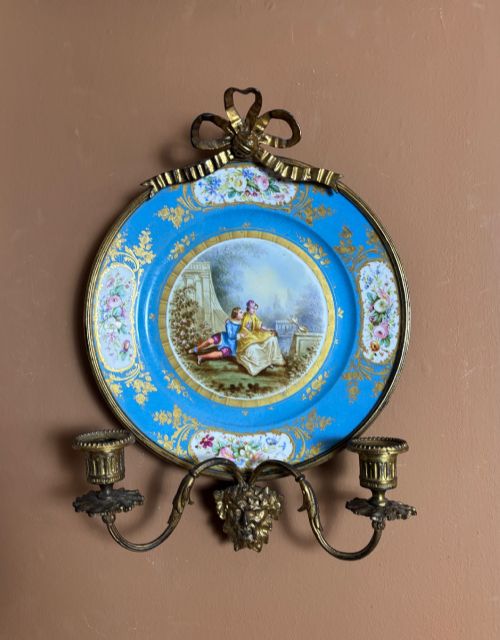
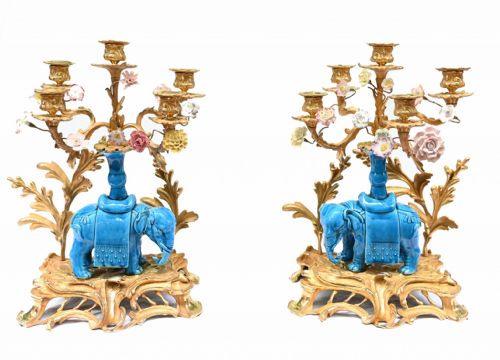
When you search for Victorian porcelain candelabras, you are looking at nineteenth-century branched lighting fixtures that combine ceramic figures or bodies with metal mounts. The selection on this page ranges from pairs of figural pieces to complete clock garnitures incorporating matching candelabras. Most examples draw upon French Rococo Revival styles or nineteenth-century continental manufacturing traditions.
The forms span multi-arm table candelabras, wall sconces, and converted vases fitted with branches. Many pieces originate from renowned factories such as Meissen, Sevres, Dresden, and Royal Worcester, often featuring allegorical figures or hand-painted details. These items functioned primarily as decorative centerpieces for wealthy Victorian drawing rooms rather than utilitarian light sources.
How they were made
Manufacturers shaped hard-paste porcelain through moulding and manual throwing, applying enamel colours and gold leaf or gilding before firing. Artisans then mounted the finished ceramic bodies into ormolu, gilt bronze, or gilded metal frames. Many branch assemblies were cast in sections and screwed together to support multiple candle nozzles securely.
Individual factories employed specialised painters for floral motifs and figural scenes, which received a secondary low-temperature kiln firing to set the enamels. Gilt elements often underwent mercury gilding or gold leaf application to achieve a durable metallic sheen alongside the glossy porcelain glaze.
Listings feature 19th Century, Victorian, 1860, 1870, 1880, 1890, and 1920 periods alongside materials including porcelain, enamel, ormolu, and gilded metal.
What varies in quality
The refinement of the modeled figures and the crispness of the hand-painted enamel work separate exceptional examples from standard production pieces. Superior items display delicate, naturalistic hand-modeling in the porcelain foliage and distinct facial expressions on figural groups rather than coarse, generic moulding.
The weight and chasing of the ormolu or gilded metal mounts also determine the grade of a candelabra. Heavily cast, finely chased bronze mounts indicate higher production costs and greater workshop investment, whereas lighter stamped metal frames suggest commercial output.
Royal Worcester·James Hadley·Meissen·Sitzendorf·Helena Wolfsohn·Dresden
The Victorian Porcelain Candelabras Glossary
- Candelabra
- A branched lighting fixture designed to hold multiple candles. These objects typically feature a central stem branching into two or more arms.
- Ormolu
- Finely ground high-carat gold applied to a bronze base using a mercury amalgamation process. This technique produces a deep, durable metallic finish found on many nineteenth-century mounts.
- Garniture
- A set of matching decorative objects designed to be displayed together on a mantelpiece. A typical nineteenth-century set includes a central clock flanked by two candelabras or vases.
- Hard-paste porcelain
- A dense, durable ceramic composed of kaolin and petuntse, fired at very high temperatures. It resists scratching and accepts bright enamel colours.
- Rococo Revival
- A nineteenth-century design style mimicking the asymmetrical scrolls, C-curves, and naturalistic flora of the eighteenth-century French Rococo movement.
Victorian Porcelain Candelabras: Frequently Asked Questions
How do I clean porcelain candelabras?
Use a soft brush to remove dust from delicate porcelain flowers and intricate figural elements without applying liquid directly to painted surfaces.
Avoid abrasive cleaners or chemical solvents that can damage antique enamel and thin gilding on the ceramic body.
What is a clock garniture?
A clock garniture is a matching decorative set consisting of a central mantel clock accompanied by two side pieces, such as candelabras or vases.
These coordinated ensembles were created to ornament nineteenth-century chimneypieces as unified decorative statements.
Are these candelabras functional for lighting?
While these pieces were originally designed to hold candles for illumination, many collectors use them purely for display to preserve their fragile enamel and gilt surfaces.
If you choose to burn candles, use standard taper sizes and monitor them closely to prevent wax drips from damaging the antique glaze or metal mounts.
How do I identify Meissen porcelain?
Meissen pieces often feature the underglaze blue crossed swords mark, which indicates production at the historic German factory.
Stylistic markers include finely modeled figures, intricate hand-painted floral decoration, and high-quality gilding typical of nineteenth-century output.