
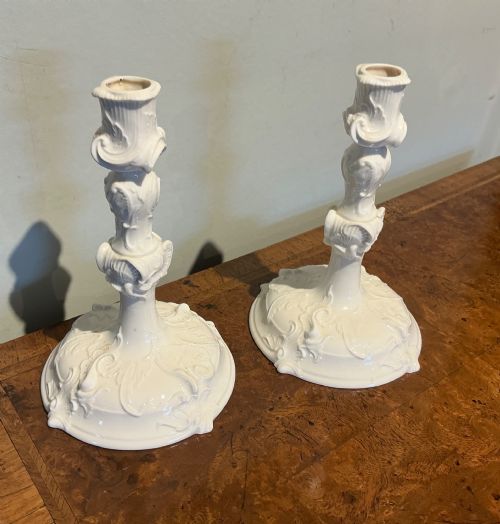


German Porcelain Candleholders
German porcelain candleholders bring figurative elegance and vibrant hand-painted colour to a room, offering rich historical craftsmanship for any interior.
German Porcelain Candleholders
When you search for german porcelain candleholders, you are looking at decorative and functional pieces designed to hold taper candles, often featuring elaborate figural and botanical ornamentation. These objects date across the nineteenth and early twentieth centuries, spanning periods from eighteen eighty to nineteen thirty.
The versions you are most likely to meet on this page take the form of single candlesticks or multi-armed candelabra. They frequently depict pastoral figures, gardeners, shepherds, and hunting scenes styled in the Rococo Revival and Edwardian novelty traditions.
Originating from established European ceramic centres, these pieces demonstrate a rich heritage of porcelain manufacture. Collectors prize them for their sculptural detail and the distinct artistic character imparted by each historic German factory.
How they were made
These items rely on hard-paste porcelain fired at high temperatures to achieve a durable and refined white ceramic body. Artisans then shaped the clay by hand, moulding intricate figural elements and applied floral bases before the initial kiln firing.
Makers applied glaze, enamel paint, and gold leaf or gilt accents by hand across the surface details. Subsequent low-temperature firings fixed the polychrome enamels and metallic leaf firmly to the glazed porcelain body.
Hunting foxes and attentive shepherdesses keep a watchful eye over the dining table, proving that historical lighting could possess a theatrical personality.
What varies in quality
The division between standard and superior pieces rests upon the crispness of the modelled detail and the precision of the hand-painted enamel work. Finer examples display deeply undercut floral applications and delicate facial expressions on the figural subjects rather than softened contours.
The application of gold leaf and the complexity of multi-arm candelabra structures further distinguish the upper tiers of manufacture. Better workshops maintained rigorous standards in both sculpting and the control of kiln temperatures during the gilding process.
Nymphenburg·Meissen·Sitzendorf·Triebner ENS and Eckert Volkstedt·Royal Bayreuth
The German Porcelain Candleholders Glossary
- Hard-paste porcelain
- A dense, vitrified ceramic composition fired at very high temperatures using kaolin and petuntse. This material provides the robust white foundation characteristic of fine European tablewares and figures.
- Enamel paint
- A glossy, vitrifiable pigment applied over the glazed surface to introduce vibrant colour. Artisans fire the piece a second time to fuse these pigments permanently with the glaze.
- Gilt
- A thin layer of gold applied to surface details and highlights. This decorative finish enhances the sculptural relief of the porcelain under candlelight.
- Rococo Revival
- A nineteenth-century design style mimicking the ornate, asymmetrical scrolls and naturalistic motifs of the eighteenth-century movement. It dominates the decorative vocabulary of many nineteenth-century figural candlesticks.
German Porcelain Candleholders: Frequently Asked Questions
What are german porcelain candleholders?
These pieces are glazed ceramic candle supports modelled into figurative scenes or floral arrangements. They were produced in European factories during the nineteenth and early twentieth centuries.
Craftsmen shaped the porcelain by hand and decorated the surfaces with enamel paints and gold leaf. They function both as lighting accessories and as decorative tabletop sculptures.
How were they used?
Owners placed them on dining tables, mantelpieces, and sideboards to provide ambient illumination during evenings. The multi-arm candelabra held several taper candles to project stronger light across formal rooms.
Beyond illumination, they served as prominent status symbols and decorative centrepieces in bourgeois and aristocratic interiors. Their elaborate figural subjects often acted as conversation pieces for guests.
How do I live with them?
Position them on stable surfaces away from high-traffic areas to protect their delicate hand-modelled porcelain flowers and protruding limbs. Keep them away from direct sunlight to preserve the vibrancy of the enamel colours.
Clean the surfaces gently using a soft, dry brush to remove dust without disturbing the gilt highlights. Avoid using liquid cleaners or submerging the pieces in water.
How do I tell periods apart?
Examine the stylistic cues and decorative motifs to estimate the era of manufacture. Pieces featuring heavy asymmetrical scrolls and rustic figural groups often align with nineteenth-century Revival styles.
Later items from the early twentieth century introduce novel thematic subjects, such as hunting dogs and specific animal figures. Factory marks stamped or painted on the underside provide the most reliable chronological indicator.