




Victorian Papier Mache Furniture
Victorian papier mache furniture brings brilliant lacquer, gilt and mother-of-pearl inlay into the home on tables, trays and chairs.
Victorian Papier Mache Furniture
Victorian papier mache furniture encompasses practical domestic items produced across the nineteenth century, blending utility with decorative flair. Buyers searching this phrase encounter pieces designed for versatile placement in reception rooms and parlours, including tray tables, occasional tables, work tables and sewing tables.
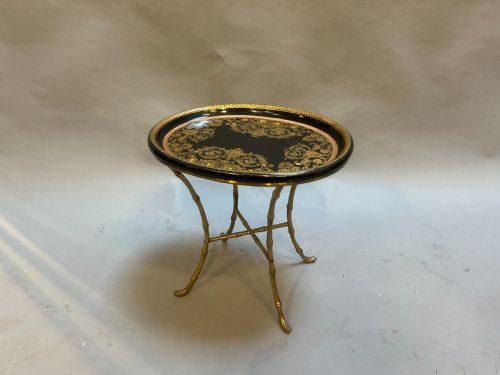
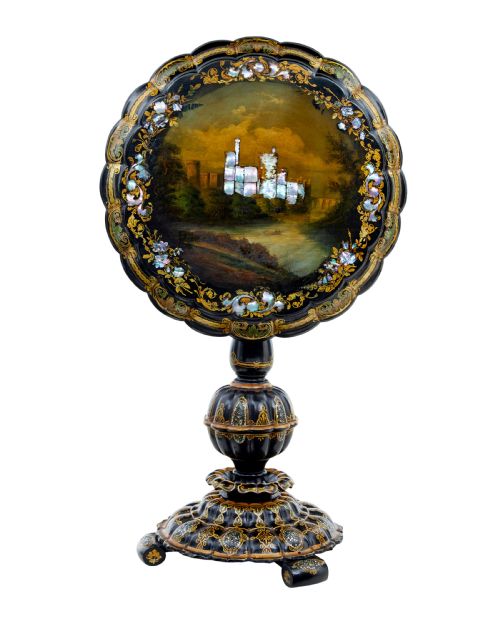
The most common forms on this page are tray tables and tilt-top tables, often supported by stands or pedestals. These items demonstrate the nineteenth-century taste for portable and multi-functional furnishings that could be moved easily around the home.
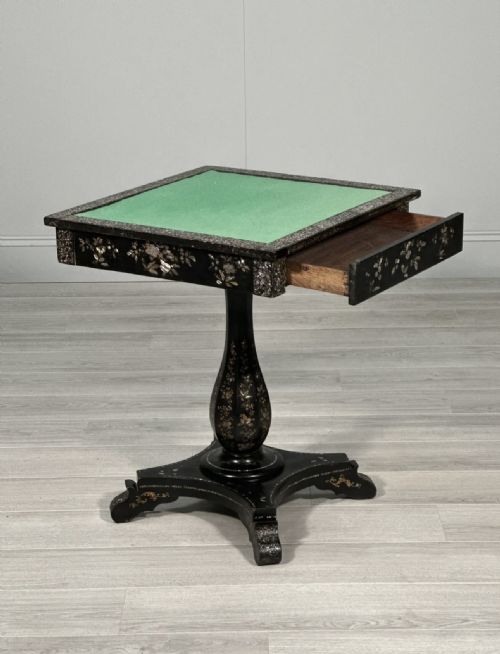
Seating and specialised items also appear, ranging from games tables and side chairs to pole-screens and children's chairs. The construction combines papier-mache components with wood frames or later stands, reflecting both original domestic usage and subsequent adaptation.
Materials and construction
Maker workshops built these pieces using moulded papier-mache combined with wood for structural stability. The base material was finished with smooth lacquer surfaces ready for ornamentation.
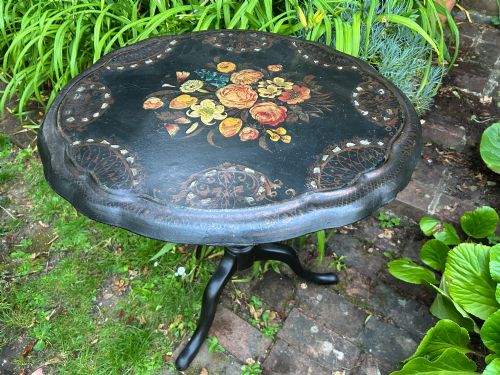
Decoration relied heavily on paint, gilt work and inlaid mother-of-pearl to create reflective, luminous finishes. Chinoiserie designs feature prominently, executed with intricate painted details that stand out against dark ebonised backgrounds.
Assessing quality
Quality reveals itself in the precision of the mother-of-pearl inlay and the delicacy of the painted Chinoiserie motifs. Superior examples maintain crisp detail in their decorative schemes and solid integration between the papier-mache top and its wooden support.
The condition of the lacquer surface distinguishes finer pieces from ordinary examples, as does the originality of the stand. Tables retaining their early tilt-top mechanisms and untouched painted decoration represent the higher end of the range.
The Victorian Papier Mache Furniture Glossary
- Papier-mache
- A composite material made from paper pulp or layers of paper reinforced with glue, pressed and dried into sturdy forms for furniture production.
- Chinoiserie
- European artistic style reflecting Chinese motifs and scenes, popular in nineteenth-century decorative painting and lacquer work.
- Tilt-top table
- A table with a hinged top that pivots vertically to save space when not in active use.
- Mother-of-pearl
- Iridescent inner layer of mollusc shell, cut into thin pieces and embedded into lacquer surfaces for decorative contrast.
- Pole-screen
- A vertical screen mounted on a pole with a tripod base, used to deflect radiant heat from a fireplace away from a person's face.
Victorian Papier Mache Furniture: Frequently Asked Questions
What is Victorian papier mache furniture?
It consists of nineteenth-century household items formed from reinforced paper pulp and finished with lacquer, paint and mother-of-pearl inlay.
These objects include occasional tables, tray tables, games tables and chairs designed for decorative display and light daily use.
How do you use these tables today?
Tilt-top tables and tray tables serve well as bedside stands, lamp tables or decorative surfaces in sitting rooms.
Their lightweight construction makes them easy to reposition, though they require care to protect their historic lacquer and inlay.
Are these pieces waterproof?
No, nineteenth-century lacquer and painted finishes can be damaged by standing water or excessive moisture.
Coasters and protective mats are essential if placing drinks or potted plants on these surfaces.
How can you tell a tray on a stand from a standard table?
Many items combine an original papier-mache serving tray with either an authentic period stand or a later support constructed to display the tray.
Looking at the joinery and finish where the tray meets the base helps determine if the stand is contemporary to the top.