



Victorian Orientalist Table
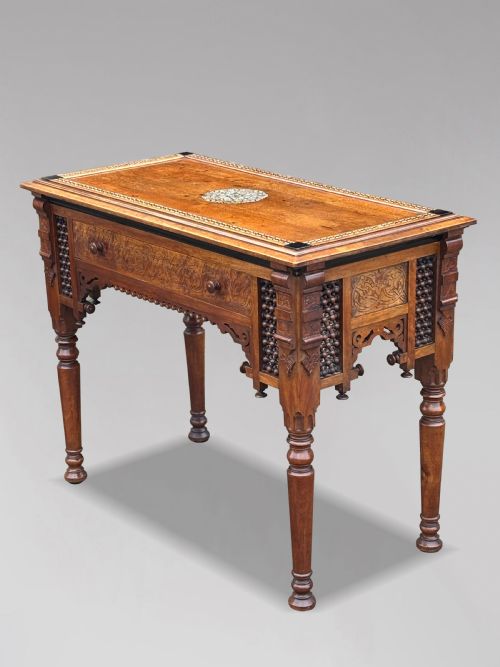
These Victorian orientalist table pieces bring rich Moorish, Syrian and Arabic revival work into a room through intricate inlay and carved geometric forms.
Victorian Orientalist Table
A Victorian orientalist table is typically a side, occasional, centre or games table decorated with motifs drawn from Middle Eastern, North African and Islamic design traditions. When you search this phrase, you encounter forms that reflect the nineteenth-century fascination with Eastern aesthetics, spanning Moorish, Mamluk and Ottoman influences.
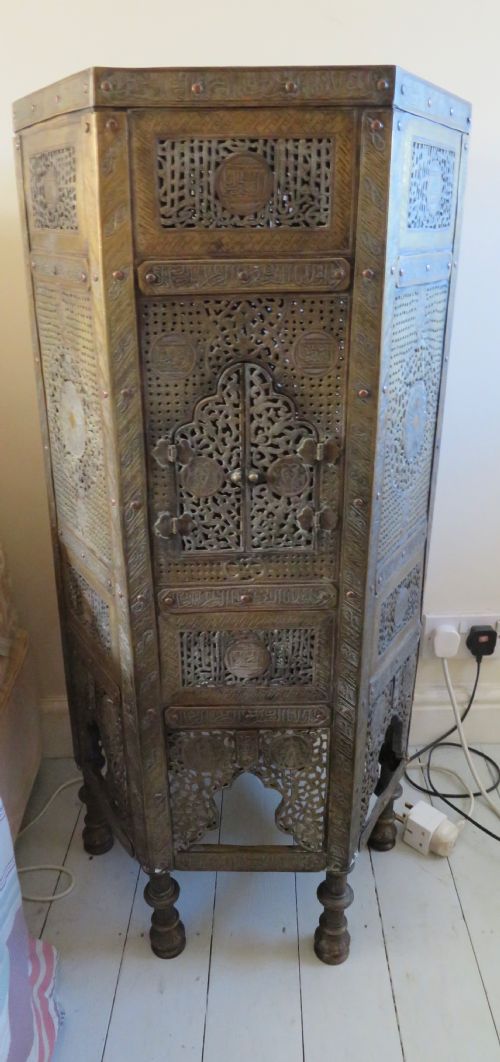
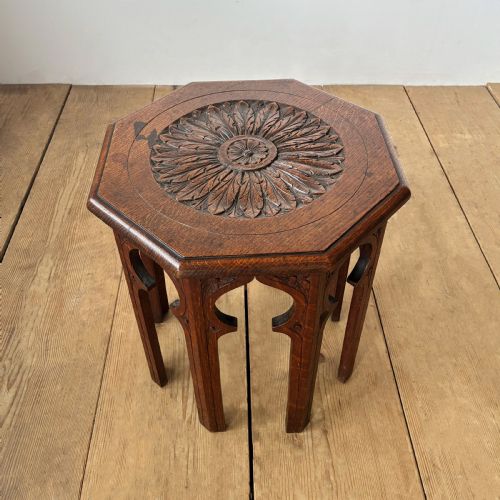
The objects seen here range from hexagonal occasional tables and octagonal forms to chess tables and low coffee or camel tables. Many pieces date from the late nineteenth century, reflecting the peak of Aesthetic Movement and revivalist tastes in British and European interiors.
How they were made
Makers constructed these tables from dense timbers such as walnut, ebonised wood, oak and various hardwoods, providing a sturdy foundation for decorative surface work. Many pieces incorporate intricate geometric joinery and openwork construction.
Surfaces receive elaborate ornamentation through the application of mother-of-pearl, bone, brass and white-metal inlays, often combined with hand carving. Certain brass examples utilise copper inlay techniques, characteristic of Cailoware production methods.
Listings feature walnut, ebonised wood, oak and various hardwoods, combined with mother-of-pearl, bone and brass inlay.
What varies in quality
Quality in these tables rests primarily upon the precision and complexity of the inlay work and the depth of the hand carving. Pieces featuring dense, finely cut mother-of-pearl, bone and metal wire set flush into the timber show a higher degree of artisan skill.
The structural integrity of the intricate openwork and lattice joints also dictates the standard of the piece. Well-preserved surfaces retain their original contrasting materials without significant shrinkage or loss in the detailed geometric patterns.
Liberty and Co·Thomas Allen Design
The Victorian Orientalist Table Glossary
- Moorish Revival
- An architectural and decorative style that draws inspiration from the medieval Moorish architecture of Spain and North Africa. It frequently appears in nineteenth-century furniture through horseshoe arches and geometric lattice patterns.
- Mamluk Revival
- A design style inspired by the art and metalwork of the Mamluk Sultanate in Egypt. This aesthetic is often characterised by heavy brass work with intricate inlaid decoration.
- Occasional table
- A small, light table designed for flexible use in a reception room or parlour. These pieces were popular in the late nineteenth century for displaying ornaments or holding drinks.
- Inlay
- A decorative technique where small pieces of contrasting materials such as bone, mother-of-pearl or metal are embedded into the wood surface to form patterns. The best examples fit flush with the timber base.
- Cairoware
- Nineteenth and early twentieth-century metalwork produced in Cairo, typically made of brass with inlaid copper and silver ornamentation. It became highly sought after by European collectors during the orientalist revival.
Victorian Orientalist Table: Frequently Asked Questions
What is a Victorian orientalist table?
A Victorian orientalist table is a piece of nineteenth-century furniture influenced by Middle Eastern and North African design. These items incorporate decorative techniques like intricate inlay and geometric carving.
They reflect the period's broad fascination with Eastern and Islamic art, often blending traditional forms with European furniture requirements.
How do I style a Moorish table?
These tables work well as statement pieces in a living room or study, providing a strong textural contrast to modern upholstery. Their rich wood tones and inlaid surfaces pair effectively with simple, neutral surroundings.
Keep decorative items on the surface minimal to allow the detailed geometric patterns and mother-of-pearl or bone inlay to remain the visual focus.
What materials are used on these tables?
The structural frames are typically fashioned from walnut, oak, ebonised wood or general hardwoods. These provide a stable base for the complex decorative elements.
Surface enrichment relies on detailed hand carving alongside contrasting inlays of mother-of-pearl, bone, brass and white-metal wire.
How do I tell different revival styles apart?
Moorish revival pieces often feature dense geometric woodwork, openwork arches and lattice structures. Mamluk revival items lean heavily towards brass work and specific Islamic metalwork motifs.
Looking at the combination of materials helps clarify the origin, as Syrian and Egyptian workshops favoured different inlay compositions compared to European firms like Liberty.