


Victorian Oil Painting Venice
These Victorian oil painting venice works capture the light and architecture of the lagoon through nineteenth-century brushwork.
Victorian Oil Painting Venice
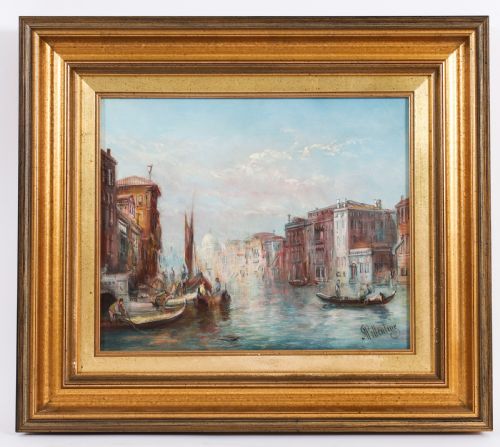
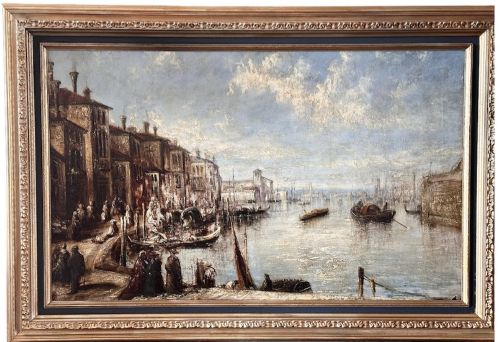
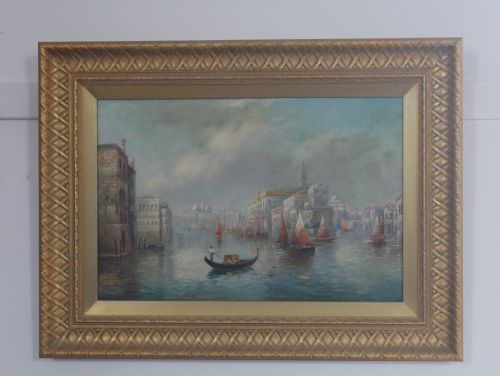
A Victorian oil painting venice captures famous sights such as the Grand Canal, the Doge's Palace, the Dogana, and the church of Santa Maria della Salute. These works record the bustling waterways and historic palazzos that fascinated nineteenth-century travellers and artists.
Most pieces on this page belong to the nineteenth century, spanning decades from the eighteen-seventies to eighteen-ninety. They take the form of framed oil paintings on canvas, often depicting sweeping townscapes under bright or atmospheric skies.
Certain canvases turn away from grand canals to focus on figures or theatrical subjects connected to the city. These include portraits of characters like Shylock from the Merchant of Venice, or aristocratic sitters linked to Italian settings.
Judging the standard of the work
Quality rests on the handling of light and architectural perspective across the Venetian lagoon and its monuments. A stronger painting shows confident brushwork in the rendering of water reflections and stone facades.
The choice of original frame contributes significantly to the integrity of the piece. Giltwood surrounds that retain their original gilding elevate the presentation of nineteenth-century canvas works.
One canvas even captures a sombre procession down the Grand Canal, recording a nineteenth-century Venetian funeral.
Alfred Pollentine·Francis Moltino·F.D. Campo·Jane Vivian·William Raymond Dommersen
The Victorian Oil Painting Venice Glossary
- Canvas
- A heavy woven fabric stretched across a wooden frame to serve as the foundation for oil painting. It provides a textured surface that holds layered pigment.
- Giltwood
- Wood carved and coated with a thin layer of gold leaf or gold paint. This material is standard for ornate nineteenth-century picture frames.
- Townscape
- A painting that depicts an urban view, focusing on streets, canals, and historic buildings. In Venetian art, these scenes centre on canals and palazzos.
- Oil
- A type of slow-drying paint made with pigments suspended in a drying oil, usually linseed. It allows artists to blend colours smoothly and build luminous glazes.
Victorian Oil Painting Venice: Frequently Asked Questions
What subjects appear in these Venetian paintings?
The canvases predominantly show famous architectural landmarks along the water, including the Grand Canal, the Doge's Palace, and the Dogana.
Artists also recorded specific events on the water, such as a Grand Canal funeral, alongside occasional character portraits linked to Venetian drama.
How do I identify a nineteenth-century frame?
Period frames typically consist of heavy wood finished with gold leaf or giltwood ornamentation. They show distinct construction methods and patination consistent with the Victorian era.
Many of these frames complement the townscape by reflecting light onto the edges of the canvas.
Where were these townscapes painted?
Some artists travelled directly to Italy to paint the lagoons and palazzos on location. Others worked from sketches and studies once they returned to British studios.
Works attributed to certain makers even connect to broader European collections and royal provenance.
How should I hang an oil painting on canvas?
Select a wall away from direct sunlight and steady heat sources to protect both the canvas and the giltwood frame. Ensure the hanging hardware is securely fastened to support the weight of the wood structure.
Keep the room at a stable humidity to prevent the fabric canvas from slackening over time.