
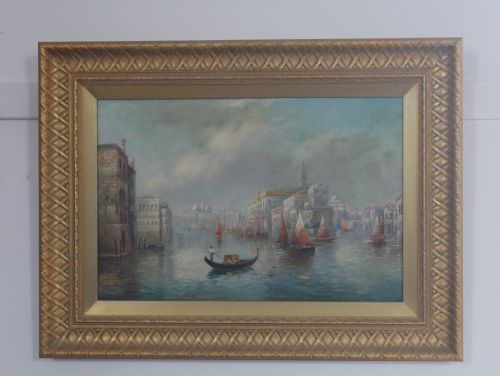


Venice Canal Landscape Painting
A venice canal landscape painting captures the waterborne light and historic palazzos of the lagoon through the eyes of artists drawn to the city.
Venice Canal Landscape Painting
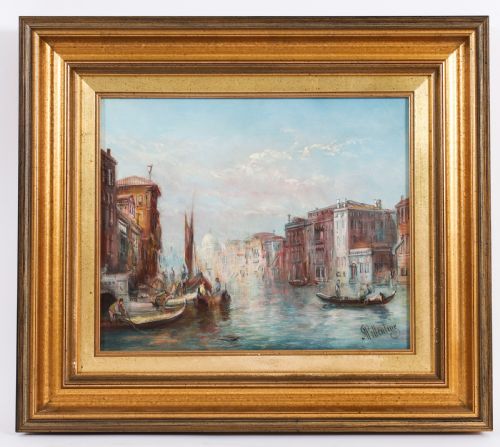
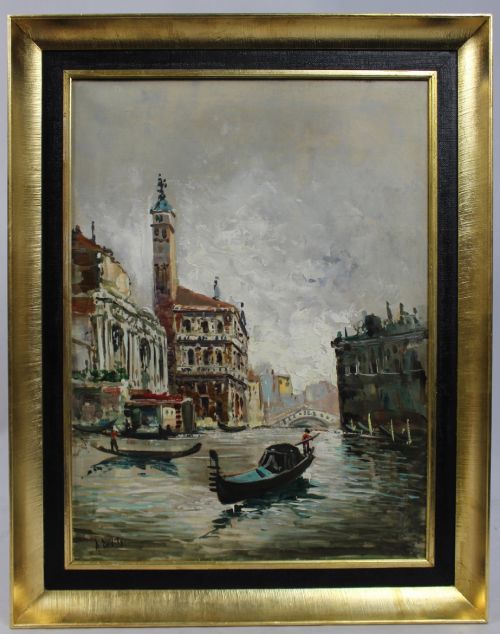
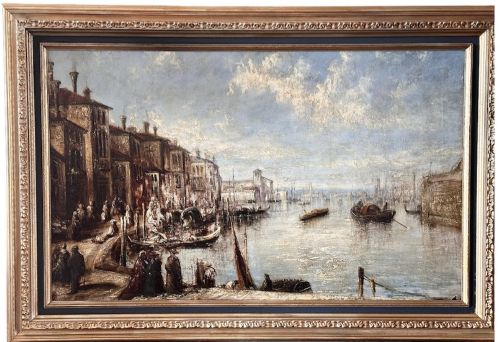
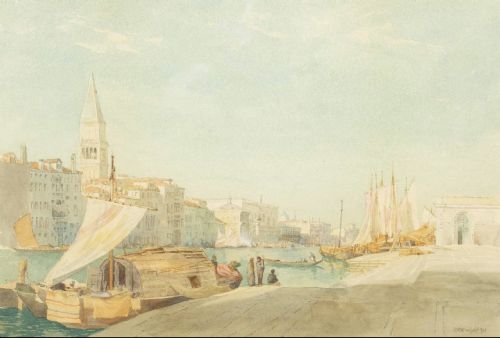
A venice canal landscape painting records the iconic architecture, waterways, and atmospheric light of the floating city through various historical periods.
You are most likely to encounter nineteenth-century oils and watercolours depicting the Grand Canal, the Doge's Palace, and the Santa Maria della Salute.
The selection spans Victorian academic views to mid-century impressionist interpretations executed on canvas, board, or paper.
These works document specific historic topographies, ranging from bustling quaysides with gondolas to quiet architectural studies.
Materials and Techniques
Artists deployed oil paint on canvas or board to build rich textures and deep tones, capturing the shifting reflections on the water.
Watercolour on paper was frequently utilised to achieve translucent washes of light and fluid movement across canal scenes.
Framed pieces often retain period surrounds in giltwood or gilded wood that complement the historic visual style.
Listings feature works spanning the nineteenth century through the mid-twentieth century, executed in oil and watercolour.
Factors of Quality
The handling of natural light and atmospheric haze separates masterly atmospheric depth from rigid architectural illustration.
The precision and confidence of brushwork or watercolour wash dictate the vitality of the water and movement of the gondolas.
The provenance and documented attribution to a known artist elevate the historical significance of the composition.
Alfred Pollentine·Antonio DeVity·Francis Moltino·Richard Henry Wright·F J Aldridge·Claude Jousset·Antonietta Brandeis·Antoine Bouvard Senior·E Perez Senet·Jane Vivian·William Raymond Dommersen·Benedetto Salviati·Hercules Brabazon Brabazon·Frank Wasley·David Law·William Knox·Wilfred Knox·Henry Wimbush·Charles Clement Calderon·Helen Donald-Smith
The Venice Canal Landscape Painting Glossary
- Oil on Canvas
- Pigment bound in a drying oil applied to a stretched woven fabric support. This medium allows for deep colour saturation and layered blending.
- Watercolour
- Pigments suspended in a water-based, translucent solution applied to paper. It relies on the white of the paper to provide luminosity.
- Giltwood
- Wood carved and coated with gold leaf or a gold-coloured finish. It provides an ornate, reflective border popular for framing fine art.
- Impressionism
- A style of painting emphasising light and its changing qualities rather than minute detail. Artists focus on everyday scenes and rapid brushstrokes.
- Gouache
- An opaque water-based paint that includes a white pigment filler, creating a heavier, matte finish compared to standard watercolour.
Venice Canal Landscape Painting: Frequently Asked Questions
How do I date a Venice painting?
Dating relies on costume details of the figures, framing materials, stretcher construction, and signatures recorded in the artist's active period.
Comparative stylistic analysis of the architectural rendering also helps narrow the decade of creation.
What subjects are most common?
The Grand Canal, the Doge's Palace, the Bridge of Sighs, and the Santa Maria della Salute appear most frequently in these historical views.
Artists favoured locations that offered dramatic perspectives of water meeting historic stone facades.
How should I display these works?
Keep framed oils and watercolours away from direct sunlight and damp environments to protect the canvas and paper supports.
Stable indoor humidity preserves both the integrity of the paint layer and the original gilded wood frames.
What is the difference between oil and watercolour?
Oils offer rich, buildable textures on canvas with deep colour saturation and slower drying times.
Watercolours provide luminous, transparent washes on paper that capture fleeting atmospheric light.