
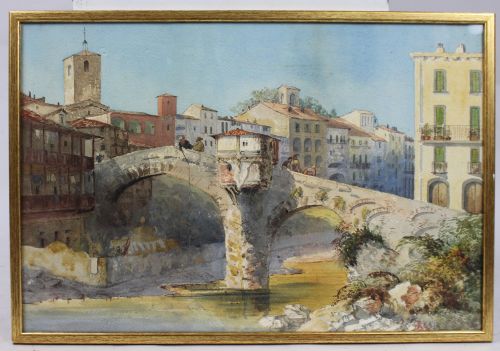
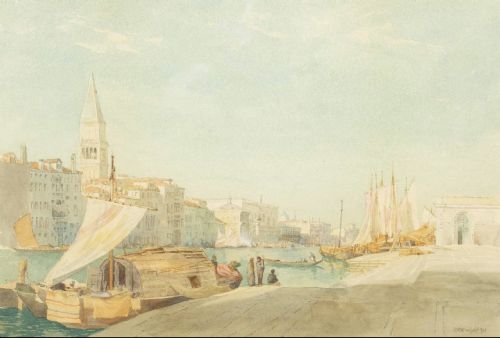
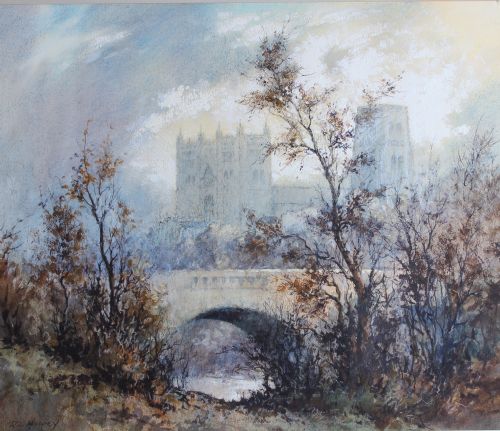


Blue Watercolour Architectural Landscape
A blue watercolour architectural landscape captures solid stone and open sky with fluid pigment, offering a lasting window onto historic streets and grand buildings.
Blue Watercolour Architectural Landscape
A blue watercolour architectural landscape brings together historic buildings, streets and open vistas rendered primarily in blue tones on paper. These pieces range from detailed townscapes and Venetian canals to English country houses and grand monuments.
The works span multiple eras from the nineteenth century through the mid-twentieth century, encompassing Victorian, Edwardian and early British twentieth-century styles. Artists recorded specific sites across Britain and Europe, including London landmarks, French riversides and Italian architecture.
Buyers will encounter both framed paintings behind glass in gilded wood or simple frames and loose architectural prints and drawings. The subject matter balances precise structural drafting with the fluid qualities of water-based pigment.
Materials and technique
Artists painted these works using watercolour pigment suspended in water, applied directly onto paper sheets. This medium allowed creators to build transparent washes for skies and water alongside sharp, controlled lines for stonework and buildings.
Finished works were typically preserved behind glass and housed within wooden frames, occasionally with gilded wood accents to complement the artwork. The combination of delicate paper supports and protective glazing remains standard for these historic pieces.
Listings feature works spanning from the nineteenth century through the mid-twentieth century, created by British and international artists.
Judging quality
Quality rests upon the artist's ability to balance architectural precision with the fluid movement of watercolour paint. Stronger examples display confident handling of perspective and light, particularly in complex structures like facades, arches and distant waterfronts.
The condition of the paper and the vibrancy of the pigment distinguish superior works from faded examples. Effective framing under glass with appropriate mounting helps protect the delicate paper surface from environmental damage over time.
Sir Thomas Newenham Dean·Rowland Henry Hill·Joseph W Milliken·Edith E Caswall·David Small·David Law·Noel Harry Leaver·Wilfred Knox·Sonia Lawson·Ettore Ascenzi·Beatrice Parsons·Tom Dudley·Lamorna Birch
The Blue Watercolour Architectural Landscape Glossary
- Watercolour
- A painting method where fine pigment is mixed with water-soluble binders and applied to paper. It creates transparent washes that allow the white of the paper to reflect light through the colour.
- Architectural print
- A reproduction or original drawing focused on buildings, monuments or structural designs. These works emphasise precise lines, perspective and topographical accuracy.
- Gilded wood
- Wood that has been coated with a thin layer of gold leaf or metallic gilt finish. It is commonly found on traditional frames enclosing nineteenth and twentieth-century paintings.
- Victorian
- The period spanning the reign of Queen Victoria, characterised by varied artistic movements and detailed academic training. Works from this era often display high technical finish and narrative focus.
Blue Watercolour Architectural Landscape: Frequently Asked Questions
What subjects appear in these paintings?
The works depict historic buildings, urban streets, cathedrals and canal scenes across Britain and Europe. Subjects range from London landmarks and country houses to Italian palazzi and French chateaux.
Many pieces focus specifically on architectural focal points such as arches, waterfronts and public squares, captured by artists travelling through major cities and historic regions.
How should I display watercolour art?
Watercolours require careful placement away from direct sunlight to prevent the pigments from fading over time. Glazing with glass and proper archival mounting protect the paper surface from moisture and atmospheric dust.
Choosing a suitable frame, such as traditional wood or gilded moulding, helps support the overall presentation while keeping the delicate paper secure.
How do I identify the period of a piece?
Dating relies on stylistic clues, artist signatures, period framing methods and written documentation on the reverse of the work. Nineteenth-century pieces often feature detailed academic drafting, while later twentieth-century examples embrace looser impressionistic brushwork.
Examining the type of paper and the mounting materials also offers clues to the era in which the artwork was created and framed.
Are these works original paintings?
The selection includes both unique hand-painted watercolours and period architectural prints. Original paintings show individual brushstrokes, pigment texture and the distinct hand of the artist across the paper surface.
Listings specify the exact medium used for each item, distinguishing between direct watercolour paintings and printed architectural works.