


Victorian Grand Tour Watercolour
These Victorian grand tour watercolour pieces capture classic Italian landscapes and historic ruins on paper, bringing nineteenth-century travel home.
Victorian Grand Tour Watercolour
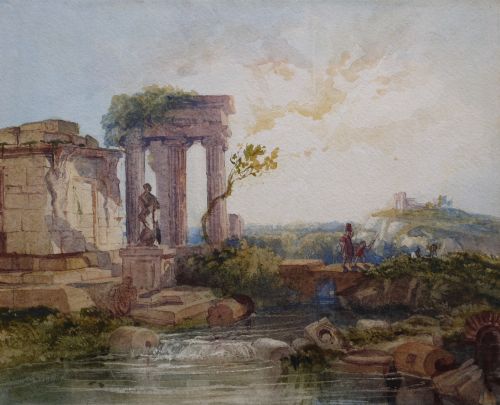
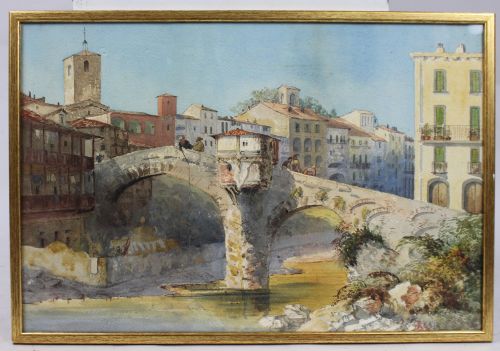
A victorian grand tour watercolour records the classical sites, lakes, and picturesque views of Italy that travellers visited during the nineteenth century. These artworks span various decades within the nineteenth century, including specific dates such as 1860, 1870, 1880, and the Regency period.
The subjects focus heavily on Italian scenery, featuring locations such as Tivoli, Venice, Lake Garda, Civita Castellana, and classical Roman monuments like the Arch of Titus and the Colosseum. Common forms include framed watercolour paintings and fine art works executed on paper.
Makers and artists represented range from named painters like Richard Principal Leitch, Benedetto Salviati, Charles H Poingdestre, William Crouch, and Thomas Brabazon Aylmer to unsigned nineteenth-century Italianate and countryside views.
Materials and technique
These works are created using watercolour paint and pigment applied directly to paper supports to capture light and atmosphere. Artists employed traditional nineteenth-century painting techniques suited for both rapid field sketches and finished studio compositions.
Framing materials play an integral role in presentation, utilising wood, glass, gold leaf, and gilt wood to protect and display the delicate paper sheets. Elaborate frames often complement the romantic and classical styles of the paintings.
Listings feature works across the nineteenth century, including specific dates from 1860, 1870, 1880, and the Regency period.
Assessing quality
Quality rests primarily on the skill of the brushwork and the precision with which the artist renders architecture and natural light. Finer examples display confident handling of pigment on paper, creating depth in landscapes and ruins.
The quality of the surrounding frame also distinguishes the pieces, with period gilt wood and gold leaf settings enhancing the overall presentation. Attribution to a recorded artist adds further distinction to an individual sheet.
Richard Principal Leitch·Benedetto Salviati·Charles H Poingdestre·William Crouch·Thomas Brabazon Aylmer
The Victorian Grand Tour Watercolour Glossary
- Watercolour paint
- A medium consisting of coloured pigments suspended in a water-soluble vehicle, applied to paper to achieve translucent colour washes.
- Pigment
- The finely ground natural or synthetic coloured powder that forms the basis of the watercolour paint.
- Gilt wood
- Wood that has been coated with a thin layer of gold leaf or metallic gilt, commonly used for period picture frames.
- Grand tour
- The traditional trip of Europe undertaken by upper-class European young men of the wealthy class, particularly to Italy, during the eighteenth and nineteenth centuries.
- Regency
- The period in British history from 1811 to 1820, or an associated neoclassical style extending slightly beyond these dates.
Victorian Grand Tour Watercolour: Frequently Asked Questions
What subjects appear in these watercolours?
The subjects focus on Italian landscapes, lakes, and classical ruins recorded by travellers during the nineteenth century.
Views frequently include specific locations such as Venice, Tivoli, Lake Garda, and Roman architectural sites.
How should these paper artworks be framed?
These watercolours require protective glass and stable framing to prevent damage from light and moisture.
Period frames utilising wood, gold leaf, or gilt wood are typical for this type of nineteenth-century artwork.
Which artistic styles define this group?
The pieces reflect nineteenth-century romanticism, classical styles, and Italianate scenic traditions.
Artists aimed to capture the atmospheric light and historical resonance of the Mediterranean landscape.
Are most of these paintings signed?
Some works bear signature initials or full artist names, while others remain unsigned examples of the period.
Attributions depend on contemporary inscriptions, artist documentation, or stylistic comparisons with known painters.