




![Pen and Ink Sketch - Female Nudes by William Edward Frost [1810-1877]](https://www.sellingantiques.co.uk/photosnew/dealer_kendallhouse/dealer_kendallhouse_full_1758970795762-8493507346.jpg)


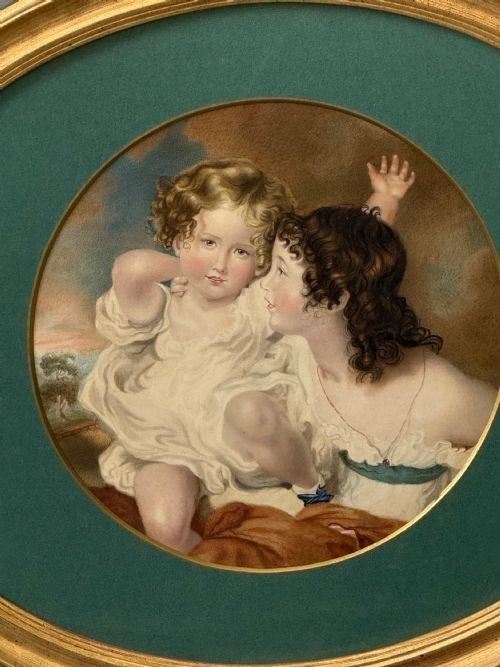
Gilt Mounted Watercolour Painting
These gilt mounted watercolour painting works bring nineteenth-century portraiture, topography and narrative illustration directly to your wall.
Gilt Mounted Watercolour Painting
A gilt mounted watercolour painting combines pigment on paper with a gilded wood frame or mount, creating a complete decorative artwork. When you search for this phrase, you encounter everything from detailed Victorian portraits and Scottish school landscapes to early twentieth-century illustrations.
The pieces on this page span several centuries, with a strong representation of nineteenth-century examples alongside eighteenth-century German works and mid-century items. Subjects range from coastal views and classical ruins to intimate character studies and botanical subjects.
You will find single sheets alongside pairs and sets, offering flexibility for display. The framing is integral to how these works present today, often utilising period wood and gold leaf to complement the delicate pigments within.
How They Were Made
Artists painted primarily in watercolour on paper, sometimes incorporating pen and ink or embroidery to add texture and line. These pigments rely on water-soluble binders that allow for delicate washes and sharp illustrative detail.
The frames utilise wood finished with gold leaf or giltwood, designed to protect the paper underneath while enhancing the visual depth of the scene. Glass covers the front to shield the delicate water-soluble pigments from atmospheric moisture and dust.
Listings span the eighteenth century to the nineteen-forties, utilising paper, glass, watercolour, wood, and gold leaf.
What Varies In Quality
Quality rests in the precision of the brushwork and the strength of the composition, distinguishing professional academic output from casual sketches. Works by documented artists with clear regional or school attributions command greater attention.
The condition of the paper and the integrity of the original gilt frame significantly influence the overall appeal. Well-preserved pigments retain their original vibrancy without excessive fading, while period frames retain their original gilding.
J Hardy·Robert Winchester Fraser·Harry Bright·William Edward Frost·James H Hulse·John McDougal·William Powell Frith·Robert Kemp·Karl Feiertag·Belisario Gioja·Alfred Rimmer·William Crouch·Earl Haig·T Fairfax
The Gilt Mounted Watercolour Painting Glossary
- Giltwood
- Wood carved and coated with gold leaf or gold paint. This finish creates a reflective border that frames the paper artwork.
- Watercolour
- A paint medium consisting of colorants suspended in a water-soluble vehicle. It produces translucent washes and fine linear details on paper.
- Scottish School
- A grouping of artists working in Scotland during the nineteenth and twentieth centuries. Their output frequently records dramatic northern landscapes and coastal towns.
- Victorian
- Pertaining to the reign of Queen Victoria, spanning the mid-nineteenth to the early twentieth century. Pieces from this era often feature narrative subjects and detailed academic technique.
Gilt Mounted Watercolour Painting: Frequently Asked Questions
How do I hang a watercolour painting safely?
Keep these framed works away from direct sunlight to prevent the watercolour pigments and paper from fading over time. Stable indoor humidity protects both the paper support and the wooden gilt frame from warping.
Use sturdy picture wire and wall fixings suited to the weight of the wood and glass. Professional framing backing helps seal the artwork against dust and environmental changes.
Are all gilt mounted watercolours from the Victorian era?
While nineteenth-century and Victorian examples are common, the selection includes eighteenth-century German works and twentieth-century pieces up to the nineteen-forties. Each period brings distinct stylistic conventions, from classical ruins to early twentieth-century illustration.
Checking the signatures, artist dates, and framing styles helps determine the correct era for each specific piece.
What subjects appear most often in these paintings?
Landscapes and coastal views appear frequently, recording locations from Scottish coastal towns to Italian architectural sites like the Colosseum. Portraiture and narrative genre scenes also form a significant portion of the available subjects.
Sketches of figures, children at play, and botanical studies provide variety for collectors focusing on specific nineteenth-century themes.
How should I clean a gilt frame?
Dust the wooden frame gently with a dry, soft brush or microfiber cloth to remove surface particles. Avoid liquid cleaners or chemical polishes, which can damage the delicate gold leaf finish.
Consult a professional conservator if the giltwood requires more intensive cleaning or structural repair.