

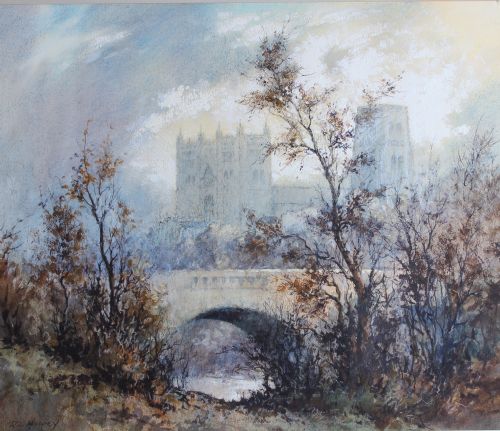


Architectural Watercolour Study
An architectural watercolour study captures historic buildings and grand interiors with precise hand-painted detail on paper.
Architectural Watercolour Study
When you search for an architectural watercolour study, you encounter detailed depictions of cathedrals, classical ruins, country houses and street scenes executed by hand. These works document specific structures ranging from Italian monuments and French pavilions to English town halls and cathedral interiors.
The pieces listed on this page span several periods, with 19th-century and Victorian works appearing alongside Edwardian and mid-20th-century examples. You frequently meet works recording Grand Tour travels through Italy alongside detailed studies of British architectural heritage.
Artists record both exterior facades and ornate interior spaces, utilising ink and watercolour paint to render stone vaulting, chimneypieces, and intricate cabinetry. Many examples arrive framed in wood or giltwood, preserving the delicate paper surfaces.
Materials and Technique
These works rely primarily on paper supports combined with water-based pigments and sometimes monochrome ink for precise linear outlines. Artists applied watercolour paint in translucent washes to suggest shadow and depth across stone facades, vaulted ceilings, and architectural ornamentation.
Many surviving examples are housed beneath glass within wooden or giltwood frames that protect the delicate paper and water-soluble pigments from environmental damage over the centuries.
Architectural Watercolour Study Retail Price Guide 2026
Typical asking prices for architectural watercolour study among the pieces listed under this phrase on Sellingantiques today, from the lower quarter to the upper quarter. They describe what is for sale here now, not the wider market.
Framing materials recorded across the inventory include both standard wood and ornate giltwood mouldings protecting the artwork beneath glass.
Distinctions in Quality
The distinction between ordinary and exceptional works rests upon the precision of the draughtsmanship and the artist's ability to render complex perspective accurately. Finer examples display meticulous pen work combined with controlled watercolour washes that define stone texture, brickwork, and decorative mouldings without appearing heavy-handed.
Provenance and documented subject matter elevate certain pieces, particularly when an artist recorded specific named monuments, archaeological sites, or notable historic interiors during travels abroad or through Britain.
Robert Leslie Howey·Pio Panfili·Peter Toft·Tom Dudley
The Architectural Watercolour Study Glossary
- Watercolour paint
- A water-soluble medium composed of pigment and binder that produces translucent washes of colour on paper.
- Grand Tour
- A traditional trip through Europe undertaken by upper-class Europeans during the eighteenth and nineteenth centuries, often resulting in commissioned artistic views of classical ruins and architecture.
- Giltwood
- Wood that has been coated with a thin layer of gold leaf, commonly utilised for traditional picture frames.
- Monochrome ink
- A single-colour ink, frequently black or brown, used to delineate sharp architectural lines before the application of wash.
Architectural Watercolour Study: Frequently Asked Questions
What is an architectural watercolour study?
An architectural watercolour study is a hand-painted artwork focusing on buildings, interiors, ruins, or structural details created using water-soluble pigments on paper.
These pieces range from quick compositional records to highly finished elevations and interior perspective views produced by professional artists and travellers.
How were these watercolours displayed?
Historically, these watercolours were framed behind glass within wooden or giltwood surrounds to protect the fragile paper support from moisture and dust.
Many were produced to hang in domestic studies, libraries, or galleries as records of travel and architectural appreciation.
Where were these subjects found?
Artists travelled extensively across Britain and continental Europe to record notable buildings, capturing Italian piazzas, French monuments, and English cathedrals.
Many studies originated from specific artistic tours or commissions documenting country houses and historic civic structures.