


19th Century Venetian Art
These pieces of 19th century venetian art capture the light, water and architecture of the lagoon through paintings, watercolours and decorative dishes.
19th Century Venetian Art
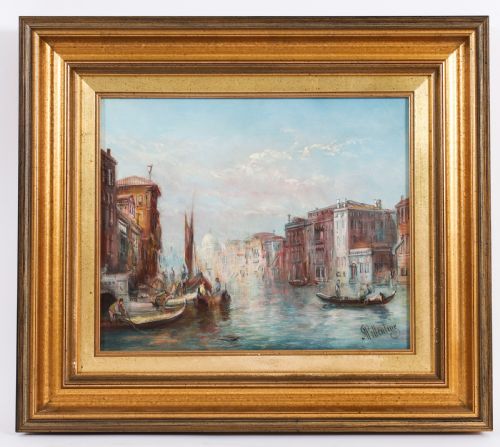
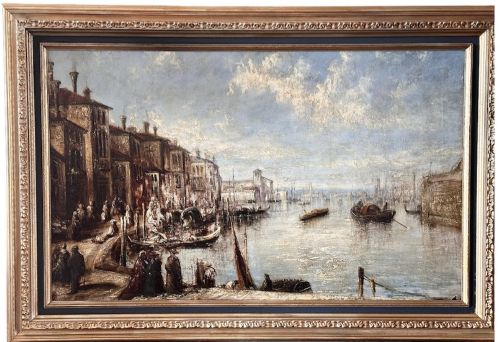
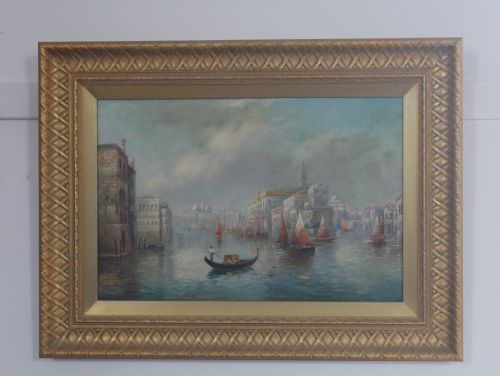
When you search for 19th century venetian art, you are looking at townscapes, canal scenes, portraits and decorative glass from the Victorian era. The selection centres heavily on oil paintings and watercolours depicting iconic landmarks like the Grand Canal, the Doge's Palace and Santa Maria della Salute.
The works you will most commonly meet on this page are oil paintings on canvas and board, alongside paper watercolours. Painters recorded the shifting light of the lagoon across decades spanning from the eighteen-seventies to nineteen-hundred, working in styles ranging from romanticism to Victorian fine art.
Alongside framed canvases and watercolours, the category includes decorative glass items such as glass plates featuring latticinio decoration. These pieces reflect the enduring British and European fascination with Venetian scenes and craftsmanship during the nineteenth century.
How they were made
Artists painted primarily with oil on canvas or applied watercolour to paper, capturing precise architectural details of Venetian palazzos and canals. Canvases were typically stretched over wood frames and often housed in giltwood or gilt wood surrounds.
Glass pieces were shaped by artisans utilising techniques like latticinio, where opaque white glass threads are embedded within clear glass to create intricate network patterns. These methods relied on traditional workshop practices passed down through generations of Venetian makers.
Several artists clearly spent too much time by the lagoon, returning home with more than a few watercolours of the Grand Canal.
What varies in quality
Quality in these artworks rests on the artist's ability to render the distinctive luminosity of water and stone under changing skies. Stronger examples display confident brushwork and accurate perspective in complex townscapes, whereas lesser pieces can feel stiff or formulaic in composition.
The handling of medium also dictates the standard, with superior watercolours maintaining transparency and freshness on paper while finer oils show rich pigment layering. Framing matters too, as period giltwood frames that complement the painting elevate the overall integrity of the piece.
Alfred Pollentine·Francis Moltino·Salviati·Antonietta Brandeis·Jane Vivian·William Raymond Dommersen·Hercules Brabazon Brabazon·Frank Wasley·David Law·George Stanfield Walters·Arthur Severn
The 19th Century Venetian Art Glossary
- Grand Canal
- The main water-traffic artery in Venice, frequently depicted in nineteenth-century paintings. It forms the curving central waterway around which many famous palazzos cluster.
- Latticinio
- A type of glass decoration involving fine white threads encased in transparent glass. This technique was widely practiced in Venetian glasshouses.
- Giltwood
- Wood that has been treated with a thin layer of gold leaf or gilt. It is commonly found on the frames surrounding nineteenth-century oil paintings.
- Townscape
- A genre of art that focuses on views of city streets, canals and buildings. In this context, it refers specifically to topographical depictions of Venetian architecture.
- Watercolour
- A painting method in which the paints are made of pigments suspended in a water-based solution. Artists applied these to paper to achieve translucent washes of light.
19th Century Venetian Art: Frequently Asked Questions
How do I date a Venetian painting?
Dating relies on recorded artist lifespans, stylistic markers of the Victorian period and occasional inscriptions on the reverse of the canvas. Many works bear signatures or dates left by the artist.
Framing can also offer clues, though frames are frequently replaced over time. Comparing the subject matter to known topographical changes in Venice helps narrow the decade.
Were these painted in Venice or Britain?
Many British and European artists travelled to Venice on the Grand Tour to paint the lagoon on location. Others worked from sketches and watercolours once they returned to their home studios.
Local Italian artists also produced these views specifically for foreign visitors and collectors. Consequently, the works represent a mix of foreign observation and domestic Venetian production.
How should I hang an oil painting?
Choose a wall away from direct sunlight and sudden temperature shifts, which can damage canvas and nineteenth-century gilt wood frames. Ensure the hanging hardware is securely fixed to support the weight of the frame.
Keep paintings away from damp areas like uninsulated exterior walls. Proper spacing allows air circulation around the back of the canvas.
What is latticinio glass?
Latticinio is a decorative glass technique originating in Murano, Venice, where white threads are twisted inside clear glass. Salviati was particularly noted for producing such decorative items during the nineteenth century.
These pieces were collected as cabinet ornaments rather than for utility. They demonstrate the continuation of traditional Venetian glass-making skills into the Victorian era.