

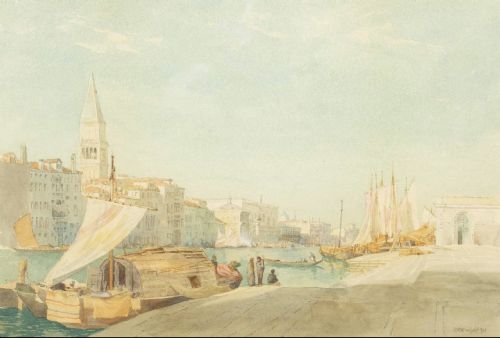


Venice Watercolour Paintings
Venice watercolour paintings capture the serene light and iconic canals of the lagoon through delicate washes applied directly to paper.
Venice Watercolour Paintings
Venice watercolour paintings are fine art works depicting Italian scenes, predominantly originating from the nineteenth and early twentieth centuries. These paintings record famous locations such as the Grand Canal, the Giudecca Canal, and the Bridge of Sighs.
Collectors encounter works spanning the Victorian and Edwardian eras through to the early decades of the twentieth century. The selections show diverse British and continental interpretations of the lagoon city.
Most examples present traditional compositions framed under glass with wooden mouldings. They preserve the atmospheric light characteristic of Italian topographical art from these periods.
Materials and technique
Artists applied watercolour pigment directly onto paper surfaces using fluid washes and fine brushwork. This water-based medium allowed creators to capture the shifting reflections and transparent light of the Venetian canals.
Finished works are typically housed in wooden frames behind protective glass to safeguard the delicate pigments from moisture and light damage. The interaction between the paper substrate and the translucent paint defines the visual outcome.
Gondoliers navigating the shadows of the Bridge of Sighs have inspired artists to mix water from home with memories of Italian sunlight for centuries.
Assessing quality
Quality rests in the handling of light, atmospheric depth, and the precision of architectural perspective. Superior works convey the movement of water and the luminosity of the Italian sky with economy and confidence.
The distinction between standard topographical records and exceptional fine art lies in the artist's brush control and compositional rhythm. Works by established Victorian and Edwardian painters display greater tonal nuance across the paper.
Thomas Ellison·Richard Henry Wright·F J Aldridge·Clara Montalba·Vittore Zanetti Zilla·Benedetto Salviati·Hercules Brabazon Brabazon·Frank Wasley·David Law·William Knox·George Stanfield Walters·Wilfred Knox·Henry Wimbush·John D Walker·Arthur Severn·Helen Donald-Smith
The Venice Watercolour Paintings Glossary
- Watercolour
- A paint consisting of a pigment suspended in a water-based solution. It is applied in translucent washes to paper to create luminous effects.
- Fine art
- Creative work valued primarily for its aesthetic appeal and cultural significance. These paintings represent traditional visual arts rather than commercial illustration.
- Victorian
- Pertaining to the reign of Queen Victoria, spanning the nineteenth century. This period produced distinct maritime and topographical painting styles.
- Edwardian
- Relating to the reign of King Edward VII during the early twentieth century. Art from this era maintains rigorous standards of draughtsmanship.
- Impressionism
- A style of painting emphasising light and its changing qualities rather than minute detail. British practitioners adapted these principles for Venetian scenes.
Venice Watercolour Paintings: Frequently Asked Questions
How do I date a watercolour?
Dates are usually established through artist biographies, stylistic markers, and period framing materials. Victorian and Edwardian works often bear signatures or exhibition labels on the reverse.
Paper quality and pigment analysis can offer further clues, though the recorded dates of the artist's active period remain the most reliable guide.
Are these paintings original works?
Every piece listed is a unique, hand-painted work on paper rather than a mechanical reproduction or print. Artists applied wet pigments directly to the sheet to create individual compositions.
Brushstrokes and paper texture confirm the hand-rendered nature of each lagoon view.
How should I frame and hang them?
Watercolours require conservation framing behind glass to prevent fading from direct sunlight and environmental moisture. Acid-free mounts keep the paper from touching the glass directly.
Position paintings away from direct heat sources and strong sunlight to preserve the integrity of the pigments.
What subjects appear most often?
Views of the Grand Canal, Santa Maria della Salute, and gondolas passing beneath historic bridges dominate these compositions. Artists frequently painted from the lagoon to capture wide architectural vistas.
Islands such as San Giorgio also feature prominently in the early twentieth-century selections.