
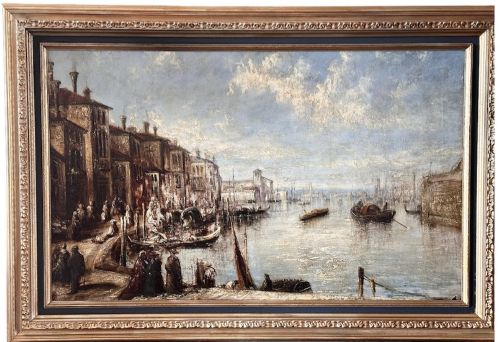


Framed Venetian Landscape Picture
A framed venetian landscape picture captures the waterborne light and historic architecture of Italy's most celebrated lagoon city.
Framed Venetian Landscape Picture
A framed venetian landscape picture depicts iconic sights such as the Grand Canal, the Doge's Palace, and Santa Maria della Salute across various periods. These works capture the changing atmosphere of the lagoon through distinct artistic interpretations ranging from strict topographical accuracy to looser impressionistic brushwork.
Buyers frequently encounter nineteenth-century watercolours and oils alongside early twentieth-century interpretations and mid-century expressions. The common thread among these varied pieces is their specific focus on Venetian topography, presented within period wooden or gilt frames.
Materials and Technique
Artists deployed oil paint on canvas or watercolour on paper to capture the shimmering light reflected upon Venetian canals. Mediums such as pastel, gouache, and ink pen drawings also appear, applied with varied techniques from precise architectural rendering to expressive dashes of colour.
Framing typically involves wood and giltwood enclosures that complement the visual weight of the paintings. These surrounds range from ornate nineteenth-century moulded frames to simpler profiles on later works.
Venice has inspired artists to brave the floating city's canals for centuries, occasionally painting while balancing precariously in bobbing gondolas.
Evaluating Quality
Quality rests upon the artist's ability to handle the notorious light and reflection unique to the Venetian lagoon. Superior works demonstrate confident brushwork or delicate washes that define water and stone convincingly, rather than relying on stiff formulae.
The harmony between the artwork and its original or period frame contributes significantly to the overall integrity of the piece. Finer examples maintain crisp detail in architectural elements and possess a strong provenance or attributed authorship.
Francis Moltino·F J Aldridge·Claude Jousset·Jane Vivian·Alfred Pollentine·William Raymond Dommersen·Hercules Brabazon Brabazon·Frank Wasley·David Law·William Knox·George Stanfield Walters·Wilfred Knox·Arthur Severn·Helen Donald Smith
The Framed Venetian Landscape Picture Glossary
- Giltwood
- Wood that has been coated with gold leaf or gold paint. This material is frequently found on nineteenth-century picture frames.
- Impressionism
- A style of painting emphasising an immediate visual impression of a scene, characterised by shifting light and unblended colour. Several British and French examples employ this approach.
- Gouache
- An opaque method of watercolour painting using water-soluble pigments bound in glue. It produces a heavier, more solid finish than standard transparent watercolour.
Framed Venetian Landscape Picture: Frequently Asked Questions
How do I identify a nineteenth-century Venetian painting?
Nineteenth-century works often rely on detailed oil on canvas or transparent watercolour techniques to depict famous landmarks with topographical precision. The framing materials and paper or canvas supports further help indicate this era.
Examination of the signature and artist records provides the firmest dating evidence, distinguishing these earlier creations from mid-century or vintage interpretations.
What subjects are most common in these pictures?
The Grand Canal, the Doge's Palace, and Santa Maria della Salute appear repeatedly across the selections. Views looking across the lagoon toward St George's Island or featuring gondolas are also frequent.
Artists continually returned to these specific viewpoints because the interplay of water and historic architecture offered endless studies in light.
Are these works originals or prints?
The listings comprise original paintings, watercolours, pastels, and mixed media works rather than mechanical reproductions. Each piece represents the direct hand of the artist using paint, ink, or pastel.
Close inspection under magnification reveals the brush hairs, pigment layering, and texture characteristic of hand-executed art.
How should I care for a framed watercolour?
Watercolours are sensitive to prolonged direct sunlight, which can fade the pigments and discolour the paper over time. Hanging them in ambient, indirect light preserves their original tones.
Keeping the works away from damp environments prevents foxing and mould growth on the paper support.
What framing styles should I expect?
Frames range from ornate nineteenth-century giltwood moulding to simpler wooden borders found on twentieth-century pieces. Many retain their period frames, which have aged alongside the artwork.
The style of the frame frequently corresponds to the decade in which the painting was executed.