


19th Century Venetian Cityscape
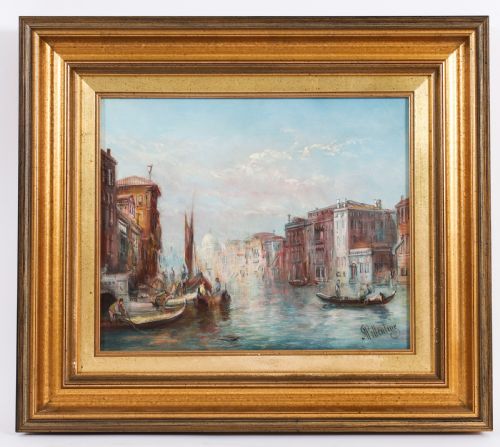
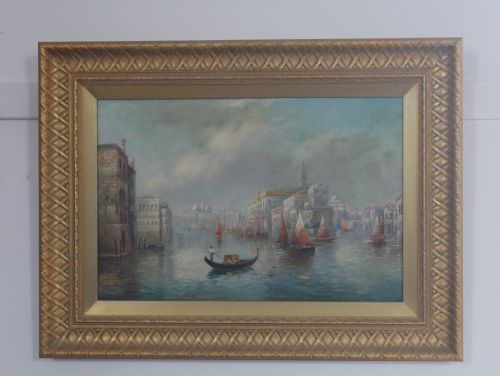
A 19th century venetian cityscape brings the golden light and historic canals of Italy directly onto the wall through period oil paintings.
19th Century Venetian Cityscape
A 19th century venetian cityscape portrays famous landmarks such as the Grand Canal, the Doge's Palace, the Santa Maria della Salute and the Dogana. These works capture the architectural splendour and bustling waterways of Venice during the Victorian era and the broader nineteenth century.
The pieces appearing on this page are predominantly oil paintings on canvas, accompanied by occasional watercolours and works on board. Artists focused on townscapes and fine art perspectives, recording the city's palazzos and gondoliers under atmospheric skies.
Most examples date from the decades spanning the late nineteenth century, including specific years such as 1870, 1880, 1890 and 1897. The style ranges from romanticism and impressionism to detailed Victorian fine art depictions.
Materials and construction
Painters applied oil pigments onto woven canvas supports, utilising the medium to build rich textures across water and stone surfaces. Some works were executed on board or paper as watercolours.
Frames play a substantial role in presentation, frequently constructed from wood and embellished with gold leaf, giltwood or gilded wood. These ornate frames complement the romantic and classical nature of the paintings.
The selection spans Victorian fine art, 19th century romanticism, impressionism and Italian townscape painting.
Distinctions in quality
Quality depends upon the precision of architectural rendering and the artist's ability to capture the specific play of light on Venetian water. Works by named painters with established oeuvres demonstrate superior brushwork and compositional balance.
The framing contributes significantly to the overall presence of the piece, with period giltwood frames offering greater historical harmony than later replacements.
Alfred Pollentine·Jane Vivian·Antonietta Brandeis·William Raymond Dommersen·Charles Clement Calderon·David Law·J. Yates
The 19th Century Venetian Cityscape Glossary
- Grand Canal
- The main waterway of Venice, lined with historic palazzos that frequently serve as the central subject for nineteenth-century artists.
- Dogana
- The historic customs house of Venice situated at the tip of the Dorsoduro, often depicted alongside the Santa Maria della Salute.
- Giltwood
- Wood that has been treated with a thin layer of gold leaf or gilt, standard for framing nineteenth-century fine art.
- Townscape
- A genre of painting focused on the visual aspects of urban architecture and street or canal scenes.
- Oil on canvas
- A traditional painting technique involving pigment suspended in drying oils applied to a stretched fabric support.
19th Century Venetian Cityscape: Frequently Asked Questions
How do I identify a genuine nineteenth-century Venetian painting?
Examine the materials of the canvas support and the construction of the wooden stretcher bars behind the painting. Period framing and artist signatures often provide further verification of the era.
Compare the style with known Victorian fine art conventions and romantic depictions of Italian subjects from the period.
Who were the notable artists painting Venice then?
Painters such as Alfred Pollentine, Jane Vivian and William Raymond Dommersen specialised in detailed architectural views of Venetian canals. Their works recorded landmarks like the Doge's Palace and the Grand Canal.
Other contributors include Antonietta Brandeis and Charles Clement Calderon, whose canvases capture the atmosphere of the city during the nineteenth century.
Where should I hang a townscape in my home?
These paintings suit reception rooms, studies or hallways where adequate wall space allows for the ornate giltwood frames. Position them away from direct sunlight to protect the oil pigments.
Pairing a cityscape with traditional interior decor enhances the historical character of the room.
What is the difference between an oil painting and a watercolour?
Oil paintings utilise pigment bound in oil on canvas or board, creating rich layers and textured surfaces. Watercolours employ water-soluble pigments on paper, offering a lighter and more translucent finish.
Both mediums were used by nineteenth-century artists to record Venetian scenes.