
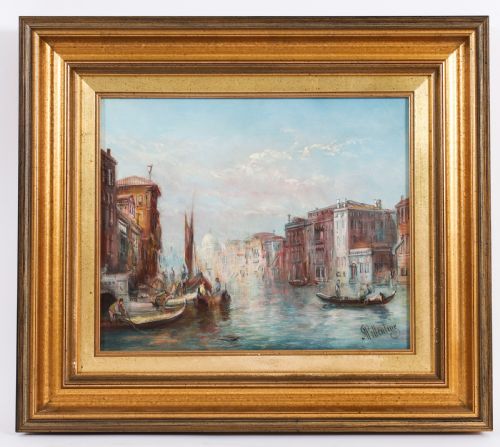
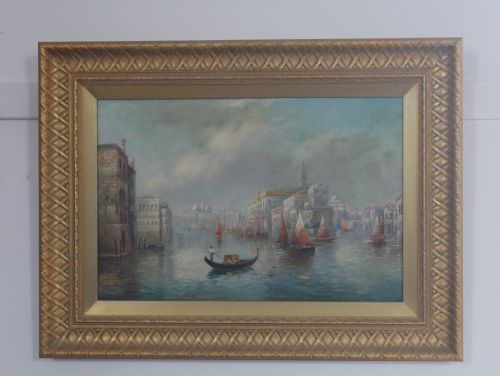


Framed Grand Canal Landscape
A framed grand canal landscape brings the light and architecture of Venice into a room through oil and watercolour.
Framed Grand Canal Landscape
A framed grand canal landscape depicts the famous waterway, palazzos, and monuments of Venice, captured across the nineteenth and twentieth centuries. Buyers searching for a framed grand canal landscape seek traditional townscapes and veduta views that record the historic architecture and waterborne life of the lagoon. The selection on this page centres on nineteenth century oil paintings on canvas and watercolours on paper, framed in wood and giltwood.
Most examples concentrate on recognizable landmarks such as the Mocenigo Palace, Santa Maria della Salute, the Dogana, and the Ducal Palace. Painters of this subject worked in styles ranging from nineteenth century romanticism and veduta to British and French impressionism. These pictures vary from intimate watercolours to large oil paintings designed to dominate a wall.
How they were made
Artists painted these scenes using oil on canvas, watercolour, pastel, gouache, and ink on paper, capturing the specific atmospheric light of the Venetian lagoon. Canvases and papers are mounted within wooden frames, frequently finished in giltwood or gilded wood with protective glass layers on works on paper.
Makers applied pigments with varying brushwork, from the tight architectural precision of traditional veduta painters to the looser, lighter touches characteristic of impressionist and maritime treatments. The physical construction combines stretched canvas or heavy paper support with robust timber framing to preserve the delicate paint surfaces.
Listings feature oil on canvas and watercolour works across periods ranging from the nineteenth century through to the mid twentieth century.
What varies in quality
Quality rests in the handling of light and perspective, distinguishing works with atmospheric depth and confident draughtsmanship from more mechanical topographical records. The articulation of water reflections, sky luminosity, and architectural stone texture separates accomplished hands from lesser studio output.
The integrity and period appropriateness of the wooden and giltwood framing also influence the overall standard of the piece. Well-preserved surfaces on both the canvas and the surrounding frame indicate careful historical stewardship.
Alfred Pollentine·F J Aldridge·Antoine Bouvard Senior·E Perez Senet·William Raymond Dommersen·Hercules Brabazon Brabazon·William Knox·Jane Vivian·Henry Wimbush
The Framed Grand Canal Landscape Glossary
- Veduta
- A highly detailed, topographical painting or drawing of a cityscape, particularly associated with eighteenth and nineteenth-century views of Venice. These works prize accuracy in architecture and perspective.
- Giltwood
- Wood that has been treated with a thin layer of gold leaf or gilt paint, commonly used for traditional picture frames. This finish adds a warm, reflective border to the artwork.
- Gouache
- An opaque watercolour paint mixed with a binding agent, yielding a dense and matte surface. Artists use it on paper to build rich colour patches in Venetian townscapes.
- Dogana
- The historic customs house of Venice, situated at the tip of the Dorsoduro district. It appears frequently in nineteenth-century paintings alongside the adjacent church of Santa Maria della Salute.
- Palazzo
- A grand Italian residential building or palace, such as the Mocenigo Palace. These structures form the primary architectural backdrop along the canal views.
Framed Grand Canal Landscape: Frequently Asked Questions
What is a grand canal landscape painting?
A grand canal landscape painting is an artwork depicting the waterways, historic palazzos, and iconic monuments of Venice. These pieces capture the unique light, architecture, and daily activity of the Venetian lagoon.
Most examples date from the nineteenth and early twentieth centuries, executed in oil on canvas or watercolour on paper. They serve as decorative townscapes that bring classical Italian scenery into domestic interiors.
How do I hang a framed oil painting?
Hanging a framed oil painting requires secure wall fixings suited to the weight of the timber and giltwood frame. Choose a location away from direct sunlight and sudden temperature changes to protect the canvas.
Ensure the hanging wire and brackets on the back of the frame are strong enough to support the piece safely. Professional picture hooks fixed directly into wall studs or solid masonry provide the best support.
How do I tell an oil painting from a watercolour?
An oil painting utilises pigment suspended in drying oil, applied to a stretched canvas or panel, yielding a textured and slightly glossy surface. Watercolours use water-soluble pigments on paper, creating a flatter, transparent finish usually protected beneath glass.
Examining the surface closely reveals the brush texture and thickness characteristic of oil paint versus the soft washes and paper grain visible in watercolours.