


Original Grand Canal Artwork
Original grand canal artwork captures the timeless light and water of Venice through nineteenth and twentieth-century paintings.
Original Grand Canal Artwork
Original grand canal artwork brings the iconic waterways and palazzos of Venice into domestic spaces through historical paintings and watercolours. These pieces capture famous sights such as the Mocenigo Palace, the Bridge of Sighs, and the Doge's Palace as recorded by artists working across the nineteenth and twentieth centuries.
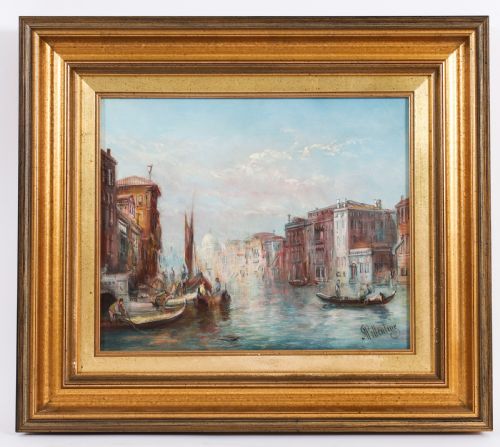
The versions most commonly met on this page are oil paintings on canvas and delicate watercolours spanning periods from Victorian fine art to later impressionist and post-impressionist movements. Many works feature traditional giltwood and gilded wood frames that complement the classical subject matter of Venetian canals and gondoliers.
How these works were created
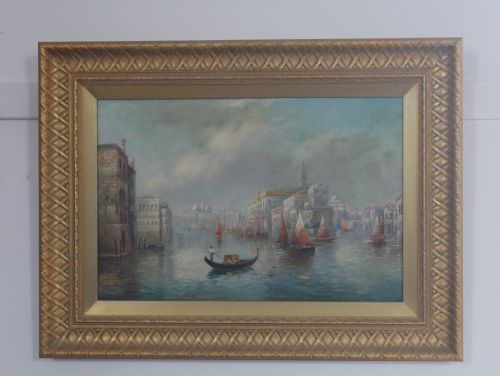
Artists working on original grand canal artwork utilised traditional oil paints on canvas to build rich, layered depictions of light reflecting off Venetian waters. The application of oil allows for deep colour saturation and visible brushwork that mimics the movement of the lagoon.
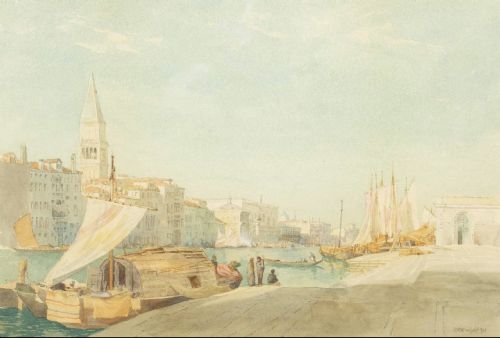
Watercolour on paper served as another primary medium for capturing the translucent quality of Venetian skies and mists. These water-based pigments were often combined with pastel, gouache, or ink pen to add fine architectural detail to palaces and bridges.
Listings feature works spanning from the 1870s through to the 1960s, executed in oil on canvas, watercolour, pastel, and gouache.
What distinguishes finer examples
The distinction between standard works and superior examples lies in the artist's handling of atmospheric light and architectural perspective. Master painters capture the elusive luminosity of the Venetian lagoon with confident brushwork that brings depth to both water and stone.
Condition and provenance further separate pieces, particularly the preservation of the original canvas or paper and the integrity of period frames. Works signed by recognised practitioners of Venetian topography tend to demonstrate superior draughtsmanship and compositional balance.
Alfred Pollentine·Richard Henry Wright·Antoine Bouvard Senior·Vittore Zanetti Zilla·Hercules Brabazon Brabazon·William Knox·Henry Wimbush
The Original Grand Canal Artwork Glossary
- Giltwood
- Wood carved and covered with a thin layer of gold leaf or gold paint. This finish frequently adorns the frames surrounding nineteenth-century paintings.
- Gouache
- An opaque water-based paint that provides solid, flat areas of colour. Artists used it alongside watercolour to create highlights on buildings and water.
- Impressionism
- A nineteenth-century art movement characterised by relatively small, thin yet visible brush strokes. It focused on accurate depiction of light in its changing qualities.
- Topography
- The detailed mapping and artistic representation of specific geographical locations. Venetian townscapes rely heavily on accurate topographical detail of canals and palazzos.
Original Grand Canal Artwork: Frequently Asked Questions
How do I hang a framed oil painting safely?
Ensure the wall fixings match the weight of the gilded wood frame and canvas.
Keep the artwork away from direct sunlight and moisture to protect the oil pigments.
What periods do these Venetian paintings cover?
The works span from nineteenth-century romanticism and Victorian fine art through to twentieth-century impressionism.
Most pieces date between the late Victorian era and the mid-twentieth century.
How should I clean antique paper watercolours?
Paper watercolours require professional conservation rather than domestic cleaning methods.
Keep them behind protective glass and away from humid environments to prevent foxing.
Can I mix oil paintings and watercolours together?
Displaying different mediums side by side adds textural variety to a gallery wall.
Ensure watercolours have proper UV-resistant glazing to protect the pigments from fading.