

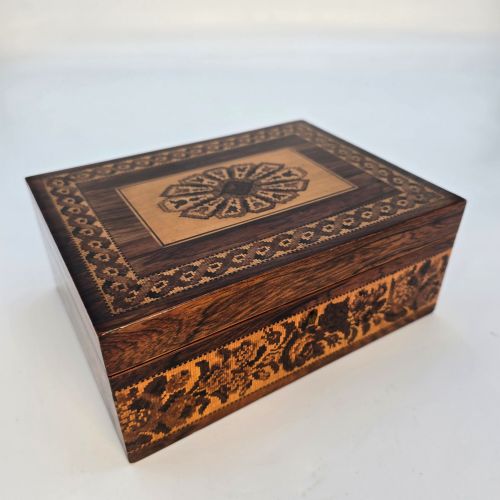


Victorian Mosaic Wood Box
These Victorian mosaic wood box examples are intricate wooden containers decorated with detailed geometric micro-mosaic imagery, prized by collectors for their extraordinary microscopic wood tesserae.

Victorian Mosaic Wood Box
A buyer seeking a victorian mosaic wood box examines small wooden containers designed for practical storage, such as tea caddies, stationery boxes, and jewellery cases. These pieces frequently originate from nineteenth-century English workshops, particularly Tunbridge Wells, alongside related Anglo-Indian and Italian productions.
The most common examples on this page are Tunbridge Ware items constructed from rosewood or walnut, featuring meticulously inlaid geometric designs or architectural views on the lid. Other variations include inlaid ladies' glove boxes, cribbage boxes, and octagonal baskets utilising similar mosaic techniques.
Form and function vary widely across the selection, ranging from simple trinket boxes to fitted tea caddies with internal compartments. The overriding characteristic remains the mosaic surface, which transforms a utilitarian container into a decorative cabinet piece.
Materials and construction
Craftsmen built the carcases of these boxes using dense timbers such as rosewood and walnut, occasionally incorporating lighter contrasting woods like boxwood, holly, and sycamore for the decorative elements. The mosaic imagery relies on thousands of tiny wood blocks, cut from naturally coloured timbers, glued together in bundles, and sliced across to create identical repeating motifs.
Beyond wood, makers integrated materials like bone, brass, and hardstone to add contrast and structural detail to the surface decoration. Surfaces were then smoothed and polished to highlight the natural grain and colour variations of the individual timber species.
Victorian Mosaic Wood Box Retail Price Guide 2026
Typical asking prices for victorian mosaic wood box among the pieces listed under this phrase on Sellingantiques today, from the lower quarter to the upper quarter. They describe what is for sale here now, not the wider market.
Listings feature nineteenth-century pieces constructed from rosewood, walnut, and boxwood, encompassing functional forms from tea caddies to stationery boxes.
Assessing quality and execution
The density and scale of the mosaic tesserae dictate the refinement of the piece, with smaller, more numerous wood blocks representing greater technical skill by the maker. The complexity of the imagery also separates standard containers from exceptional works, particularly when pictorial scenes or complex perspective cubes replace simple geometric borders.
Timber selection and the retention of original interior fittings heavily influence the desirability of a box. Pieces that retain their original velvet linings, paper labels, and functional locks maintain a higher degree of integrity than those with replaced elements.
Edmund Nye·Henry Hollamby
The Victorian Mosaic Wood Box Glossary
- Tunbridge Ware
- A type of nineteenth-century decorative woodwork originating from Tunbridge Wells, characterised by mosaic designs built from thousands of tiny wood blocks. It represents the pinnacle of British micro-mosaic craftsmanship.
- Marquetry
- The art of applying thin pieces of wood veneer to a structural carcase to form decorative patterns or pictures. On these boxes, it forms the borders and background panels framing the central mosaic.
- Tea Caddy
- A specialised container designed to store loose tea leaves securely, often featuring internal lidded compartments and mixing bowls. They are among the most substantial forms found in mosaic wood boxes.
- Pietra Dura
- An Italian technique using cut and fitted polished coloured stones to create mosaic images. Examples mounted onto ebonised wood boxes appear alongside traditional wood mosaics.
- Sadeli Work
- A specific form of nineteenth-century Anglo-Indian mosaic decoration utilising minute geometric patterns constructed from materials such as horn, ivory, and various woods. These appear on boxes distinct from the Kentish tradition.
Victorian Mosaic Wood Box: Frequently Asked Questions
What were these boxes used for?
These containers served practical domestic purposes in the nineteenth century, holding valuable commodities like dry tea leaves, stationery, or personal trinkets. Their decorative nature meant they sat openly on parlour tables or dressing desks.
Over time, their primary role shifted from utilitarian storage to decorative display items collected for their intricate surface craftsmanship.
How do I care for a wood mosaic box?
Keep the piece away from direct sunlight and dramatic temperature fluctuations to prevent the delicate wood veneers and tiny mosaic tesserae from shrinking or lifting. Gentle dusting with a dry, soft cloth is sufficient for maintenance.
Avoid using liquid polishes or modern cleaning agents, as these can seep between the microscopic wood joints and damage the adhesive holding the mosaic together.
How can I tell Tunbridge Ware apart?
Tunbridge Ware is identified by its signature mosaic technique, which uses thousands of differently coloured wood blocks to depict flora, geometric patterns, or famous Kentish views. The wood species are typically natural, relying on the native tones of holly, sycamore, and barberry rather than artificial stains.
Many pieces also feature distinctive border bands made of perspective cubes or tessellated triangles that frame the central lid panel.
Are the interiors usually original?
Many surviving boxes retain their original paper linings, compartmentalised trays, or velvet fittings, though some have experienced minor restorations due to age and use. The presence of maker's paper labels inside the lid often helps confirm authenticity.
Inspect the internal hinges and lock plates, as original brass hardware is a strong indicator of an undisturbed nineteenth-century piece.