


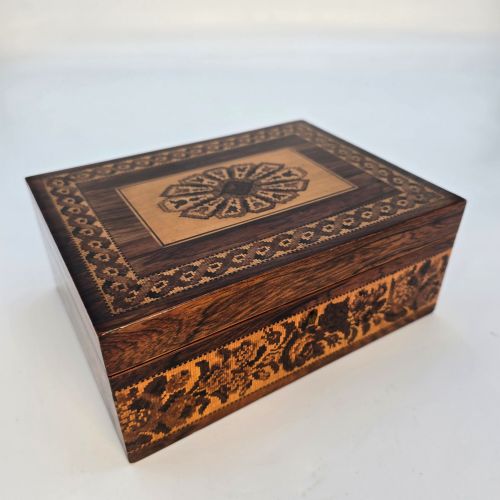


Rosewood Marquetry Keepsake Box
These rosewood marquetry keepsake box examples are timber caskets inlaid with precise geometric or floral motifs, prized for their dense grain and miniature craftsmanship.

Rosewood Marquetry Keepsake Box
A rosewood marquetry keepsake box is a small timber chest designed for trinkets, jewellery, or correspondence, typically encountered from the Regency and Victorian eras. These containers serve as desktop ornaments and functional receptacles, showcasing dark tropical timber figured with contrasting veneers.
The pieces on this page span the nineteenth century, including specific dates from eighteen sixty to eighteen ninety alongside Regency and Victorian stylistic periods. Buyers frequently encounter Tunbridge Ware variants featuring intricate microscopic mosaic wood imagery alongside standard marquetry patterns.
Forms vary from compact trinket boxes and ladies glove boxes to larger tea caddies and document caskets. Most examples originate from English workshops, utilising native and exotic woods to create decorative lids and compartmented interiors.
Materials and construction
Makers built the primary carcase using dense rosewood, complemented by secondary timbers such as walnut, boxwood, holly, and mixed hardwoods. This foundation provided a stable dark background essential for highlighting lighter inlaid details.
Marquetry and Tunbridge Ware techniques involved assembling thousands of tiny coloured wood blocks or sliced veneers to form pictorial or geometric motifs. Craftsmen glued these detailed panels to the box lids and sides before finishing the surfaces with polish.
Rosewood Marquetry Keepsake Box Retail Price Guide 2026
Typical asking prices for rosewood marquetry keepsake box among the pieces listed under this phrase on Sellingantiques today, from the lower quarter to the upper quarter. They describe what is for sale here now, not the wider market.
Some Victorian ladies stored their fitted gloves inside these long rosewood caskets before stepping out for evening carriage rides.
Assessing quality and execution
Quality rests in the precision of the wood inlay and the complexity of the geometric or pictorial mosaic work. Finer examples display microscopic tile alignment and crisp botanical accuracy without gaps in the timber matrix.
The selection of contrasting native and exotic woods dictates visual depth, where varied tones of holly and boxwood enhance the rich grain of the primary rosewood body.
Edmund Nye·Henry Hollamby
The Rosewood Marquetry Keepsake Box Glossary
- Marquetry
- The art of applying pieces of veneer to a structure to form decorative patterns. This technique transforms plain timber surfaces into detailed pictorial or geometric displays.
- Tunbridge Ware
- A specialised form of woodworking originating in Kent featuring microscopic mosaic patterns. Craftsmen glued thousands of dyed wood filaments together before slicing them into repeating decorative bands.
- Veneer
- A thin slice of figured wood applied over a sturdier underlying carcase. This method allows makers to display expensive grain patterns economically.
- Caddy
- A small container originally designed for storing tea leaves. These boxes often feature internal compartments and secure lids.
- Carcase
- The main structural body of a piece of furniture or box before decorative veneers or hardware are applied. It provides the rigid support for all exterior ornamentation.
Rosewood Marquetry Keepsake Box: Frequently Asked Questions
What are these boxes used for?
These decorative containers served historically to hold precious trinkets, correspondence, tea leaves, or ladies accessories. Today they function as desktop storage or decorative cabinet pieces.
Their sturdy timber construction and compartmentalised interiors make them practical for organising small modern items while retaining their antique character.
How do I identify Tunbridge Ware?
Tunbridge Ware is recognised by its distinctive mosaic imagery built from tiny geometric wood blocks. These motifs often depict castles, butterflies, or floral bands.
The technique creates a pixelated pictorial effect using natural coloured timbers rather than painted pigment.
What is the difference between Regency and Victorian boxes?
Regency boxes typically display cleaner architectural lines with restrained brass stringing and classical proportions. They reflect earlier nineteenth century tastes in furniture design.
Victorian pieces tend to embrace more ornate surface decoration, heavier marquetry, and specialised forms like glove boxes or table cabinets.
How should I care for rosewood furniture?
Rosewood surfaces require stable humidity and protection from direct sunlight to prevent timber shrinkage and veneer lifting. Gentle dusting with a dry cloth maintains the polished finish.
Avoid applying modern silicone polishes, as traditional wax dressings preserve the historic timber patina much better.