



Victorian Mantel Spill Vases
Victorian mantel spill vases are small ceramic holders designed to store wooden tapers for lighting fires, and you buy them for their charming folk character.
Victorian Mantel Spill Vases
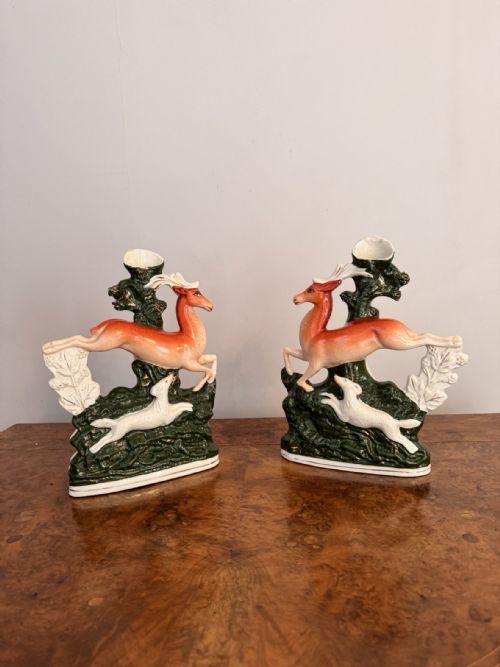
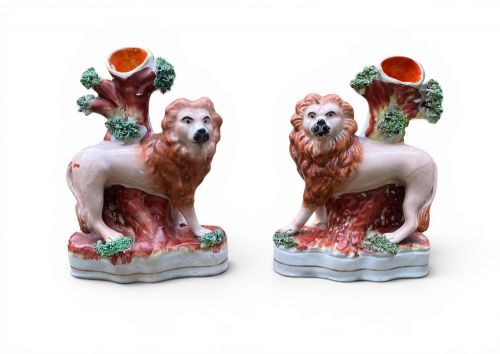
Victorian mantel spill vases are domestic ornaments designed to hold thin tapers used for lighting candles, pipes, and coal fires. You will most frequently encounter pairs modelled as animals, birds, or castles on this page.
The pieces on offer span the nineteenth and early twentieth centuries, capturing the distinct aesthetic of the Victorian and Edwardian eras. Staffordshire pottery and porcelain predominate, taking the form of figures, dogs, lions, swans, and deer.
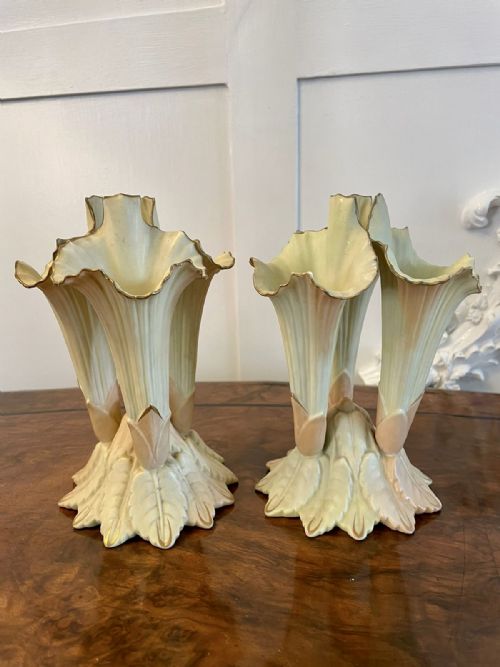
Makers such as Locke and Co. appear alongside unmarked Staffordshire works, showcasing both refined porcelain and robust earthenware. These mantel pieces bring a tactile slice of nineteenth century domestic life directly to the fireplace.
Manufacture and materials
Potters relied primarily on earthenware, ceramic, and porcelain to form the body of these mantel ornaments. These materials were shaped into figures and animals, then finished with lead glaze or standard glaze to provide a protective, glossy surface.
Victorian Mantel Spill Vases Retail Price Guide 2026
Typical asking prices for victorian mantel spill vases among the pieces listed under this phrase on Sellingantiques today, from the lower quarter to the upper quarter. They describe what is for sale here now, not the wider market.
Listings feature earthenware, porcelain, and ceramic materials shaped into Victorian animal and figural forms.
Judging quality and execution
Preservation of the original glaze and any delicate gold leaf accents separates superior examples from those worn down by time. A well defined Staffordshire flatback with clean enamel work sits firmly at the top of the range.
Locke And Co·Vion And Baury
The Victorian Mantel Spill Vases Glossary
- Spill
- A thin strip of wood or paper used for transferring a flame from a fire to a candle or pipe. These vases held a bundle of them ready on the mantelpiece.
- Flatback
- A ceramic figure modelled with a detailed front and a flat, unadorned reverse designed to stand flush against a wall. This technique saved time and material during nineteenth century production.
- Earthenware
- A porous pottery body fired at lower temperatures, commonly used for Staffordshire figures and glazed to ensure it held water for the spills. It forms the backbone of vernacular nineteenth century ceramics.
- Bisque
- Unglazed ceramic fired once to a porous state, valued for its matte, marble like finish on nineteenth century portrait and toy figures. It captures fine detail without the distortion of a heavy glaze.
- Lead glaze
- A traditional shiny coating containing lead oxide applied to ceramics before a final firing. It provides a durable, glassy surface that deepens the underlying enamel colours.
Victorian Mantel Spill Vases: Frequently Asked Questions
What are victorian mantel spill vases?
These items are small ceramic holders created to sit on a mantelpiece and store wooden tapers. They combined ornamental animal or figural sculpture with a practical household function.
Victorian homes relied on them to keep spills close at hand for lighting fires and lamps before matches were common.
How were they used?
Households placed a bundle of wooden tapers inside the hollow cylindrical section of the vase. When a fire or candle needed lighting, a taper was drawn out and touched to the hearth.
They served as both a decorative hearth accessory and an accessible storage container for daily use.
How do I date a spill vase?
Dating relies on observing the ceramic body, glaze characteristics, and stylistic markers such as Rococo Revival curves or Edwardian elegance. Mid nineteenth century pieces often show heavier Staffordshire earthenware construction.
Later examples from around nineteen hundred introduce finer porcelain and blush ivory finishes typical of factories like Locke and Co.
Where should I display them?
They look best positioned on a mantelpiece, shelf, or side table where their bright enamels and whimsical animal forms can be appreciated up close. Displaying them in pairs maintains the traditional symmetry intended by nineteenth century makers.
Keep them away from high traffic edges to protect the delicate porcelain or earthenware glaze.