
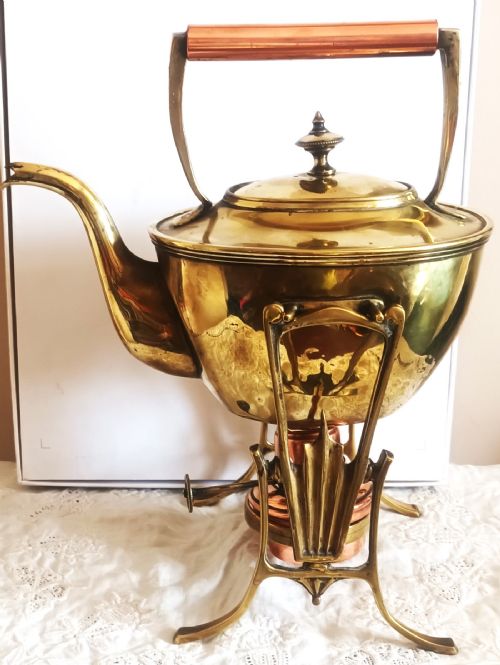


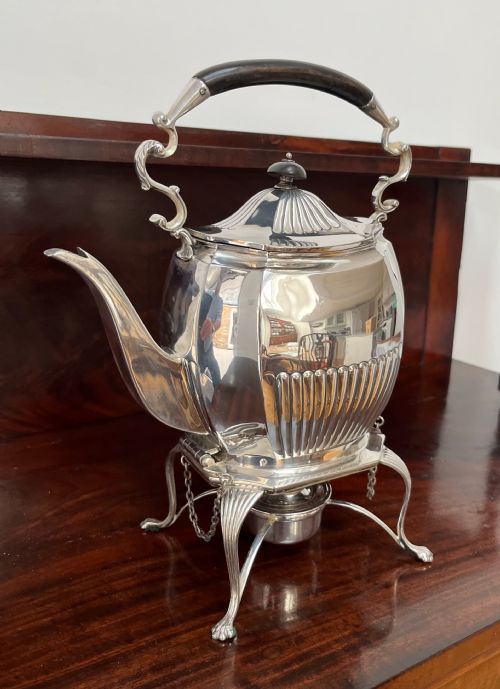


Victorian Hot Water Kettle
A victorian hot water kettle brings practical nineteenth-century hospitality to the table, offering a dependable source of piping hot water for tea service.
Victorian Hot Water Kettle
A victorian hot water kettle comprises spirit kettles on stands with burners, alongside larger copper samovars and tea urns fitted with taps. These pieces originate across the nineteenth and early twentieth centuries, spanning the Victorian and Edwardian periods.
The selection ranges from portable spirit kettles designed for tabletop use to substantial samovars built for gatherings. Brass, copper, and silver plate dominate the forms, frequently accompanied by stands, burners, and handles incorporating wood, bone, or ebonised elements.
Materials and construction
Metalworking techniques shape the core of these kettles and samovars, utilising beaten or polished copper and heavy brass alongside silver plating over base metal. Artisans fashioned vessels to withstand direct heat from spirit burners while maintaining a decorative exterior for the parlour.
Insulating components protect the user from heat during service, employing materials such as ebony, bone, and ebonised wood for handles and knobs. Stands often integrate with the burner assembly to secure the vessel during use.
Listings feature vessels spanning the Victorian, Edwardian, and Arts and Crafts periods, constructed primarily in copper, brass, and silver plate.
Assessing quality
Quality rests in the weight of the metal, the crispness of the manufacturing details, and the integrity of the original components like burners and stands. Substantial gauge copper or heavy silver plating separates utilitarian items from finer examples produced by established makers.
The refinement of handles, spigots, and taps indicates the level of craftsmanship invested in the piece. Well-balanced stands and complete burner assemblies preserve the functional design intended by the manufacturer.
William Soutter & Sons·Walker & Hall·Frederik Ellis Tim & Co
The Victorian Hot Water Kettle Glossary
- Spirit kettle
- A water vessel mounted on a metal stand above a small alcohol burner to keep the contents hot at the table. These portable units form a central part of nineteenth-century teaware.
- Samovar
- A large heated metal container traditionally used to boil and heat water for tea. These pieces often feature a central internal tube or an attached tap for dispensing.
- Silver plate
- A thin layer of silver applied to a base metal such as copper or brass. This technique provided the appearance of solid silver at a lower cost.
- Ebonised wood
- Timber treated to resemble ebony, a dense dark wood. It appears frequently on the handles and insulating spacers of kettles.
- Tea urn
- A large vessel fitted with a spigot for serving hot water. These structures are built for communal service rather than individual tabletop use.
Victorian Hot Water Kettle: Frequently Asked Questions
What is the difference between a kettle and a samovar?
A spirit kettle is typically smaller, sits upon a dedicated stand with a burner, and is designed to tip or pour. A samovar is a larger urn fixed to a base, featuring a tap near the bottom for dispensing water.
Samovars suit larger gatherings and continuous tea service, whereas spirit kettles serve at the tea table for smaller groups.
How do I care for copper and brass?
Clean the metal surfaces periodically with a suitable polish formulated for copper and brass to remove tarnishing. Apply the cleaner gently with a soft cloth and rinse thoroughly to preserve the finish.
Avoid abrasive pads that scratch the metal or damage any protective lacquer applied by previous owners. Ensure wooden or bone handles remain dry during cleaning.
How should I display these pieces?
Place the kettle, stand, and burner together on a stable surface where the metalwork catches the light. Keeping the components united maintains the historical context of the setup.
Position the piece away from direct heat sources and damp environments to protect both the metal and any insulating handle materials.