

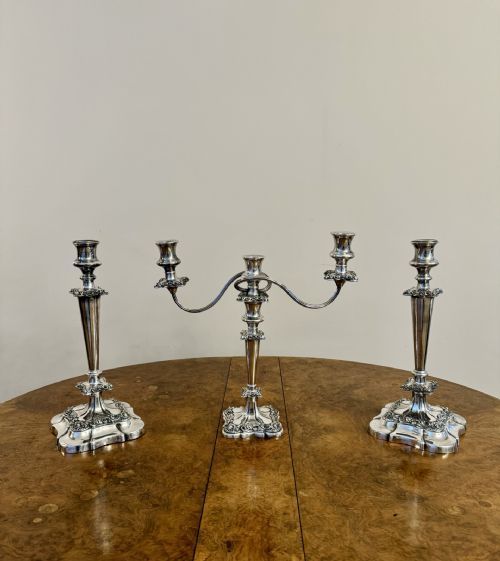


Victorian Garniture Set
A victorian garniture set brings symmetry to a room, pairing a central clock with matched urns or candelabra.
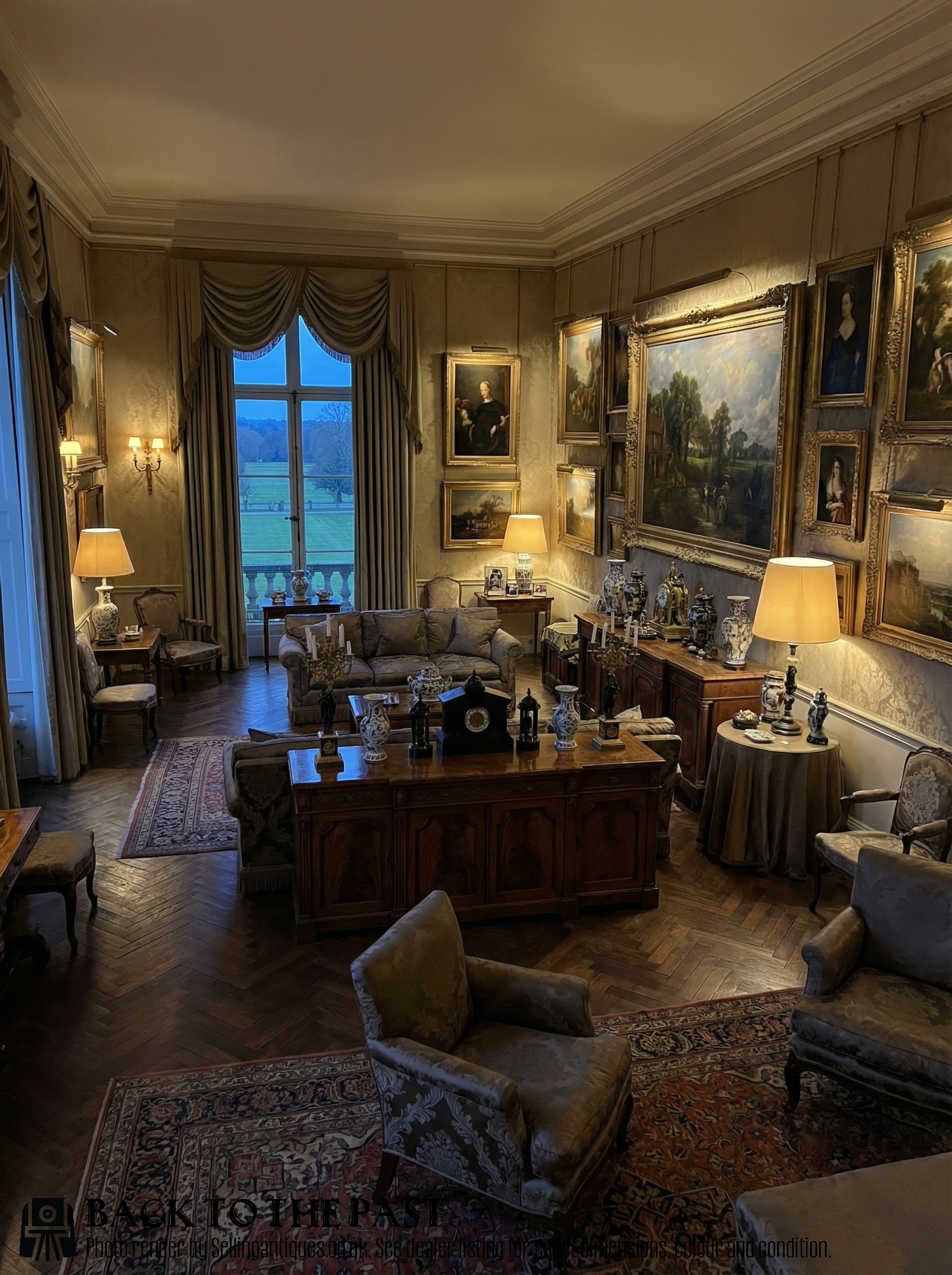
Victorian Garniture Set
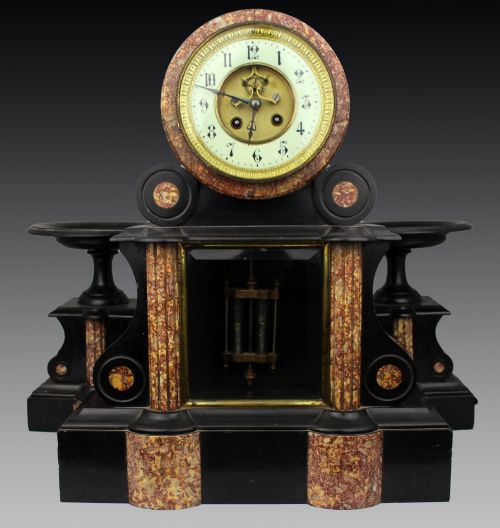
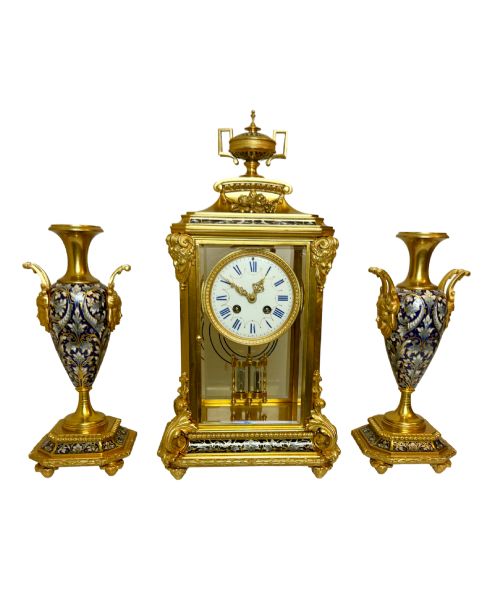
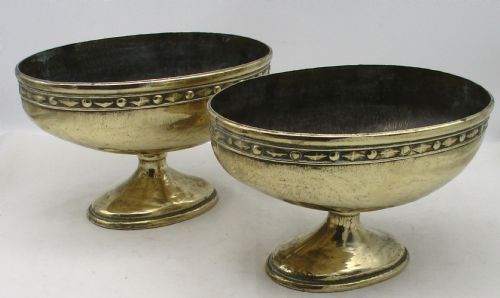
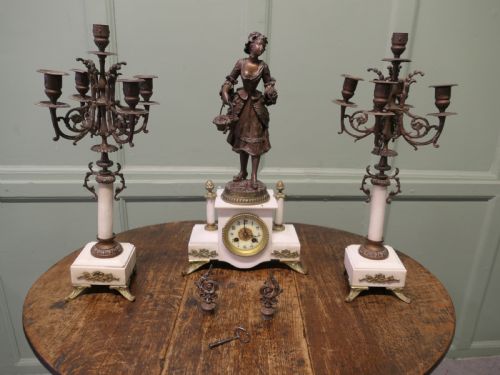
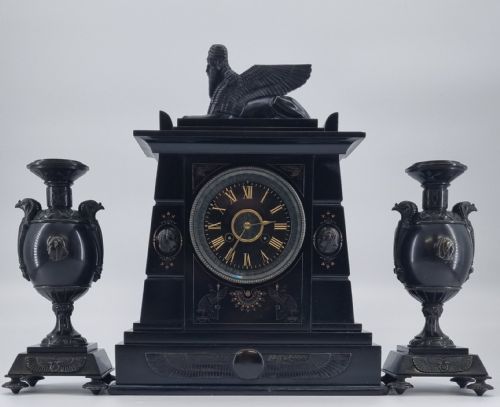
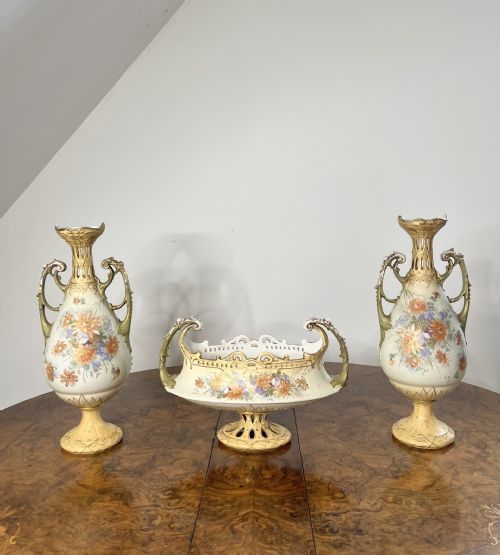
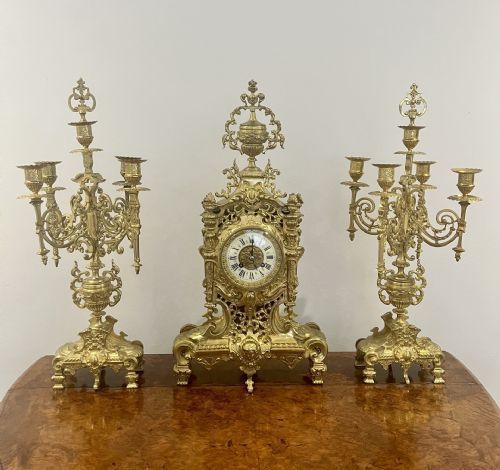
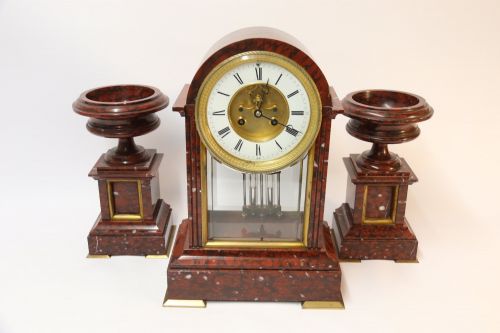
A victorian garniture set comprises a central mantel clock accompanied by matching side pieces such as urns, vases, candelabra or pedestal bowls, designed to be displayed together on a fireplace mantel or sideboard. These decorative ensembles originate largely from nineteenth-century French workshops as well as British makers, reflecting a period taste for balanced interior decoration.
The most common configurations found here combine a marble, slate or gilt bronze clock with a pair of side vessels, often following Rococo Revival, Napoleon III or Egyptian Revival styles. Buyers encounter three-piece groupings most frequently, though occasional larger centrepieces with matching side vases appear.
These arrangements served both a practical purpose in telling time and a decorative function in drawing the eye across a mantelpiece. The side pieces repeat the motifs, materials and colour palettes of the central clock to create a unified focal point within the room.
Materials and construction
Makers utilised heavy structural materials such as black marble, white marble, black slate and onyx to form the sturdy bases and bodies of the clocks and side pieces. Metalwork components combined cast brass, ormolu, gilt bronze and silver plating, often worked with intricate chased details.
Decorative surfaces frequently incorporated champleve enamel, cloisonne, hand-painted porcelain panels from factories like Sevres and KPM Berlin, or overlaid Bohemian glass. Movement mechanisms relied on traditional eight-day brass clockworks produced by specialist French makers.
Some nineteenth-century French clockmakers hid their brass movement signatures so cleverly behind the bell that owners needed a flashlight just to find them.
Assessing quality and execution
Quality rests in the crispness of the bronze casting and the depth of the ormolu gilding, where sharper chiselling separates superior examples from softer secondary work. The integration of the set matters profoundly, as top-tier groupings share identical patination, matching marble blocks and synchronized decorative motifs across all components.
The sophistication of the secondary materials dictates the upper tier of the range, distinguishing hand-painted porcelain panels and complex champleve enamel work from simpler brass or plain slate. Movement signatures from recognised mechanists further elevate an assemblage.
Japy Freres·Samuel Marti·A D Mougin·Raingo Fres Paris·KPM Berlin
The Victorian Garniture Set Glossary
- Garniture
- A set of ornamental objects designed to be displayed together, typically consisting of a central clock flanked by two matching vases, urns or candelabra. This arrangement provides symmetrical decoration for a mantelpiece.
- Ormolu
- Gilded bronze produced by applying a mercury and gold amalgam to cast bronze before heating. The process creates a rich, durable golden finish characteristic of nineteenth-century French decorative metalwork.
- Champleve enamel
- A technique where troughs are hollowed out in the surface of a metal object and filled with vitreous enamel powder before firing. The resulting coloured patterns sit flush with the surrounding metal borders.
- Candelabra
- Branched candlestick holders designed to hold multiple tapers simultaneously. They frequently form the side pieces of a clock garniture set.
- Toleware
- Painted or enamelled sheet metal items produced in various decorative styles. These pieces provide durable coloured surfaces often seen in nineteenth-century decorative sets.
Victorian Garniture Set: Frequently Asked Questions
How do I style a garniture set?
Place the central clock in the exact middle of your mantelpiece or sideboard to establish symmetry in the room. Position the matching side urns or candelabra evenly on either side to complete the balanced arrangement.
Ensure the display has sufficient depth behind it so the decorative side pieces do not crowd the wall. Let the natural light hit the gilt bronze or enamel panels to highlight the fine details.
What powers these antique clocks?
Most clocks within these sets operate on an eight-day mechanical movement driven by a spring and controlled by a pendulum. They require manual winding using a matching key every week to maintain accurate time.
Professional servicing helps keep the delicate brass gears running smoothly. Avoid moving the clock without securing the pendulum first to prevent internal damage.
How do I identify French sets?
French sets often feature movement stamps, serial numbers or maker signatures engraved directly onto the brass clock mechanism inside the back door. The styling typically leans toward Napoleon III, Empire or Rococo Revival aesthetics with heavy use of marble and ormolu.
Stylistic cues include hand-painted porcelain plaques depicting romantic scenes and intricate champleve enamel work. The craftsmanship of the cast bronze mounts also points toward Parisian workshops.
What is the difference between slate and marble?
Black slate is a dense, uniform fine-grained metamorphic rock that provides a heavy, matte black foundation for many nineteenth-century clocks. Marble is a crystalline limestone that displays natural veining in colours ranging from white to green and red.
Slate sets often feature incised gilt engravings, whereas marble sets rely on the polished stone grain for visual texture. Both materials offered the substantial weight needed to support heavy bronze mounts.