



Victorian Ceramic Children Figure
These Victorian ceramic children figure pieces capture nineteenth-century sentiment through modelled clay and porcelain.
Victorian Ceramic Children Figure
A victorian ceramic children figure depicts young subjects in various settings, ranging from Staffordshire pottery pairs featuring children with horses and setters to delicate porcelain groups from continental workshops. Buyers encounter these figures in forms such as individual statues, holy water fonts, terracotta busts, and elaborate pairs meant for mantel display.
The objects span production dates from the mid-nineteenth century into the early twentieth century, reflecting diverse regional aesthetics including English earthenware, French bisque, and German porcelain. Many representations capture domestic innocence, pastoral scenes, or literary themes popular during the period.
Materials and production
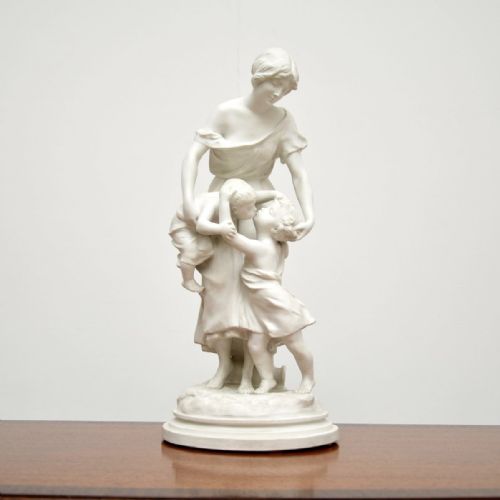
Potters utilised materials such as earthenware, terracotta, parian porcelain, and bisque porcelain to model these figural groups. Bisque and parian bodies were left unglazed to highlight sculptural detail and emulate carved marble.
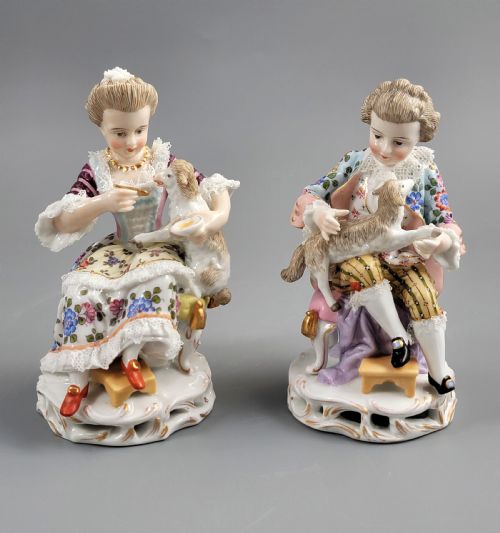
Makers applied hand-painted enamels and gold leaf accents over fired ceramic bases. Earthenware figures often received tin or lead glazes before secondary low-temperature firing for colour application.
Children occasionally share the ceramic stage with remarkably cooperative pets, including steadfast setters and bemused lambs.
Evaluating the pieces
Model crispness distinguishes finer figures, where facial expressions, hands, and drapery remain sharp and well-defined rather than soft or blurred from worn moulds. Superior examples show careful brushwork in the hand-painted enamels and precise application of gilt details.
The distinction between standard commercial output and superior studio work lies in the delicacy of the modelling and the finish of the ceramic body, particularly in unglazed parian and bisque pieces where surface texture dictates visual appeal.
Copeland·Sitzendorf·Carl Thieme Dresden·Ernst Bohne und Söhne·Royal Worcester·Helena Wolfsohn·Royal Dux Bohemia
The Victorian Ceramic Children Figure Glossary
- Parian porcelain
- A fine-grained, unglazed porcelain developed in the nineteenth century to imitate white marble. It contains a high proportion of feldspar, which vitrifies during firing to produce a smooth, matte finish.
- Bisque porcelain
- Unglazed porcelain that has undergone a single firing to produce a porous, matte surface resembling marble. It is frequently used for nineteenth-century portrait busts and figural groups.
- Staffordshire pottery
- Earthenware produced by numerous potteries in the English region of Staffordshire. These works are typically slip-cast or hand-modelled and painted with bright underglaze colours.
- Majolica
- Low-fired earthenware covered with an opaque tin-lead glaze and painted with metallic oxide colours. The technique yields vibrant green, brown, and ochre tones characteristic of Victorian decorative wares.
- Holy water stoup
- A small vessel or basin for holy water, often incorporating figural ceramic backplates for domestic wall hanging. These devotional objects appear in various Victorian ceramic traditions.
Victorian Ceramic Children Figure: Frequently Asked Questions
How do I clean antique ceramic figures?
Dust these fragile figures gently with a soft, dry brush to prevent the loss of delicate painted details or unglazed ceramic edges.
Avoid using water or chemical cleaners, particularly on bisque, parian, and enamel surfaces where moisture can cause permanent staining or damage.
Were these figures made as pairs?
Many Victorian figural groups were produced as symmetrical pairs designed to balance mantelpieces or sideboards.
Single figures also appear frequently, often representing standalone subjects like literary characters or allegorical children.
What is the difference between parian and bisque?
Parian porcelain contains specific fluxing agents that melt during firing to create a dense, marble-like body used for statuary.
Bisque is standard porcelain fired without glaze, resulting in a more porous and chalky texture suited to softer figural modelling.
How can I tell English pieces from continental ones?
English Staffordshire and Parian pieces generally exhibit sturdier earthenware or dense porcelain bodies with simpler utilitarian forms.
Continental factories from Germany and France often employed more intricate mouldings, elaborate floral encrustations, and delicate polychrome enamels.