
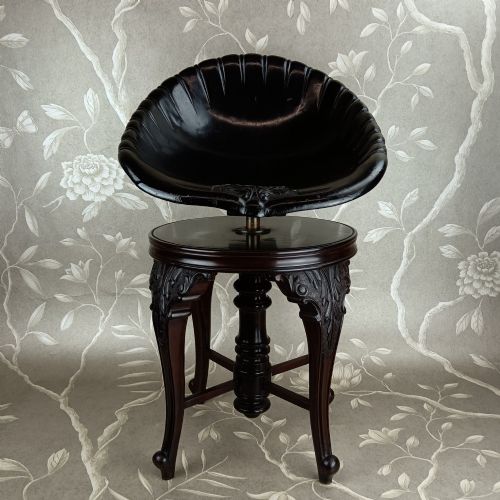
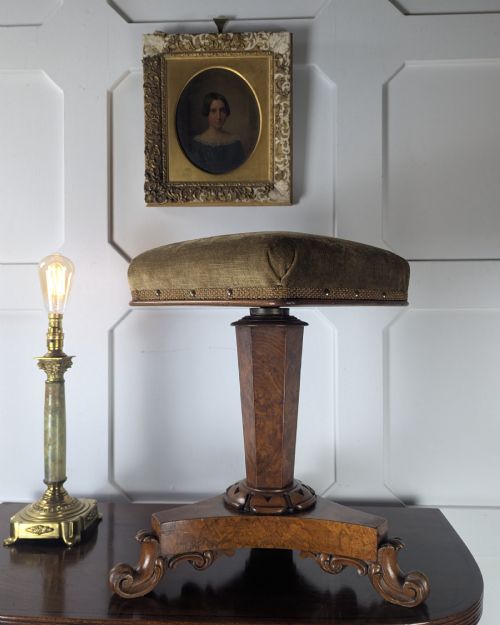
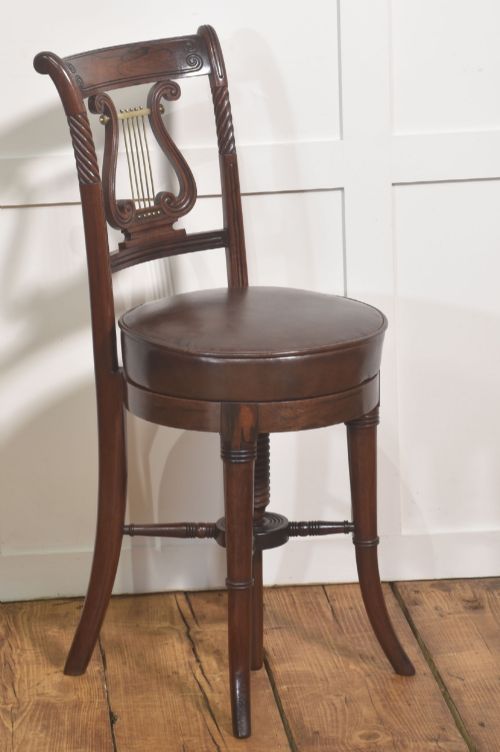
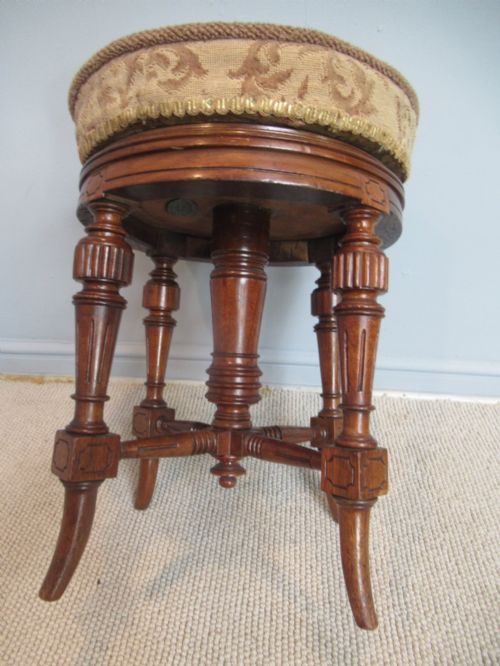


Victorian Carved Music Stool
A victorian carved music stool brings adjustable height and fine timber turning to the piano or harp, offering practical comfort alongside period presence.
Victorian Carved Music Stool
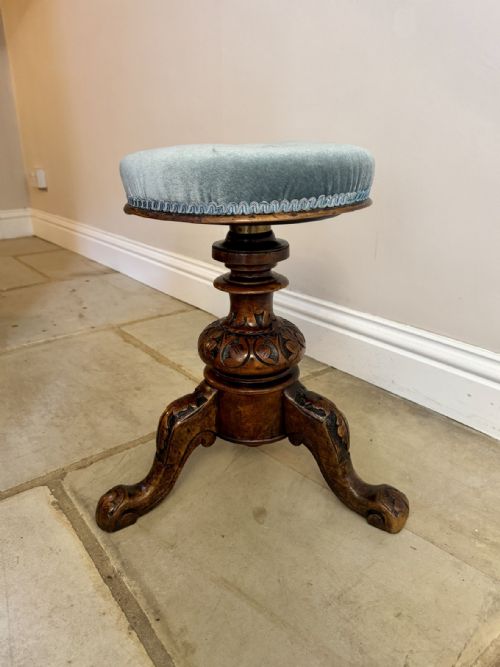
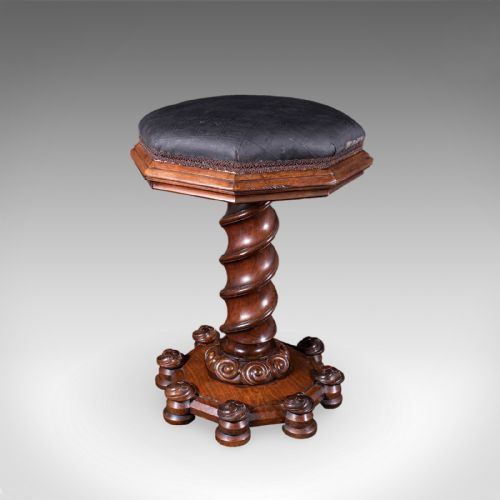
A victorian carved music stool spans piano stools, revolving chairs, and harpist seats created across the nineteenth century. The typical piece encountered here employs a swivel or rising mechanism atop a turned pedestal or carved legs.
Makers drew on styles ranging from William IV and Grand Regency through to Aesthetic Movement and French Chateau influences. Walnut and rosewood dominate the selection, often featuring upholstered tops in velvet, leather, or fabric.
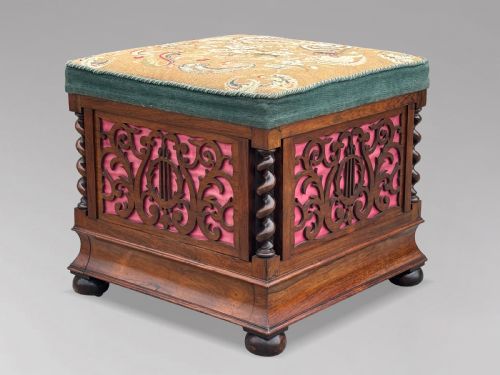
Beyond standard single seats, the record shows duet stools with hinged lids and Canterbury compartments for sheet music storage. Occasional variations include grotto motifs, oak frames, and papier-mâché details.
Defining quality
The standard of carving sets the finer examples apart, distinguishing crisp, deep relief work from plain turned legs. Walnut and rosewood framing with robust timber thickness denotes superior workshop production compared to lighter secondary woods.
Mechanism integrity dictates daily usability, where a smooth, stable swivel or a precise rise-and-fall screw without excessive wobble separates better specimens. Original upholstery support and retained makers' signatures add further distinction.
Listings feature woods such as walnut, rosewood, mahogany, and oak, alongside brass and leather details.
Jennens and Bettridge·Jas Shoolbred
The Victorian Carved Music Stool Glossary
- Revolving stool
- A seat featuring a threaded spindle or swivel joint allowing the top to rotate. This mechanism lets the pianist adjust height or pivot smoothly toward the keyboard.
- Harpist chair
- A specialised seat often designed with an asymmetric or low backrest to accommodate the player's instrument. These pieces frequently appear in rosewood or walnut.
- Canterbury stool
- A music seat incorporating partitioned lower racks designed for holding sheet music. It combines dual-purpose seating with practical storage.
- Rise and fall
- An adjustable height mechanism operated by turning the seat top on a central wooden or metal screw. This allows precise positioning for different performers.
- Papier-mâché
- A composite material made from paper pulp reinforced with glue and resin, pressed into moulds. Jennens and Bettridge utilised this technique on decorative stool components.
Victorian Carved Music Stool: Frequently Asked Questions
How do adjustable piano stools work?
Most examples rely on a central wooden screw or metal spindle hidden beneath the upholstery. Rotating the seat clockwise or anti-clockwise raises or lowers the top.
Simpler models use a pin and ratchet system or a revolving swivel joint without height alteration.
What is a Canterbury stool used for?
A Canterbury combines a padded seat with vertical wooden partitions built underneath. Musicians used the lower compartments to store sheet music and folios.
This kept scores tidy and close at hand beside the piano or harp.
How can I date a music stool?
Dating relies on timber choice, carving style, and mechanical fittings. Earlier nineteenth-century pieces often display William IV rosewood or mahogany framing.
Later Victorian versions frequently incorporate walnut, ebonised finishes, or Aesthetic Movement motifs.
Are these stools suitable for daily use?
Solid hardwood construction and durable joints make these pieces robust enough for regular sitting. The internal screw mechanisms are built to handle frequent height adjustments.
Care should be taken not to spin the top past its stopping point to protect the wooden thread.