


Victorian Brass Cookware
Victorian brass cookware brings honest nineteenth-century utility to the modern interior, offering robust metal vessels shaped for practical use.
Victorian Brass Cookware
When buyers search for victorian brass cookware, they encounter nineteenth-century kitchen vessels and related culinary metalwork originating from the Victorian period. These pieces span utilitarian pans, preserving vessels, and small models that reflect the heavy domestic output of the era.
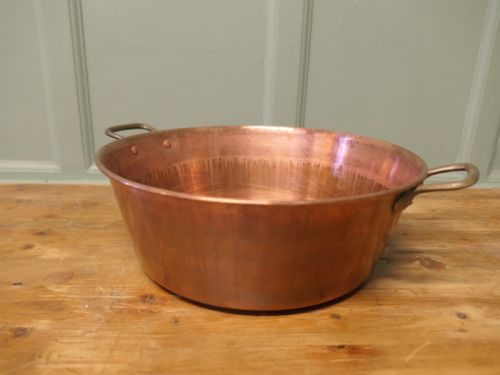
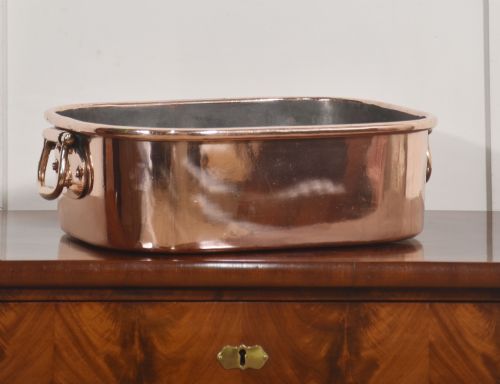
The objects most frequently met on this page include preserving pans, saucepans, and fish kettles constructed primarily from copper and brass. Many items combine brass handles with copper bodies or feature iron attachments suited to heavy kitchen routines.
How they were made
Makers utilised heavy sheet metals and casting techniques to produce durable vessels capable of enduring direct heat. Copper bodies often joined with brass handles via rivets, while interiors frequently retained a thin coating of tin for safe food contact.
Surface finishes range from plain hammered textures to embossed decorative patterns on pots and cooking vessels. Iron and cast iron elements were incorporated into handles or specific structural components to ensure rigidity during heavy domestic service.
Some nineteenth-century kitchen collections include miniature flat tub stoves, proving that Victorian cooks enjoyed tiny domestic appliances just as much as modern ones.
What varies in quality
Subtleties in metal gauge and wall thickness set finer nineteenth-century vessels apart from standard utility items. Heavier metal gauge prevents warping under heat and indicates a higher grade of original manufacture intended for sustained domestic service.
The integrity of joints, riveted handle attachments, and the survival of interior tinning dictate the structural merit of each piece. Superior examples retain balanced proportions and uncompromised metal thickness across both the pan body and handle fixings.
Hodges and Sons·Harrods
The Victorian Brass Cookware Glossary
- Preserving pan
- A wide, open vessel designed for boiling fruit and sugar mixtures, typically featuring a curved base and a strong carrying handle.
- Fish kettle
- An elongated metal pan equipped with a tight-fitting lid and internal straining tray, built specifically for poaching whole fish.
- Tinning
- A protective layer applied to the interior surface of copper and brass cooking vessels to prevent metallic transfer to food during preparation.
- Embossed
- A technique where decorative patterns are hammered or pressed into the sheet metal to raise the design in relief from the surface.
Victorian Brass Cookware: Frequently Asked Questions
How do I clean old brass cookware?
Maintenance requires gentle cleaning solutions designed for historic metals to preserve the natural patina developed over the nineteenth century.
Avoid abrasive scouring pads that strip away the aged surface character accumulated by these working kitchen items.
Can I still cook with these pans?
Many nineteenth-century vessels retain their structural form, but modern culinary use depends on the condition of the interior lining.
Vessels lacking an intact tin lining are best reserved for display rather than active food preparation on modern cooktops.
What metals were used in Victorian kitchens?
Kitchen equipment from this era relied heavily on copper, brass, iron, and tin for different cooking tasks.
Metals were selected for their thermal properties, strength, and ability to withstand continuous exposure to open fires and hearths.
How do I date nineteenth-century brass items?
Dating relies on observing manufacturing techniques, tool marks left by hand-hammering, and stylistic cues typical of the Victorian period.
Comparing handle construction and rivet placement against documented nineteenth-century examples helps narrow down the period of origin.