
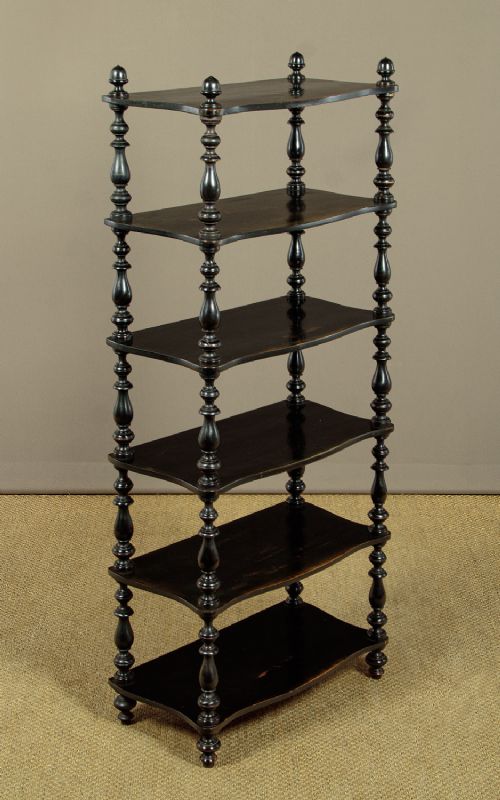


Victorian Black Lacquer Furniture
Victorian black lacquer furniture brings gleaming dark surfaces and intricate painted scenes into a room.
Victorian Black Lacquer Furniture
Victorian black lacquer furniture encompasses small tables, étagères, cabinets, and occasional seating produced during the nineteenth century. These items showcase dark finishes, often drawing on Asian design motifs through Chinoiserie and Japonisme influences.
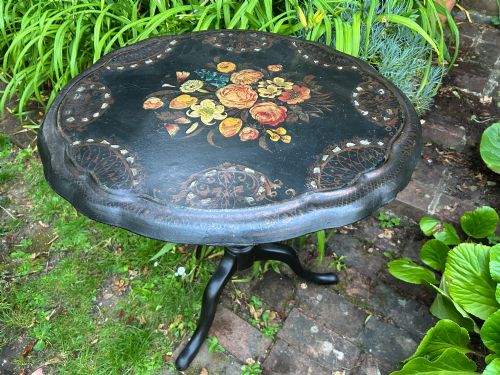
Tray tables and tilt-top tables formed from papier-mâché appear frequently alongside wooden occasional tables and stands. Many examples incorporate pedestals, tier structures, or later stands adapted to support historic lacquer trays.
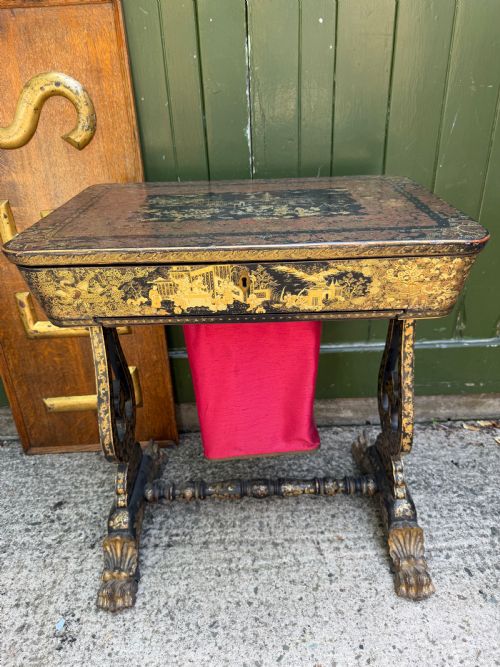
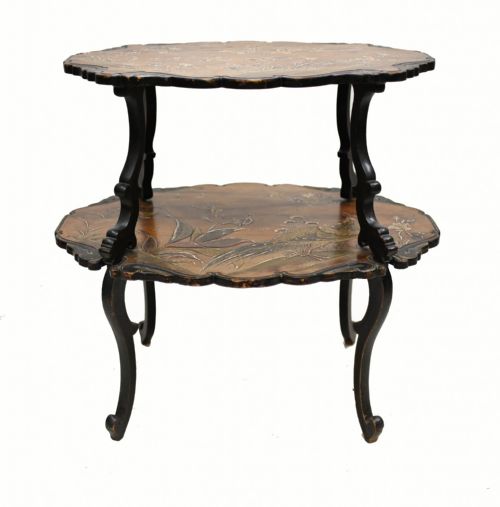
The style shifts from mid-century Chinoiserie towards Aesthetic Movement and late nineteenth-century Japonisme expressions. Buyers encounter diverse forms ranging from games tables and work-tables to multi-tiered stands and display shelves.
Materials and construction methods
Papier-mâché serves as a primary foundation for many surfaces, moulded under pressure and finished with dark lacquer to create smooth, resilient table tops and trays. Wood forms alternative structures, sometimes ebonised to mimic solid black finishes or combined with bamboo.
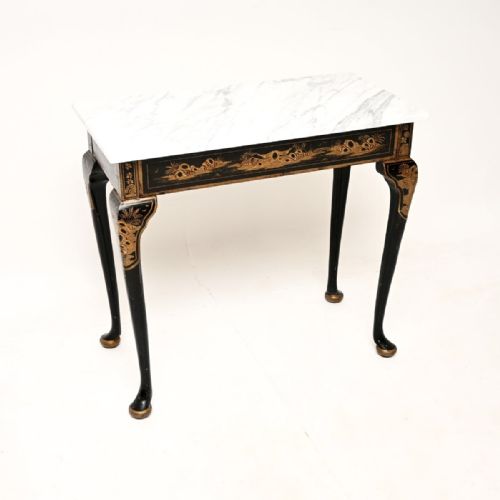
Gilded decoration and painted scenes define the aesthetic, often paired with mother-of-pearl inlay that catches the light against the dark background. Brass fittings and marble tops appear on specific tables and stands to add structural weight and contrast.
Materials documented across the selection include lacquer, ebonised wood, papier-mâché, bamboo, mother-of-pearl, gilt, and marble.
Evaluating quality and execution
Quality reveals itself in the depth of the lacquer surface and the precision of the hand-painted or gilded motifs. Finer pieces display crisp detail in Chinoiserie landscapes and securely set mother-of-pearl inlay rather than flat, repetitive stencilling.
The integrity of the underlying papier-mâché or wood substructure dictates durability, particularly at tilt-top mechanisms and table joints. Original stands or harmonious period adaptations hold greater consistency than mismatched recent replacements.
The Victorian Black Lacquer Furniture Glossary
- Lacquer
- A durable resin finish applied in multiple layers to wood or papier-mâché to create a hard, glossy surface. It provides the characteristic deep black sheen found across these nineteenth-century pieces.
- Papier-mâché
- A composite material formed from paper pulp or layers of paper mixed with glue and resin, then pressed and dried. It offers a lightweight yet rigid base for decorative trays and tilt-top tables.
- Chinoiserie
- European artistic interpretation of Chinese and East Asian decorative styles, featuring pavilions, figures, and landscapes. This style frequently adorns the black lacquer surfaces of Victorian tables and cabinets.
- Japonisme
- The influence of Japanese art and design on Western makers during the late nineteenth century. It often appears alongside Chinoiserie elements in Aesthetic Movement furnishings.
- Ebonised
- Wood treated with chemical stains, dye, or paint to simulate the appearance of solid ebony. This technique achieves a dark, uniform finish on frames and structural supports.
- Tilt-top table
- A table designed with a hinged mechanism allowing the top to pivot vertically when not in use. This clever space-saving feature appears frequently on papier-mâché occasional tables.
Victorian Black Lacquer Furniture: Frequently Asked Questions
How do I care for black lacquer furniture?
Dust surfaces gently with a soft, dry microfibre cloth to prevent scratching the glossy finish. Avoid harsh chemical cleaners, moisture, and direct sunlight, which can dull or crack the delicate lacquer over time.
Place protective felt pads under any items set upon the tables to preserve the painted decoration. Maintaining a stable room temperature helps protect both the wooden and papier-mâché foundations.
Were these pieces made in Asia or Europe?
Most items listed originate from British and European workshops interpreting Asian aesthetics, though pieces like Chinese export lacquer work-tables were brought from abroad. European makers embraced techniques from Japan and China to satisfy domestic demand for exotic goods.
Local manufacturers produced papier-mâché trays and wooden stands locally, applying Chinoiserie and Japonisme designs by hand. This blend of foreign inspiration and domestic craftsmanship defines the category.
What is the difference between papier-mâché and wood pieces?
Papier-mâché items utilise a compressed paper pulp composite that allows for smooth, moulded contours without visible joints. Wooden pieces rely on solid timber or ebonised frames to provide traditional structural support.
Both materials receive similar black lacquer finishes and painted decoration, but papier-mâché is typically found on lighter occasional items like trays and tilt-top tables.
How can I identify the Aesthetic Movement influence?
Aesthetic Movement pieces often incorporate simplified geometric lines, bamboo framing, or Japanese-inspired motifs that depart from earlier ornate Victorian styles. The focus shifts towards the relationship between form and surface decoration.
These designs frequently utilise contrasting materials and embrace a more restrained approach to ornamentation compared to mid-century Chinoiserie work.