



Chinoiserie Nesting Side Tables
Chinoiserie nesting side tables bring portable surface space and painted lacquer decoration into a room, offering clever stacking forms for modern living.
Chinoiserie Nesting Side Tables
These chinoiserie nesting side tables are portable sets of graduating surfaces designed to stack together when not in use. You will most frequently encounter sets of four tables, alongside occasional sets of three, originating from the nineteenth century up to the early twentieth century.
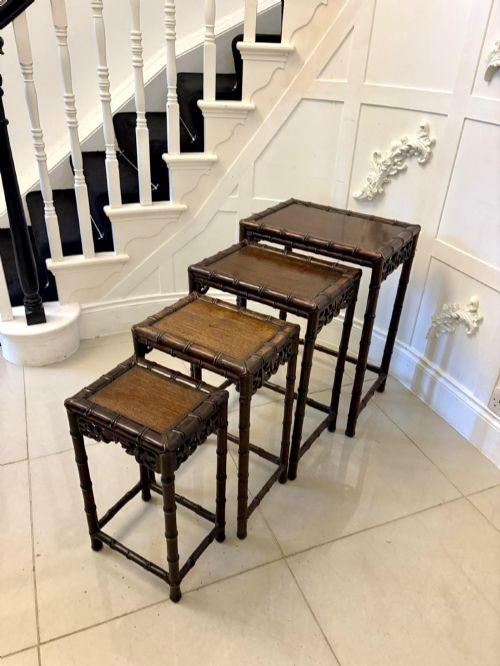
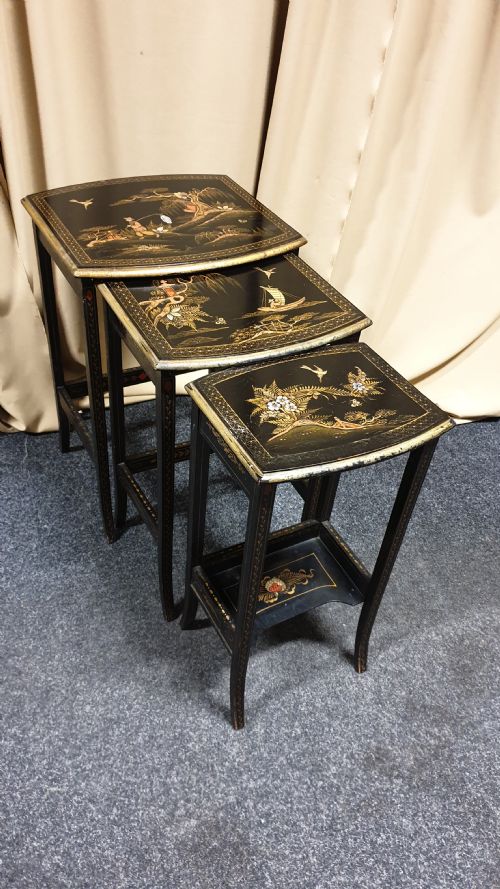
The aesthetic draws heavily on traditional oriental motifs translated through European tastes, encompassing French chinoiserie and Queen Anne styles. Pieces range from carved faux bamboo frameworks to flat occasional tables decorated with elaborate painted scenes.
Makers utilised dark finishes to frame intricate pictorial details, creating a coherent group of multi-tiered tables that save space while providing distinct decorative impact.
Materials and construction methods
Construction relies upon solid hardwood frames and occasional carved bamboo components that provide sturdy support for the graduating surfaces. Artisans built these tiers to slip neatly beneath one another, requiring precise dimensional tolerances.
Surfaces are finished in black lacquer and detailed with gold leaf, gilding, or gilt paint to depict pictorial motifs. Some examples incorporate fine boulle-work alongside the lacquer to introduce contrasting textures across the tables.
Listings span the nineteenth century through to 1920, incorporating lacquer, hardwood, and gold leaf across four distinct styles.
Assessing quality and craftsmanship
The fineness of the painted decoration and the crispness of the gilt work dictate the visual distinction of a set. Superior examples display detailed brushwork and careful application of gold leaf over deep lacquer grounds.
Structural integrity across all graduating tiers marks the difference between standard production and finer pieces. The smoothness with which tables slide into their nested arrangement reflects the initial precision of the maker's joinery.
The Chinoiserie Nesting Side Tables Glossary
- Chinoiserie
- European artistic interpretation of Chinese and East Asian decorative styles, popular in furniture design. It typically involves painted scenes of figures, pavilions, and landscapes on dark lacquer.
- Nest of tables
- A set of graduating tables designed to fit one beneath another to save floor space. They function as individual occasional surfaces when separated.
- Lacquer
- A durable resin finish applied in multiple layers and polished to a smooth sheen. It provides the dark background typical of these decorative surfaces.
- Boulle-work
- Inlay technique utilising brass and tortoiseshell or similar materials, integrated here into black lacquer surfaces. It adds reflective metallic detail to the composition.
- Faux bamboo
- Wood turned and carved to imitate natural bamboo stalks. This technique appears on nineteenth-century structural supports.
Chinoiserie Nesting Side Tables: Frequently Asked Questions
How were chinoiserie nesting side tables used historically?
These tables served as versatile furniture that could be pulled out to hold tea or books and stacked away compactly when floor space was needed.
Their portable nature allowed servants to reposition them easily around a drawing room to suit the immediate needs of guests.
How do I style these tables at home?
Display the set nested together in a corner or beside a sofa to showcase the graduated painted tops and layered decoration.
Alternatively, separate the tables around a room to provide functional surfaces for lamps or drinks while maintaining a unified decorative theme.
What is the difference between sets of three and four?
Sets of four offer a taller stack and an extra graduating tier, resulting in a slightly wider footprint when fully nested.
Both configurations function similarly as occasional tables, though sets of four demand more vertical wall clearance.
How do I identify a Queen Anne style set?
Queen Anne style versions typically feature distinct cabriole legs that curve outward and taper to pad feet. This form reflects early eighteenth-century furniture shapes revived during later manufacturing periods.