





Victorian Anglo Indian Shelves
Victorian Anglo Indian shelves bring intricate colonial craftsmanship and rich exotic timbers into a room, offering both display space and historic character.
Victorian Anglo Indian Shelves
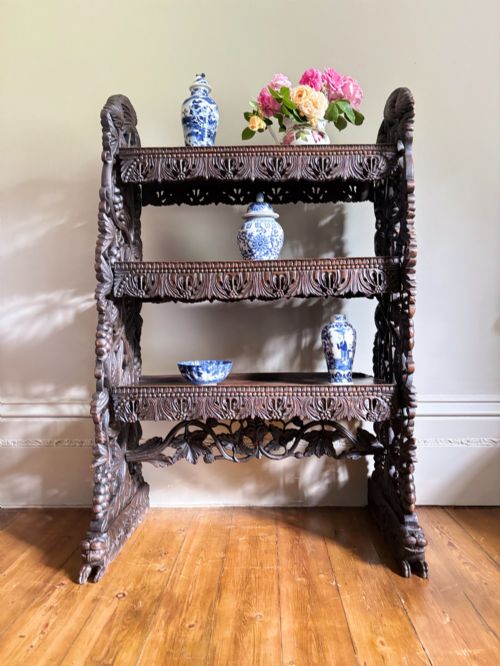
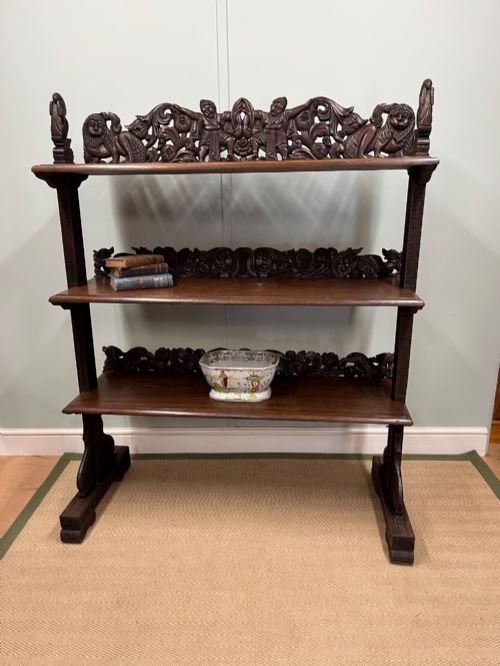
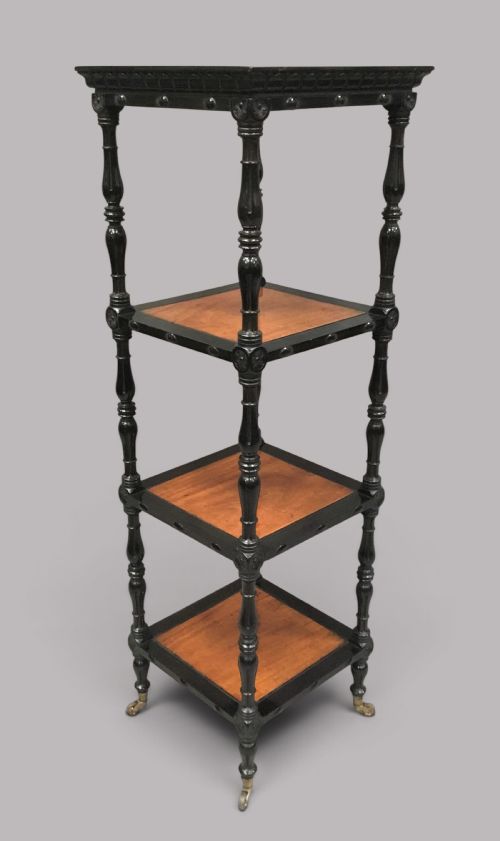
Victorian Anglo Indian shelves encompass a variety of wall brackets, etageres, and multi-tiered whatnots originating from the nineteenth century. These pieces display distinct colonial design influences, merging British furniture forms with traditional local carving traditions.
Buyers frequently encounter three-tier buffets, carved wall shelves, and revolving bookcases. The selection spans compact wall brackets alongside larger floor-standing pieces suited for display.
Origins represented in the inventory include Anglo Indian and Burmese work, utilising dense tropical timbers shaped into distinct shelving units. Each piece demonstrates the cross-cultural exchange of the Victorian period.
Materials and construction
Craftsmen built these shelves from dense exotic timbers including padauk, teak, rosewood, satinwood, and ebony. These heavy hardwoods provided the structural stability needed for elaborate open shelving and fretwork.
Makers utilised deep relief carving and pierced fretwork to decorate the surfaces, frames, and upright supports. This decorative technique created intricate floral and geometric patterns typical of colonial workshops.
Victorian Anglo Indian Shelves Retail Price Guide 2026
Typical asking prices for victorian anglo indian shelves among the pieces listed under this phrase on Sellingantiques today, from the lower quarter to the upper quarter. They describe what is for sale here now, not the wider market.
Assessing quality
Quality rests upon the depth, sharpness, and intricacy of the hand carving across the timber framework. Superior pieces display crisply defined foliage and figures without the softness or shallow cuts seen in simpler work.
The choice and figuring of the timber dictate the overall character and visual weight of the item. Dense rosewoods, highly figured satinwoods, and rich padauk elevate the piece above standard mahogany or secondary hardwoods.
The Victorian Anglo Indian Shelves Glossary
- Whatnot
- A piece of furniture consisting of open shelves for displaying small objects. They typically feature three or more tiers supported by turned columns or carved uprights.
- Padauk
- A heavy, durable tropical hardwood with a reddish-brown colour that darkens with age. It is prized for its strength and ability to hold fine carved details.
- Etagere
- A set of open shelves for knick-knacks and ornaments, often designed to fit into corners or hang upon walls.
- Fretwork
- Ornamental perforated woodwork created by cutting patterns through thin boards. It provides a lace-like visual effect on brackets and mirror frames.
- Satinwood
- A lustrous, yellow-brown timber with a satin-like sheen, frequently used for high-status colonial cabinetry and inlay.
Victorian Anglo Indian Shelves: Frequently Asked Questions
What are Victorian Anglo Indian shelves?
These items are nineteenth-century display furniture and wall brackets created under British colonial influence, using dense tropical timbers and intricate hand-carved decoration.
They combine traditional European forms, such as whatnots and bookcases, with the distinct decorative styles of South and Southeast Asian workshops.
Where were these shelves made?
The pieces originated in colonial workshops across India, Burma, and Ceylon during the nineteenth century. Local artisans executed British-commissioned forms using native timbers.
This synthesis created a distinct crossover aesthetic that served expatriate homes and the domestic British market.
How do I style wall brackets?
Wall brackets and small shelves provide a focal point for displaying small sculptures, ceramics, or framed photographs. Mount them securely to accommodate the substantial weight of the dense tropical hardwoods.
Keep surrounding wall colours neutral to let the deep tones and intricate carving stand out clearly.
What timbers were used?
Makers relied on durable exotic hardwoods capable of supporting intricate pierced work and heavy tiered structures. Common species include teak, padauk, rosewood, satinwood, and ebony.
These woods offer rich natural colouration and dense grain patterns that respond well to traditional hand-finishing.