

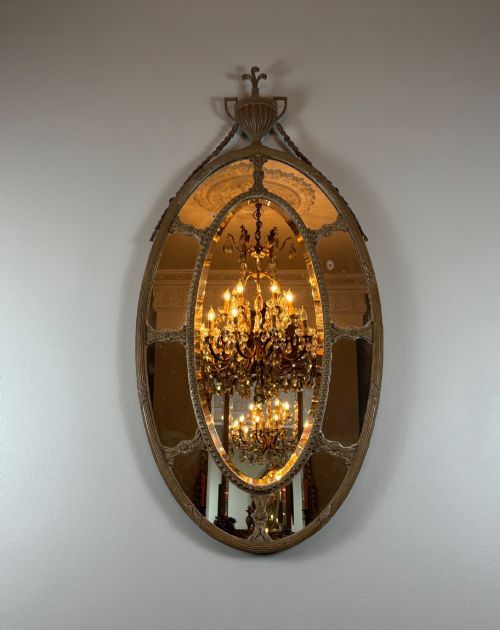


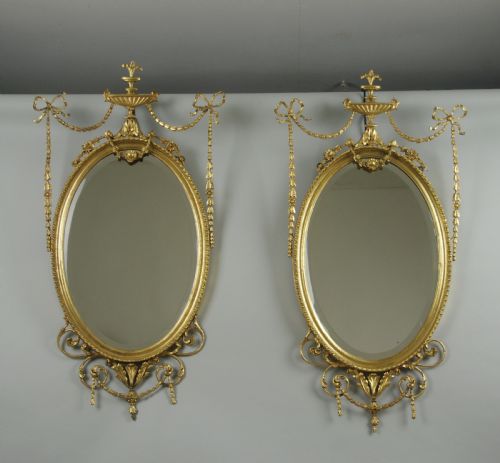


Urn Crest Oval Mirror
An urn crest oval mirror brings neoclassical symmetry to a room, combining vertical glass with classical cresting.
Urn Crest Oval Mirror
An urn crest oval mirror is a wall-hung glass piece topped by a decorative urn, appearing in Victorian, Edwardian, and eighteenth-century examples across these listings. These mirrors draw heavily on neoclassical and revival styles, bringing classical motifs into domestic interiors through balanced proportions and symmetrical ornament.
The format ranges from restrained ebonised frames to elaborate giltwood designs featuring swags and floral details. Most pieces on this page lean towards nineteenth-century revivals of Adam and Regency aesthetics, offering traditional wall decor for reception rooms and halls.
How they were made
Frames rely on a foundation of timber, frequently shaped from oak or softer woods before receiving decorative surface treatments. Gilding and painted finishes define the visual weight of these pieces.
Composition material and gesso allowed craftsmen to mould intricate urns, swags, and floral crests with high relief. These moulded ornaments were applied to the wooden frames prior to gilding or ebonising.
Several mirrors wear their age quietly beneath swags of composition flowers that have outlasted empires.
What varies in quality
The refinement of the carved or moulded crest separates standard production from finer work, with crisp detail in the urns and swags indicating superior craftsmanship. Hand-tooled ornament holds greater depth than simplified mass-produced mouldings.
The depth of the gilding and the quality of the underlying gesso layer dictate how the frame ages and reflects light. Original mirror glass with minor foxing often retains a softer, more atmospheric reflection than modern replacements.
The Urn Crest Oval Mirror Glossary
- Giltwood
- Wood that has been coated with a thin layer of gold leaf. This finish creates a bright, reflective surface characteristic of formal period frames.
- Gesso
- A plaster-like mixture applied to wooden frames to provide a smooth base for gilding. It holds sharp, intricate details when carved or moulded.
- Composition
- A moulded mixture of whiting, resin, and oil used for decorative details. It allowed makers to produce consistent classical motifs efficiently.
- Ebonised
- Wood treated with a chemical stain or finish to imitate ebony. This dark, formal surface appears frequently on nineteenth-century frames.
Urn Crest Oval Mirror: Frequently Asked Questions
Where should I hang an urn crest oval mirror?
These mirrors suit spaces where vertical symmetry matters, such as above a fireplace mantelpiece or on a principal hallway wall.
Their elongated proportions help draw the eye upward, making them effective focal points in rooms with traditional proportions.
How do I identify a revival style piece?
Revival pieces draw on earlier classical vocabularies, such as eighteenth-century Adam designs, but were manufactured decades later during the Victorian or Edwardian periods.
Material composition and backboards often provide clues to the true production era rather than the historical style referenced.
What is parcel-gilt?
Parcel-gilt refers to an object that is only partially gilded, leaving another finish like ebonised wood visible alongside the gold leaf.
This technique creates contrast between the dark frame and the highlighted decorative elements.
Are pairs common in these mirrors?
Matched pairs appear occasionally, usually designed to hang symmetrically on either side of a doorway, window, or piece of furniture.
Finding matching examples from the nineteenth century requires attention to frame dimensions and ornament placement.