


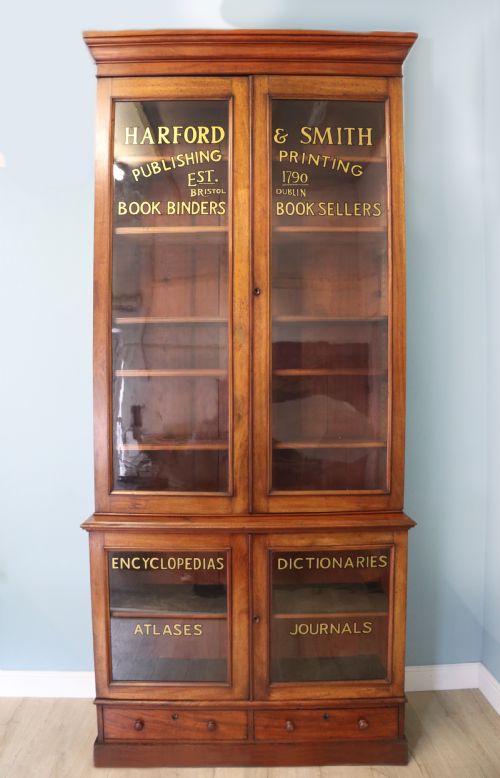
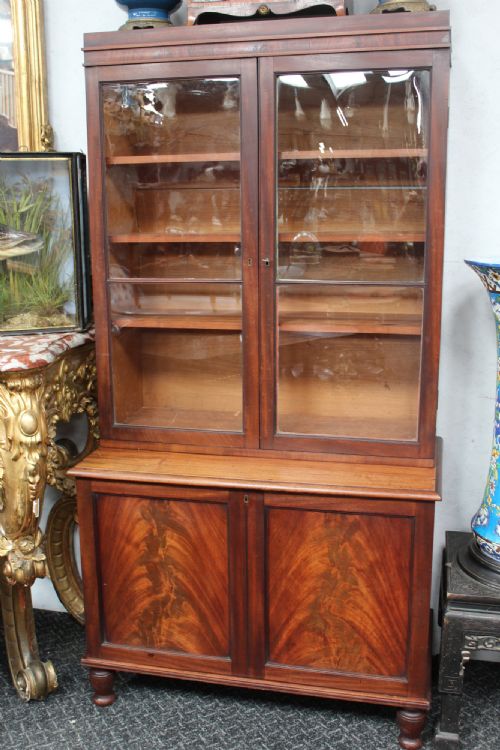

Two Section Bookcase
A two section bookcase gives you serious storage that splits for moving, combining towering proportions with practical transport.

Two Section Bookcase
A two section bookcase is a substantial piece of furniture built in an upper and lower tier to ease transport and placement in tall rooms. The versions you meet most often on this page are Victorian and Edwardian examples in mahogany or walnut, alongside earlier Georgian forms.
These pieces serve as working library furniture or display cabinets, often featuring glazed upper doors to protect books or open shelving for daily access. You also encounter secretaire variants that integrate a fitted writing drawer into the lower section.
The form bridges domestic studies and grand libraries, offering adjustable shelves and robust timber construction across centuries of British cabinet making. Each piece relies on the two-part modular build to negotiate staircases and tight doorways.

How they were made
Makers constructed these bookcases using dense hardwoods like mahogany, walnut and oak, frequently pairing them with secondary pine for internal framing and drawer linings. Glass panelling and brass hardware complete the primary materials recorded in the archive.
Joinery techniques focus on stability under heavy book loads, utilising dovetailed drawers, panelled backs and internal rack systems for adjustable shelving. The split construction demands precise alignment between the upper carcass and the lower base unit.
Some stacking oak bookcases arrive in six separate modular sections, proving that flat-pack convenience belongs to the early twentieth century too.
What varies in quality
Quality rests in the choice of timber and the handling of grain, where figured walnut or well-figured mahogany elevates a standard utilitarian carcass into a refined focal point. The sophistication of internal fittings, such as finely turned shelf supports and pigeonhole interiors, also separates simpler pieces from finer commissions.
Proportion and architectural detail define the upper tiers, distinguishing plain workspace cabinetry from bespoke library furniture with dentil cornices or astragal glazing bars. The integrity of the original split mechanism and the precision of the parting joint remain central to the construction standard.
Lebus
The Two Section Bookcase Glossary
- Two-part
- A cabinet constructed in an upper and lower section that stack together for stability and separate for transport. This division makes tall furniture manageable in domestic rooms.
- Secretaire
- A desk form incorporating a drop-front writing drawer with internal pigeonholes and small drawers. It sits within the lower section of the bookcase.
- Astragal
- The narrow wooden moulding that divides panes of glass within a glazed door. Fine astragals indicate higher craftsmanship than plain single-pane windows.
- Campaign
- Furniture built with modular sections and recessed brass fittings designed for travel. These pieces separate easily and withstand transit.
- Cornice
- The ornamental moulding projecting around the top of the upper section. It caps the elevation and balances the visual weight of the base.
Two Section Bookcase: Frequently Asked Questions
How do I move a two section bookcase?
You separate the top tier from the bottom base by lifting it off the parting joint, reducing the overall weight and height for transport. Removing the adjustable shelves and doors further lightens each carcass.
Once both sections are in the new room, set the base level on the floor before lowering the top section back into place.
Are the shelves adjustable?
Many examples feature movable shelves supported by wooden ratchets, brass studs or traditional sliding grooves inside the upper carcass. This allows you to reconfigure the interior heights for different book sizes.
Older or simpler vernacular pieces may have fixed shelving pegged directly into the sides.
How do I tell a Victorian from a Georgian bookcase?
Georgian pieces often display crisper architectural details like classical cornices, fielded panels and hand-cut cockbeading around drawer fronts. Timbers tend to be dense Cuban mahogany with deep, warm patination.
Victorian versions frequently employ machine-sawn elements, figured walnut veneers, or bolder, heavier proportions suited to larger 19th-century rooms.
What is a secretaire bookcase used for?
The secretaire section provides a pull-out writing surface with small drawers and pigeonholes concealed behind a folding front flap. This gives you a dedicated desk space without needing a separate piece of furniture.
When closed, the desk drawer matches the clean exterior lines of the lower bookcase cabinet.