

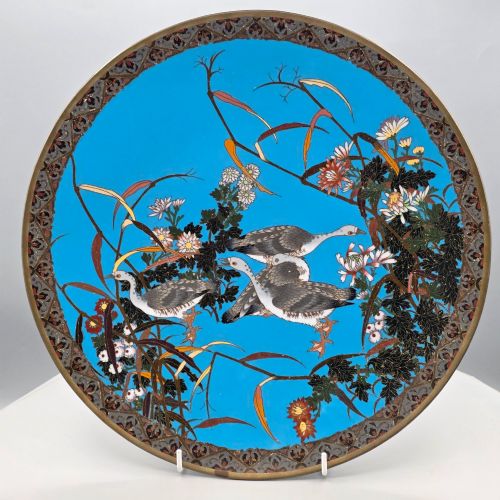



Turquoise Cloisonne Charger
A turquoise cloisonne charger is a striking metal plate decorated with coloured enamel cells, bringing vibrant floral and figurative scenes into any room.
Turquoise Cloisonne Charger
When you search for a turquoise cloisonne charger, you encounter heavy decorative plates and plaques originating mainly from Japan during the Meiji and late Edo periods, alongside earlier Chinese examples. These substantial pieces function primarily as decorative chargers, trays, and dishes rather than tableware.
The dominant visual feature of these works is a vivid turquoise ground that sets off detailed imagery of birds, flowers, dragons, and figures. The selection ranges from medium plates to massive chargers measuring up to fifty centimetres across.
How they were made
Artisans constructed these vessels using a base of copper or brass, forming the foundation of the plate or dish. Onto this metal surface, they soldered thin metal wires, known as cloisons, to outline intricate decorative motifs.
Makers then filled the resulting compartments with enamel paste before firing the piece in a kiln and polishing the surface to a smooth finish. This technique allowed for the creation of complex pictorial scenes defined by precise metal outlines against the turquoise background.
Turquoise Cloisonne Charger Retail Price Guide 2026
Typical asking prices for turquoise cloisonne charger among the pieces listed under this phrase on Sellingantiques today, from the lower quarter to the upper quarter. They describe what is for sale here now, not the wider market.
A solitary bird sits forever on a bronze branch, watching visitors pass by through a sea of turquoise.
What varies in quality
Quality in these works rests upon the precision of the wirework and the depth of the enamel composition. Finer examples display meticulous cell division that creates convincing feathers, petals, and facial expressions without uneven sinking in the fired paste.
The ambition of the subject matter and the finish of the metal rim further distinguish the output. Masterpieces often incorporate signed elements and complex iconography like samurai or dragons, executed with disciplined control over the turquoise fields.
Kinkozan
The Turquoise Cloisonne Charger Glossary
- Cloisonne Enamel
- A technique where metal wires are soldered to a metal base to form cells that hold coloured enamel paste. This method creates detailed patterns bounded by thin metal lines.
- Charger
- A large decorative plate or dish intended for display rather than for serving food. These items often feature prominent pictorial designs.
- Meiji Period
- A Japanese historical era lasting from eighteen sixty-eight to nineteen twelve, known for significant developments in metalwork and decorative arts. Many extant pieces date from this time.
- Edo Period
- A period in Japanese history preceding the Meiji era, spanning from sixteen hundred and three to eighteen sixty-seven. Pieces from the late portion of this era demonstrate early mastery of large-scale enamelling.
- Cloisons
- The small metal wires affixed to the body of a vessel to create compartments for enamel. These wires remain visible on the finished surface as outlines.
Turquoise Cloisonne Charger: Frequently Asked Questions
What were turquoise cloisonne chargers used for?
These large plates served primarily as decorative items for display in traditional interiors rather than for practical dining use. Their striking pictorial designs made them central decorative elements on walls or surfaces.
Craftsmen produced them in various sizes to suit different domestic settings, utilising intricate imagery such as birds, dragons, and historical figures to catch the eye.
How do I date a cloisonne charger?
Dating relies heavily on stylistic markers, metal types, and the complexity of the wirework. Pieces from the late Edo period often feature heavier copper foundations and distinct bird or branch motifs.
Meiji period examples frequently exhibit finer wire execution and brighter turquoise grounds, while earlier Chinese pieces display different compositional weight and palette choices.
How should I display a large charger?
Large chargers require sturdy wall mountings or specialist display stands due to their substantial copper and enamel weight. Placement should avoid direct sunlight to protect the integrity of the coloured enamel fields.
Allowing sufficient space around the piece ensures that the detailed wirework and turquoise ground remain the focal point of the room.
What is the difference between Chinese and Japanese pieces?
Chinese and Japanese works employ similar wire-cell techniques but differ significantly in their scale, subject matter, and colour palettes. Chinese examples, such as early plaques, often incorporate bold dragon motifs with distinct ritual undertones.
Japanese pieces from the Meiji era tend to focus on naturalistic studies of birds, flowers, and human figures set against vibrant turquoise backgrounds.