
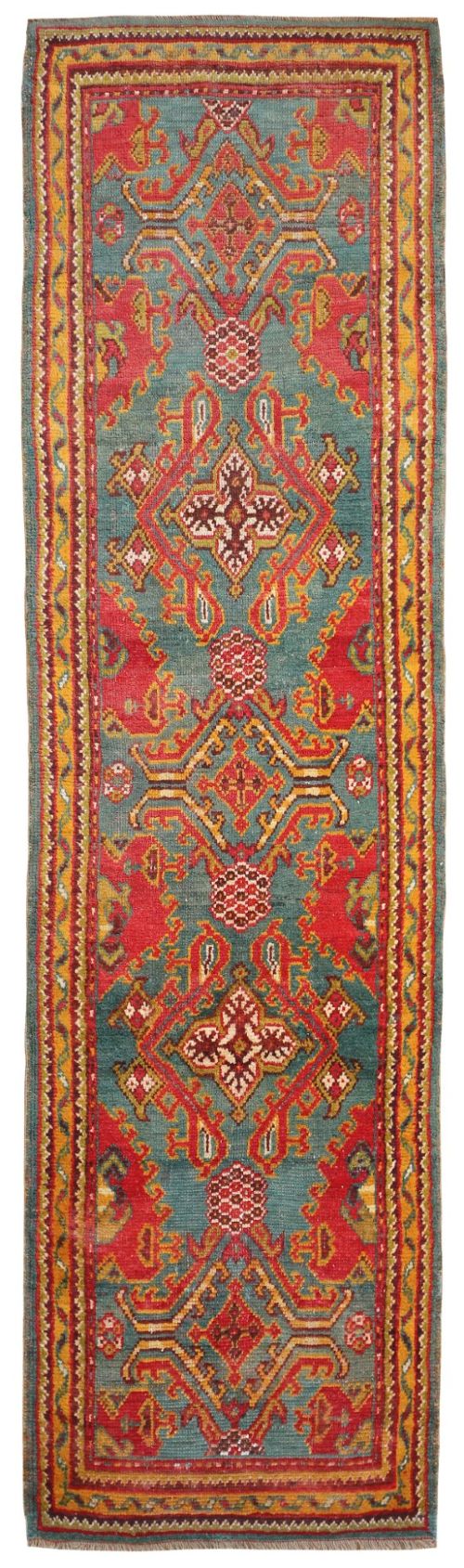



Turkish Ushak Rug
A turkish ushak rug brings understated character to a room through faded palettes and generous proportions.
Turkish Ushak Rug
A turkish ushak rug is a floor covering originating from the historic weaving centre of Ushak in western Anatolia. These pieces encompass large carpets, smaller area rugs, narrow runners, and occasional flatwoven kilims designed for domestic interiors.
The pieces on this page span the late nineteenth century and the early twentieth century, aligning with Victorian production eras and the Ottoman period. Buyers frequently encounter room-sized carpets alongside long runners suited for hallways.
Makers and retailers such as Howard and Sons and Maple and Co. retailed these woven works, linking Turkish production directly to British homes. Regional variations include Borlu examples and specialised prayer rugs.
How they were made
Weavers utilised natural wool and cotton foundations, occasionally incorporating soft angora wool to yield a supple handle. Wood and brass elements appear strictly in associated furniture pieces rather than the textiles themselves.
Construction relied on traditional hand-knotting techniques characteristic of Ottoman and Anatolian workshops. Artisans employed vegetable and natural dyes that softened over time into gentle ivory grounds and pastel tones.
Turkish Ushak Rug Retail Price Guide 2026
Typical asking prices for turkish ushak rug among the pieces listed under this phrase on Sellingantiques today, from the lower quarter to the upper quarter. They describe what is for sale here now, not the wider market.
Some club armchairs arrived wrapped in Ushak carpet upholstery, proving that nineteenth-century comfort could double as an Ottoman floor show.
What varies in quality
The nuance of dye palette and wool selection dictates the visual depth of each floor covering. Softer, more pliable wool grades and harmonious faded hues distinguish superior examples from standard production.
Scale and proportion also influence desirability, particularly in large decorative carpets and matching runner pairs. Intact medallion geometries and well-balanced border designs reflect greater artisan skill.
Howard And Sons·Maples
The Turkish Ushak Rug Glossary
- Ushak
- A traditional town and carpet-weaving centre in western Turkey known for distinctive large-scale floral and medallion motifs. These rugs became staples of late nineteenth and early twentieth century interior decoration.
- Kilim
- A flatwoven textile produced without a pile by tightly interweaving warp and weft strands. These pieces offer lighter floor coverings with crisp geometric patterns.
- Medallion
- A central ornamental design motif placed in the field of the carpet. This focal element anchors the overall composition of Anatolian weaving.
- Angora wool
- A specialised soft fibre utilised in select textile weaving to create a particularly lustrous pile. It yields a tactile quality distinct from standard sheep wool.
- Runner
- A long, narrow carpet format designed specifically for corridors, hallways, and stairs. These pieces often appear in matched pairs from the early twentieth century.
Turkish Ushak Rug: Frequently Asked Questions
How do I clean an antique rug?
Gentle surface brushing and professional specialist cleaning preserve delicate natural dyes and soft wool piles. Heavy immersion washing risks damaging historical foundations.
Regular low-suction vacuuming without a rotating beater bar prevents dust accumulation between the knots.
Where were these carpets used?
Households placed large room-sized carpets in principal reception spaces and drawing rooms to anchor heavy furnishings. Narrow runners fitted transitional hallways and landing floors.
Specialised prayer formats served designated contemplative spaces within domestic interiors.
How do I date a carpet?
Stylistic indicators such as Ottoman design shifts, structural weave density, and retail attribution labels help narrow the period of origin. Victorian and early twentieth-century examples often carry retailer documentation or distinct structural signatures.
Comparison with documented archive pieces provides further chronological context.
Are these pieces fragile?
While historic wool and cotton foundations require mindful placement, sturdy construction allows for domestic use in low-traffic areas. Using a quality underlay reduces friction and physical wear.
Avoiding direct, harsh sunlight prevents premature fading of natural dye compounds.