

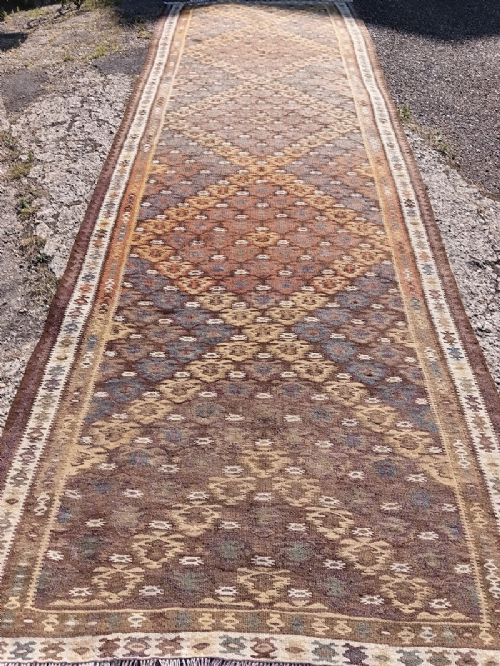


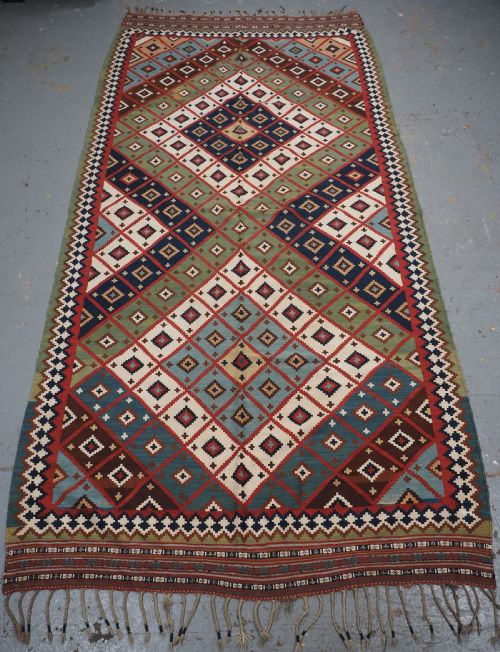


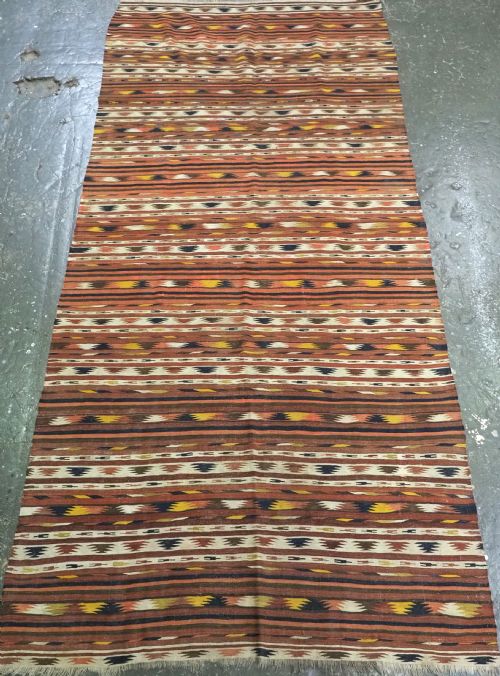
Tribal Flatweave Floor Runner
A tribal flatweave floor runner brings nomadic textile heritage into a hallway, relying on geometric pattern and flat surface construction for long corridors.
Tribal Flatweave Floor Runner
A tribal flatweave floor runner comprises narrow, elongated carpets produced by nomadic or village weavers using tapestry or Soumak techniques. When searching for a tribal flatweave floor runner, buyers encounter long corridor pieces originating from Central Asian, Caucasian, Persian, Anatolian, and Moroccan traditions.
The selection on this page spans from the late nineteenth century through the early twentieth century, encompassing periods from eighteen eighty to nineteen twenty. Formats range from narrow Moroccan Berber runners to multi-strip Uzbek kilims and Yomut Turkmen palas pieces.
These floor runners serve practical transit spaces, bringing distinct tribal motifs, repeat designs, and banded patterns to high-traffic areas. The structure lacks a piled nap, making them thin, durable underfoot, and well-suited for laying flat along corridors and hallways.
What varies in quality
Quality in these floor runners depends upon the tightness of the weave, the precision of the geometric design, and the integrity of the long kilim ends. Finer weaves, such as those found in nineteenth-century Turkmen pieces, demonstrate exceptional structural density.
The depth and stability of natural dyes influence the visual success of the runner, where soft faded reds and distinct colour contrasts remain vibrant over decades. Original construction details, such as complete borders and securely joined multi-strip panels, elevate the standing of the piece.
Tribal Flatweave Floor Runner Retail Price Guide 2026
Typical asking prices for tribal flatweave floor runner among the pieces listed under this phrase on Sellingantiques today, from the lower quarter to the upper quarter. They describe what is for sale here now, not the wider market.
The listings feature pieces dated across the late nineteenth and early twentieth centuries, spanning eighteen eighty to nineteen twenty.
The Tribal Flatweave Floor Runner Glossary
- Kilim
- A flatwoven carpet or rug produced without a pile by tightly interweaving the warp and weft strands. This construction method creates a lightweight, reversible textile suitable for floor use.
- Soumak
- A brocade-like flatweaving technique where extra weft threads are wrapped around the warp yarns to create a textured surface. This method adds structural strength and weight to the runner.
- Palas
- A traditional flatweave textile term often associated with tribal rugs from Turkmen traditions. These pieces utilise durable weave structures for practical domestic utility.
- Warp
- The stationary vertical threads stretched onto a loom before weaving begins. The weft threads pass over and under these foundational yarns.
- Weft
- The horizontal threads passed through the warp yarns to build the pattern and colour fields. In flatweaves, these threads carry the visible design.
Tribal Flatweave Floor Runner: Frequently Asked Questions
How do I clean a flatweave runner?
Regular gentle vacuuming without a rotating brush roll prevents dust accumulation within the tight weave structure. Professional specialist cleaning is necessary for addressing deeper dirt to protect natural wool fibres.
Water exposure should be managed carefully to avoid colour bleeding in antique natural dyes. Allowing the runner to dry completely flat preserves its structural integrity.
Are flatweave runners durable for hallways?
The flat construction lacks a raised pile that can crush or mat under heavy foot traffic. This makes them practical for corridors and high-transit domestic spaces.
Utilising an appropriate underlay prevents slipping and cushions the thin textile against hard flooring. This simple addition significantly extends the lifespan of antique flatweaves.
How do I date an antique runner?
Dating relies on assessing the natural dye palettes, material composition, and structural characteristics typical of specific decades. Pieces from the late nineteenth century often display distinct regional motifs compared to early twentieth-century examples.
Examining the selvages, end finishes, and wool quality provides further clues regarding origin and age. Comparing construction methods with documented tribal examples helps narrow the production period.
What is the difference between a kilim and a Soumak?
A kilim is constructed using flat tapestry weaving where weft threads are packed tightly to cover the warp completely. This produces a smooth, reversible textile with sharp geometric pattern transitions.
Soumak involves wrapping supplementary weft threads over the warp yarns, creating a textured, ribbed surface on the face and loose threads on the reverse. This technique adds substantial weight and durability to the finished runner.