
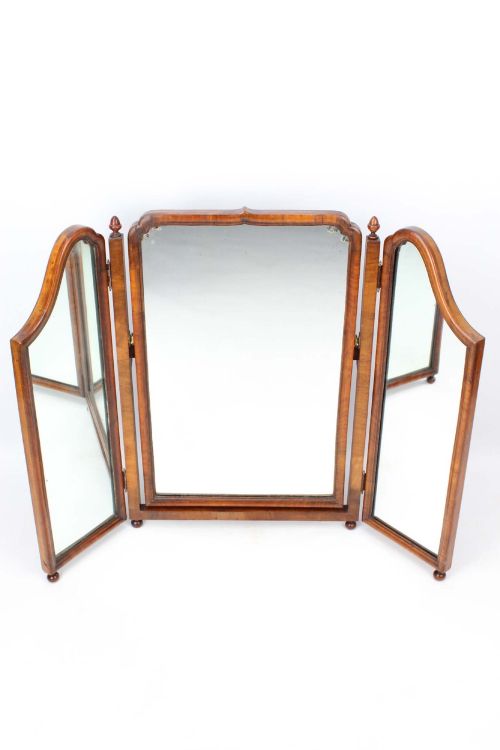
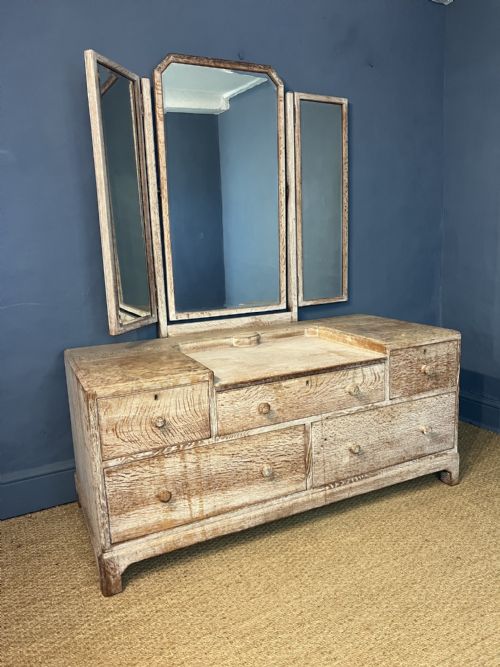


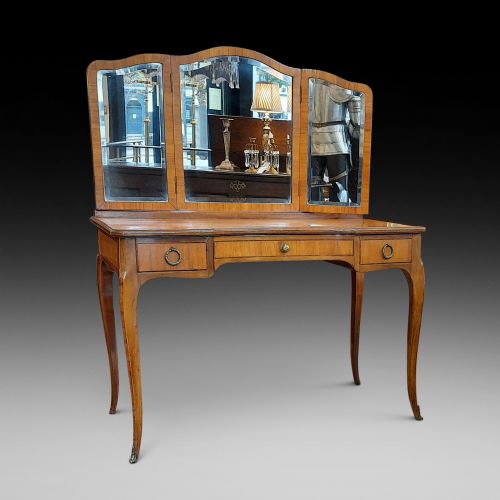

Tri Fold Dressing Mirror
These tri fold dressing mirror examples offer pivoting glass panels to catch every angle, pairing practical vanity with period charm.
Tri Fold Dressing Mirror
A tri fold dressing mirror provides three adjustable glass panels designed to sit atop a dressing table or stand independently.
Most pieces seen here span the late nineteenth century through to the mid twentieth century, drawing on French Neoclassical, Art Deco, and Rococo Revival styles.
You will encounter standalone table mirrors in brass and giltwood alongside larger pivoting vanity glass set into mahogany, oak, and walnut dressing tables.
How they were made
Timbers such as mahogany, oak, limed oak, and walnut form the structural frames and table carcases, frequently enhanced by crossbanding or brass embellishments.
Metalwork plays a key role through cast brass hinges, swan neck handles, and decorative finials that allow the outer wings to pivot smoothly.
Moulded giltwood and mirrored glass complete the construction, creating reflective surfaces supported by bracket feet or shaped table bases.
Some Edwardian brass mirrors feature small lion finials keeping watch over the morning routine.
What varies in quality
The precision of the pivoting hinges and the weight of the cast brass fittings dictate the durability of the folding action.
Cabinetwork distinction shows in the crispness of carved details, the choice of figured veneers like kingwood and rosewood, and the integration of marble tops.
The Tri Fold Dressing Mirror Glossary
- Triptych
- A three-panelled folding mirror configuration where the outer wings angle inward to adjust the reflection.
- Crossbanded
- A border technique where thin strips of veneer are laid across the grain to frame the primary timber.
- Finial
- A decorative terminal ornament, often cast in brass, positioned at the top of the mirror frame.
- Giltwood
- Timber carved and coated with a thin layer of gold leaf or gilt paint to achieve a lustrous metallic finish.
Tri Fold Dressing Mirror: Frequently Asked Questions
How do you clean the brass fittings?
Use a soft dry cloth to remove dust from the brass hinges and finials without disturbing the surrounding wood or gilt surfaces.
Avoid harsh chemical polishes that can strip the natural patina accumulated over decades of use.
Where should I place a tri fold mirror?
Position the mirror on a sturdy dressing table or chest of drawers where natural light can strike the angled glass panels.
Ensure the surface is level so the folding side panels swing freely without catching on the wood.
Are the side mirrors adjustable?
The hinged side wings pivot independently to direct light and provide multiple viewing angles for grooming.
Check that the connecting brass screws or pins remain properly adjusted to hold the glass firmly in position.
How do I identify the period?
Examine the timber choices, such as limed oak pointing to the nineteen-thirties or mahogany indicating earlier Victorian and Edwardian work.
Decorative motifs like gilt Rococo scrolls or sleek Art Deco lines further point towards the date of manufacture.