


Traditional Walnut Writing Slope
These traditional walnut writing slope examples are timber desks designed for correspondence, prized for their rich grain and fitted stationery compartments.

Traditional Walnut Writing Slope
When you search for a traditional walnut writing slope, you find a collection of timber desks, bureaux, and davenports designed for correspondence and record keeping. The selection spans the Georgian, Victorian, and early twentieth century periods, with styles ranging from plain early eighteenth century forms to heavily inlaid Queen Anne revival pieces.
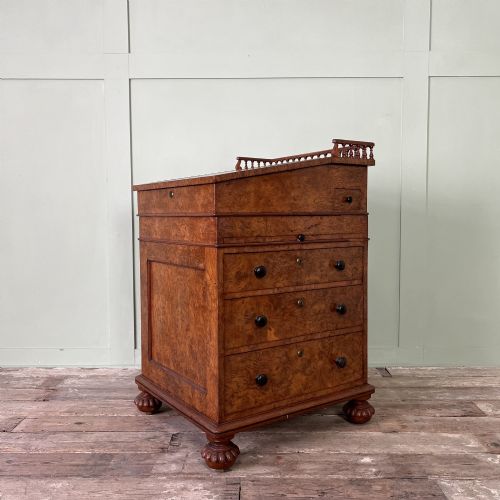
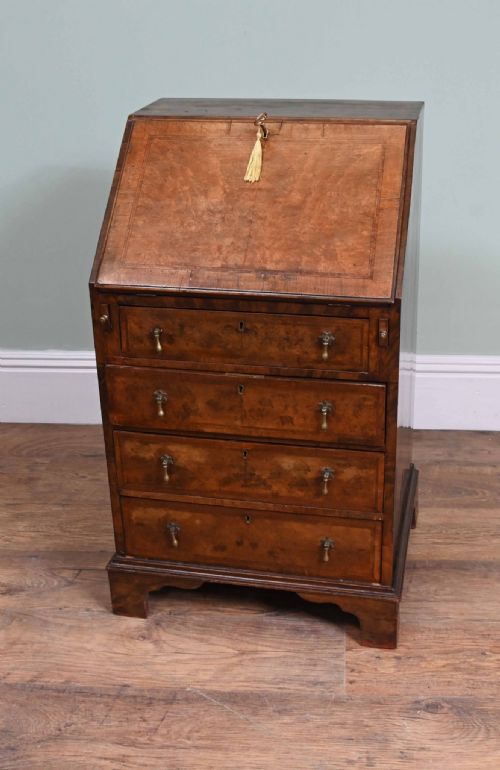
The versions you meet most frequently on this page are Victorian davenports and walnut bureaux, often constructed from burr walnut veneers. Forms include freestanding ladies davenports, estate desks, and the compact Dickens desk layout with tiered drawers.
How they were made
These pieces are built using walnut, burr walnut, elm, and burr elm, frequently applied as fine veneers over secondary timbers such as oak. Craftsmen utilised marquetry inlay to decorate surfaces, pairing the dark timber with contrasting light floral or geometric motifs.
Hardware forms an integral part of the construction, with brass hinges, locks, and inset handles securing the writing surfaces and internal compartments. Sloping lids are lined with leather to provide a smooth writing surface when opened.
What varies in quality
The distinction between standard examples and the finest pieces lies in the selection and matching of the walnut veneer. Burr walnut with intense, swirling grain patterns elevates the appearance significantly compared to plain cut timber.
Mastery of construction is evident in the precision of the marquetry inlay and the complexity of the interior fittings. Elaborate stationery wells, secret compartments, and secondary timbers like burr elm indicate superior workshop production.
Gillow & Co
The Traditional Walnut Writing Slope Glossary
- Walnut
- A hard timber prized for its rich dark brown colour and decorative grain patterns, widely used in fine cabinet making.
- Burr Walnut
- A figured veneer obtained from the deformed growth or burl of a walnut tree, creating complex and swirling patterns.
- Davenport
- A compact writing desk featuring a sloped writing surface above a pedestal of drawers.
- Bureau
- A desk with a sloping hinged lid that drops down to form a writing surface, enclosing drawers and pigeonholes.
- Marquetry
- Decorative inlay work using pieces of contrasting wood veneer to create pictorial or geometric patterns on a surface.
Traditional Walnut Writing Slope: Frequently Asked Questions
What is a davenport desk?
A davenport is a compact desk featuring a sloped writing top that lifts or drops, positioned above a pedestal of side drawers. It gained popularity during the Victorian era as a space-saving writing station for the home.
The top section often incorporates a small stationery box or pen tray, while the drawers pull out from the side rather than the front.
How do I spot burr walnut?
Burr walnut is identified by its turbulent, swirling grain containing clustered knot formations. These dense patterns reflect light differently from straight-grained timber, creating a highly decorative surface.
Cabinet makers reserved this prized veneer for the exterior primary surfaces of formal desks and bureaux.
What is a bureau desk?
A bureau is a writing cabinet featuring a hinged sloping flap that opens downward to form a horizontal desk surface. Inside, the workspace contains small drawers, pigeonholes, and sometimes hidden compartments.
Beneath the writing flap, the main body houses a chest of drawers for storing papers and personal effects.
How do I care for walnut furniture?
Walnut furniture requires placement away from direct sunlight and heat sources to prevent the timber and veneer from drying out. Regular dusting with a soft, dry cloth maintains the finish.
Conditioning with appropriate wax polish preserves the moisture and depth of the timber grain over time.
What is marquetry inlay?
Marquetry is the craft of applying thin slices of various tinted woods to a structural panel to form decorative patterns. Artisans cut floral, scroll, or geometric designs to adorn the exterior surfaces of high-status desks.
The technique creates flat, ornate pictures that highlight the natural tones of different timbers.