





Small Victorian Pedestal Desk
A small victorian pedestal desk organises writing and papers efficiently while anchoring a study with rich timber grain and polished brass.

Small Victorian Pedestal Desk
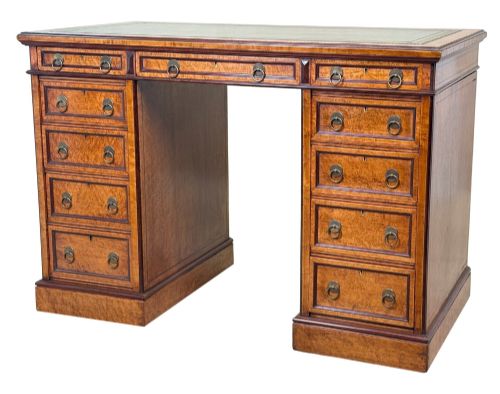
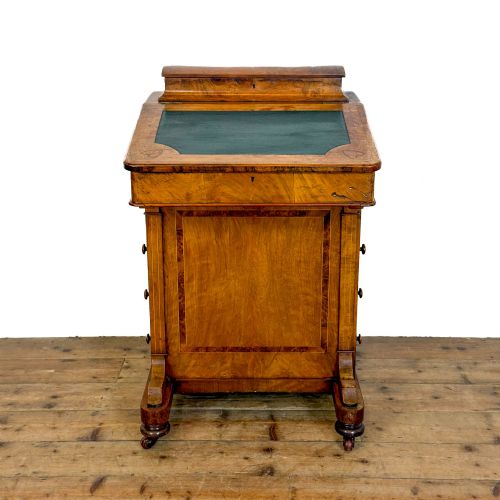
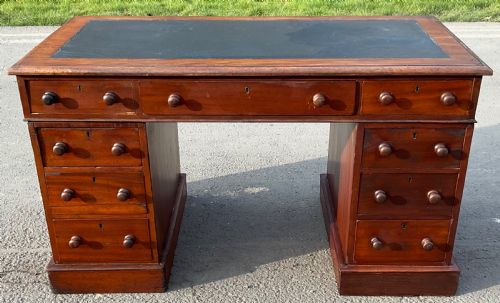
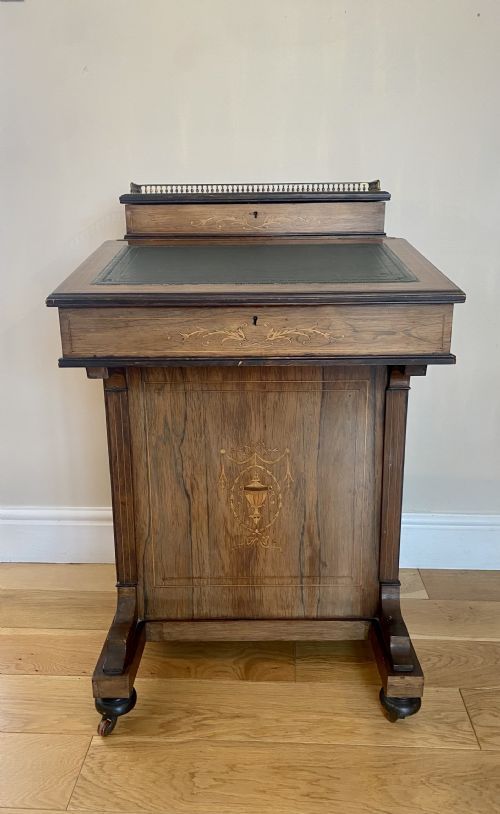
A small victorian pedestal desk brings compact writing utility to smaller rooms, combining a central workspace with banks of drawers below. The selection here spans the mid nineteenth century through to the Edwardian era, encompassing traditional kneehole pedestal forms alongside sloping davenport desks.
Makers and cabinetmakers constructed these compact pieces from durable timbers, yielding practical forms intended for domestic studies, libraries and private chambers. Walnut, mahogany and oak dominate the offerings, frequently enhanced by contrasting crossbanding and decorative wood inlay.
The inventory covers distinct regional variations, including English mahogany writing tables, burr walnut slope-front davenports and twin pedestal configurations with leather skivers. Buyers encounter both freestanding variants designed to occupy the centre of a room and standard pedestal formats intended for placement against a wall.
How they were made
Cabinetmakers built these desks using solid timbers and decorative veneers over stable secondary woods, employing flame mahogany, burr walnut and figured oak for exterior surfaces. Timber selection governed the visual character of each piece, with bookmatched grain patterns utilised across drawer fronts and sloping writing lids.
Surfaces dedicated to writing incorporate inset leather skivers finished with blind and gilt tool borders, paired with turned wooden knobs or cast brass drawer pulls. Structural joinery relies on traditional dovetailing for drawer construction and secure framing to support the weight of multiple drawers within each pedestal.
Desk forms recorded in the archive range from slope front davenports and piano top desks to twin pedestal partners desks.
What varies in quality
Quality rests in the selection and application of timber veneers, where highly figured burr walnut and crossbanded mahogany distinguish superior examples from plain variants. The crispness of inlaid wood details and the precision of the cabinet joinery further separate standard workshop production from finer retail output.
Interior refinements dictate the upper tier of pieces, seen in functional stationery compartments, concealed drawers and secondary timbers chosen for drawer linings. Original brass hardware, working locks with keys, and well-preserved leather writing surfaces retain the integrity intended by the original cabinetmaker.
Gillows·James Winter and Son·James Shoolbred·Hobbs and Co
The Small Victorian Pedestal Desk Glossary
- Davenport
- A compact writing desk featuring a sloping lid that lifts to reveal storage, resting atop a pedestal of drawers. The form gained widespread popularity during the nineteenth century for domestic correspondence.
- Skiver
- A panel of leather inset into the top of a desk to provide a smooth writing surface. These are frequently decorated with blind or gilt tooling around the perimeter.
- Crossbanding
- A narrow strip of veneer applied across the grain of the main surface to create a decorative border. It frames drawer fronts and writing surfaces on better quality furniture.
- Kneehole
- The central recess beneath a desk top that accommodates the legs of the person sitting at it. Twin pedestal desks position banks of drawers on either side of this opening.
- Biedermeier
- A Central European style spanning the early to mid nineteenth century characterised by utilitarian comfort and clean lines. Pieces in this style emphasise natural wood grains over ornate carving.
Small Victorian Pedestal Desk: Frequently Asked Questions
Where were these desks placed?
Homeowners positioned compact writing furniture in private sitting rooms, bedrooms and libraries where full sized library tables proved too large.
Freestanding variants allowed placement in the middle of a room, while standard pedestal formats sat neatly against perimeter walls.
How do davenports differ from pedestal desks?
Davenports combine a sloping writing lid with side drawers, creating a tall and narrow footprint suited to upright sitting.
Pedestal desks provide a flat writing surface supported by two distinct columns of drawers with a central kneehole opening.
What woods were commonly used?
Cabinetmakers relied heavily on mahogany and walnut, frequently selecting figured burr varieties for decorative exterior surfaces.
Oak and pine appeared in utility and smaller scale pieces, while rosewood and ebonised finishes served high end formal commissions.
Can these desks be used daily?
Solid timber construction and sturdy pedestal frames make these pieces fully functional for contemporary writing and laptop use.
Preserving the antique leather skiver requires care, though many retain durable writing surfaces suited to regular tasks.