



Tilt Action Dining Table
A tilt action dining table is a versatile piece that combines formal presence with practical space-saving utility, making it a clever choice for compact rooms.
Tilt Action Dining Table
When you search for a tilt action dining table, you are looking at substantial pedestal furniture designed with a mechanism that allows the top to fold vertically when not in use. These pieces bridge the gap between large dining furniture and flexible centre tables, offering a practical solution for rooms where space is at a premium. The selection spans the Georgian, Regency, and Victorian periods, reflecting how interior layouts evolved over the eighteenth and nineteenth centuries.
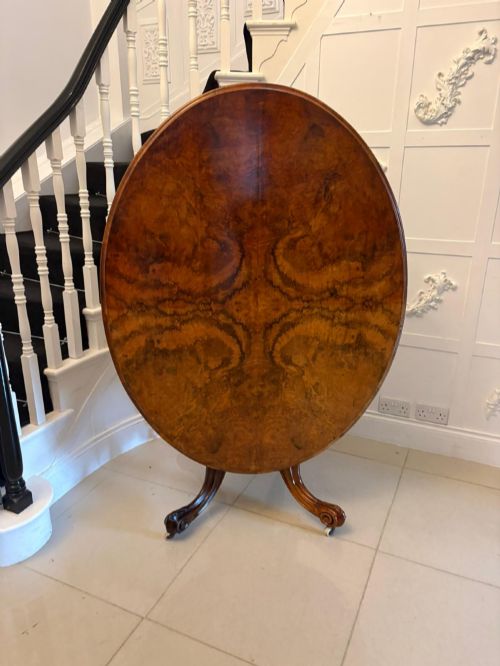
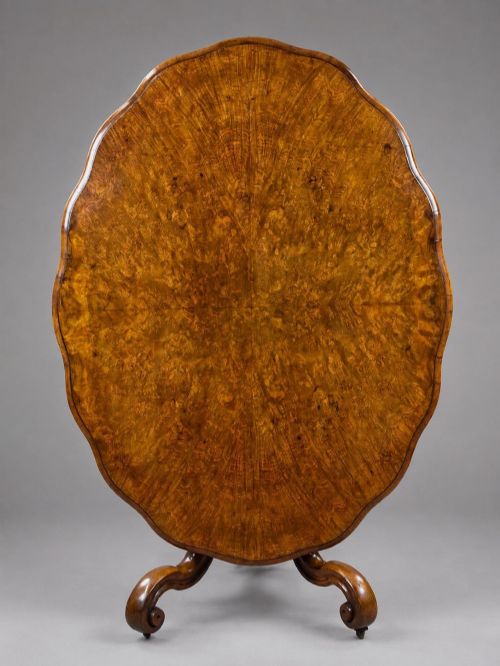
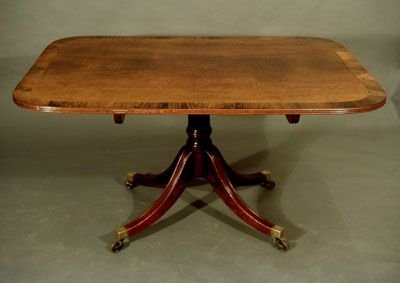
On this page, you are most likely to meet Victorian examples alongside Georgian and Regency pieces. The forms appear as oval, round, and serpentine shapes, often designated for breakfast, supper, or centre use. These tables sit on a central pedestal base, frequently supported by pillar and tripod legs, rather than traditional four-cornered frames.
How they were made
Cabinet makers constructed these tables using solid hardwoods such as mahogany and walnut, frequently applying burr walnut veneer or figured mahogany to create striking surface patterns. The timber selection governed both the visual weight and the durability of the top, with cabinet makers carefully matching grain patterns across the surface.
Structural integrity relied on sturdy central pedestals and brass mechanisms that enabled the pivoting action. Inlaid details in brass or contrasting woods like satinwood further decorated the tops and pedestals of higher-status examples.
The documented periods stretch from the eighteenth century through the Georgian and Regency eras into Victorian times.
What varies in quality
Quality reveals itself in the choice of timber and the complexity of the grain. Pieces featuring figured mahogany or burr walnut veneer display a much higher degree of decorative ambition than plain surfaces.
The sophistication of the pedestal base and the precision of the brass tilting mechanism distinguish superior pieces from standard workshop production. Carved details on the legs and the weight of the central column dictate the overall balance and stability of the table.
The Tilt Action Dining Table Glossary
- Tilt top
- A tabletop mounted on a pivoting mechanism that allows the surface to be folded vertical for storage against a wall.
- Pedestal table
- A table supported by a single central column resting on a tripod or platform base.
- Burr walnut veneer
- A thin decorative slice of wood cut from the warty growths of a walnut tree, prized for its swirling grain patterns.
- Serpentine
- A curved edge design featuring alternating convex and concave lines, common on finer nineteenth-century tabletops.
Tilt Action Dining Table: Frequently Asked Questions
Can these tables be used for everyday dining?
These pieces were originally built for breakfast, supper, or general centre use. Their sturdy pedestal construction provides ample legroom for diners seated around the perimeter.
While functional for daily meals, use heat-resistant mats to protect polished mahogany and walnut surfaces from warm plates and moisture.
How do I tell a Georgian table from a Victorian one?
Georgian tables from the eighteenth century typically display restrained proportions and simpler mahogany framing. They often date around the seventeen-eighties.
Victorian examples, particularly from eighteen-sixty onwards, frequently utilise burr walnut veneer, heavier pedestals, and more elaborate oval or loo table formats.
Why did they design tables with tilting tops?
Homes in the eighteenth and nineteenth centuries required multipurpose rooms where furniture needed to be cleared away quickly. Folding the top allowed the table to stand flat against the wall, freeing up floor space for other activities.
This practical feature also made the furniture easier to move between rooms or transport during house moves.